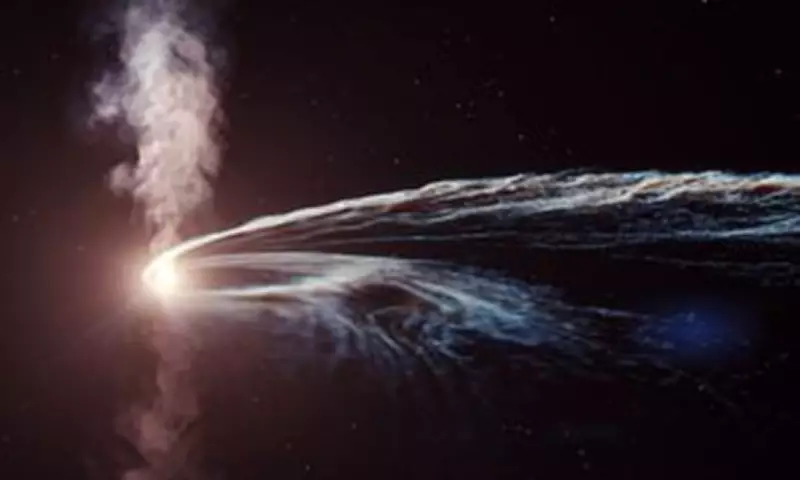
In a remarkable astronomical discovery, a supermassive black hole exhibiting what scientists describe as 'cosmic indigestion' has been continuously emitting the remnants of a shredded star for an astonishing four-year period. This unprecedented celestial phenomenon has captured the attention of astrophysicists worldwide, revealing behaviours never before documented in the study of these mysterious cosmic entities.
An Unprecedented Energy Outflow
Astronomers have determined that the radio wave jet emanating from this black hole represents one of the brightest and most energetic emissions ever detected in the observable universe. Detailed calculations suggest the current energy outflow reaches staggering levels, potentially measuring up to 100 trillion times the destructive power of the fictional Death Star from the Star Wars universe. This extraordinary output places the event on par with gamma ray bursts, ranking it among the most powerful single occurrences ever recorded by scientific instruments.
The Tidal Disruption Event
The process began in 2018 when a relatively small star ventured too close to a black hole situated in a galaxy approximately 665 million light years from Earth. The immense gravitational forces tore the star apart in what astronomers term a 'tidal disruption event' (TDE), a violent process colloquially known as 'spaghettification'. This phenomenon involves the extreme vertical stretching and horizontal compression of celestial objects into elongated, thin shapes resembling spaghetti strands.

While astrophysicists have documented numerous incidents where stars become gravitationally shredded by black holes, this particular event has demonstrated truly exceptional characteristics. What makes this occurrence particularly remarkable is the delayed and sustained energy emission that began nearly three years after the initial stellar destruction, challenging previous assumptions about black hole behaviour.
Exponential Energy Increase
Dr Yvette Cendes, an astrophysicist at the University of Oregon who led the research team, expressed her astonishment at the findings. 'This is really unusual,' she stated. 'I'd be hard-pressed to think of anything rising like this over such a long period of time.' The scientific team has documented how the energy emitted from the black hole has continued to rise sharply over recent years, with current measurements indicating the phenomenon is now fifty times brighter than when initially detected.
The celestial event, officially designated AT2018hyz but affectionately nicknamed 'Jetty McJetface' by researchers, has shown exponential energy increases that scientists predict will continue before reaching a peak next year. This sustained energy release represents a significant departure from typical black hole behaviour, where outflows normally develop quickly rather than persisting for extended periods.
Scientific Implications and Observations
Professor Edo Berger, co-author of the study and astronomy professor at Harvard University, highlighted the exceptional nature of this discovery. 'We have been studying TDEs with radio telescopes for more than a decade,' he explained. 'We sometimes find they shine in radio waves as they spew out material while the star is first being consumed by the black hole. But in AT2018hyz there was radio silence for the first three years, and now it's dramatically lit up to become one of the most radio luminous TDEs ever observed.'
Dr Cendes offered a vivid analogy to describe the phenomenon: 'It's as if this black hole started abruptly burping out a bunch of material from the star it ate years ago. This caught us completely by surprise — no one has ever seen anything like this before.' The research team plans to continue monitoring this extraordinary object to better understand its behaviour and evolution in coming years.

Understanding Black Hole Mechanics
Black holes represent some of the most enigmatic objects in the universe, possessing gravitational fields so intense that not even light can escape their pull. These cosmic entities act as powerful gravitational centres that accumulate surrounding dust and gas, with their formation processes remaining partially understood by the scientific community. Astronomers theorise that supermassive black holes may form through the collapse of massive gas clouds or through the evolution and merger of smaller black hole seeds.
The recent findings, published in the prestigious Astrophysical Journal, contribute significantly to our understanding of black hole dynamics and their interactions with surrounding celestial bodies. This discovery follows other remarkable astronomical observations, including last month's documentation of a 'reborn' supermassive black hole awakening after 100 million years of dormancy, demonstrating the ongoing evolution of our understanding of these cosmic phenomena.