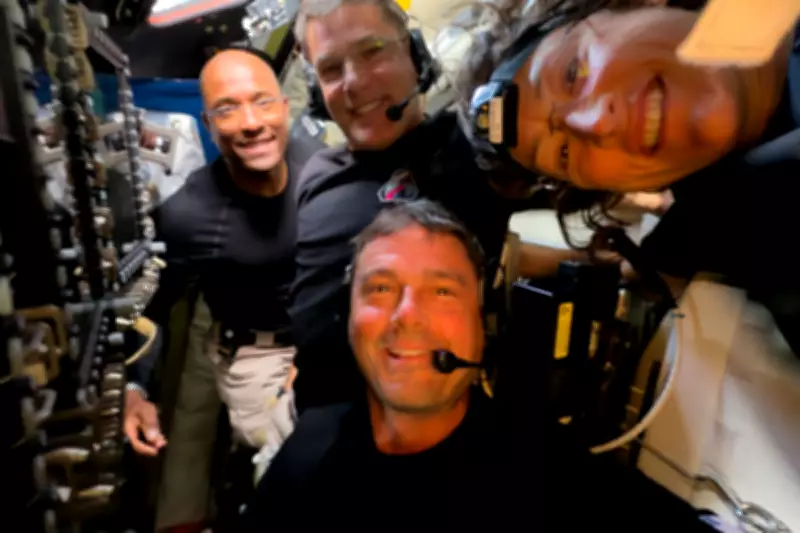
The Artemis II astronauts, still basking in the glow of their successful lunar flyby, made a groundbreaking long-distance call to their colleagues aboard the International Space Station on Tuesday as they began their journey back to Earth. This unprecedented radio linkup marked the first direct communication between a spacecraft near the moon and another orbiting Earth, a feat never accomplished during the Apollo era of the 1960s and 1970s.
A Joyous Space Reunion Across Vast Distances
For astronauts Christina Koch, who was aboard the Artemis II spacecraft, and Jessica Meir, stationed on the International Space Station, the call represented a special reunion despite the staggering 230,000-mile (370,000-kilometer) separation between them. The two NASA veterans previously made history together in 2019 when they conducted the world's first all-female spacewalk outside the orbiting laboratory.
Mission Control Orchestrates Cosmic Conversation
Houston's Mission Control expertly arranged the historic conversation between the four lunar travelers—commander Reid Wiseman, pilot Victor Glover, mission specialist Christina Koch, and Canadian Space Agency astronaut Jeremy Hansen—and the space station's current residents. The station's crew consists of three NASA astronauts and one French astronaut, creating a truly international dialogue.

As Tuesday unfolded, Commander Wiseman continued transmitting breathtaking images from the previous day's lunar encounter, which established a new distance record for human space exploration. Among the most remarkable photographs was an "Earthset" image capturing our planet disappearing behind the lunar horizon, evoking memories of the iconic Earthrise photograph taken by Apollo 8 astronauts in 1968.
Historic Mission Nears Its Conclusion
As the first lunar explorers since Apollo 17's mission in 1972, Wiseman and his crew are targeting a Friday splashdown in the Pacific Ocean off the coast of San Diego. This will conclude their nearly ten-day test flight, which has successfully demonstrated critical systems and procedures for future lunar missions.
Setting the Stage for Future Lunar Exploration
The Artemis II mission represents a crucial stepping stone in NASA's ambitious lunar exploration program. Next year's Artemis III mission will feature a lunar lander docking demonstration in Earth orbit, followed by Artemis IV in 2028, when two astronauts will attempt to land near the moon's resource-rich south pole region.
This historic space-to-space communication demonstrates remarkable technological advancement since the Apollo era, when astronauts had no off-planet companions with whom to share their experiences. The successful linkup between Artemis II and the International Space Station represents both a symbolic connection between different phases of space exploration and a practical demonstration of communication capabilities that will be essential for establishing a sustained human presence on and around the moon.