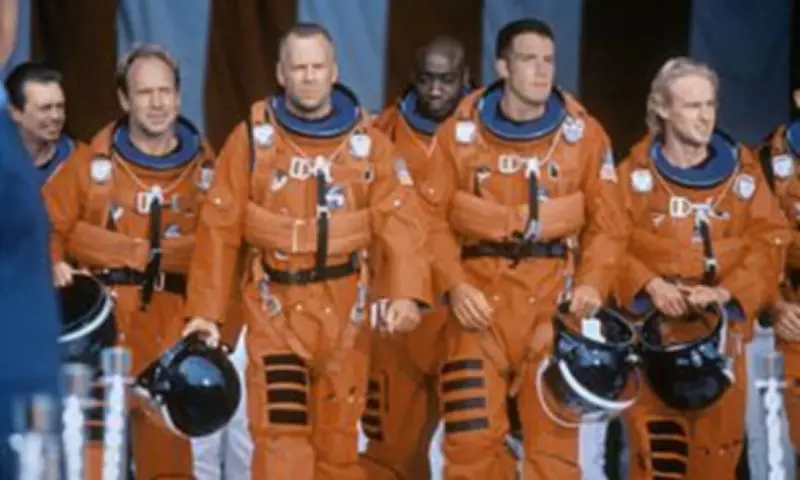
The 1998 science fiction blockbuster Armageddon, starring Bruce Willis and Ben Affleck, has long been criticised for its scientific inaccuracies. However, groundbreaking new research suggests the film's central premise – using nuclear weapons to deflect an Earth-bound asteroid – might be more plausible than previously believed.
Nuclear Deflection: From Hollywood Fantasy to Scientific Reality
Scientists from the University of Oxford have conducted simulations revealing that certain asteroid materials actually strengthen when subjected to extreme forces, rather than shattering into dangerous fragments. This discovery challenges long-standing concerns that nuclear deflection would create multiple smaller threats instead of solving the original problem.
Unlike the cinematic depiction where asteroids are blown apart, real-world nuclear deflection involves a precisely timed explosion that nudges the space rock just enough to alter its trajectory, sending it harmlessly past our planet.

Groundbreaking Laboratory Experiments
Researchers collaborated with nuclear deflection startup Outer Solar System Company (OuSoCo) to investigate how metal-rich asteroids would respond to nuclear blasts. Since detonating actual nuclear weapons in laboratories is impossible, scientists turned to CERN's massive 4.3-mile (7km) Super Proton Synchrotron particle accelerator.
The team exposed a fragment of the Campo del Cielo meteorite – a metal-rich iron-nickel body – to 27 successive bursts of high-energy protons, simulating the effects of a nuclear explosion. Remarkably, the asteroid material exhibited unexpected behaviour.
"The material became stronger, exhibiting an increase in yield strength, and displayed a self-stabilising damping behaviour," explained co-lead author Melanie Bochman, co-founder of OuSoCo. The asteroid fragment's strength actually increased by a factor of 2.5 during the simulated nuclear impact.
Current Planetary Defence Strategies
Space agencies currently focus on kinetic impactor technology, which involves slamming spacecraft into asteroids to alter their trajectories. NASA's 2022 DART mission successfully demonstrated this approach by redirecting asteroid Dimorphos.
However, kinetic impactors require years of advance warning to allow small trajectory changes to accumulate sufficiently. Nuclear deflection could provide a crucial alternative for scenarios with shorter warning times or larger threatening objects.
"For large objects or scenarios with short warning times, it is widely regarded by space agencies and experts as the only viable deflection option," Ms Bochman told the Daily Mail.
Limitations and Future Research Directions
While promising, the current research only examined metal-rich iron-nickel asteroids. Planetary defence experts must consider diverse asteroid compositions, as extinction-level threats come in various forms.
The research team plans to expand their investigations to more complex asteroid types, including pallasite meteorites containing magnesium-rich crystals. These additional studies will help determine whether nuclear deflection remains viable across different asteroid compositions.
Thousands of space rocks enter Earth's atmosphere annually, with most burning up harmlessly. However, significant threats do occur, as demonstrated by the 2013 Chelyabinsk event where an 18-metre asteroid injured thousands when it exploded in the atmosphere.
Practical Implementation Challenges
Before nuclear deflection becomes operational, substantial research and international cooperation will be necessary. The Outer Space Treaty currently prohibits placing nuclear weapons in space, though exceptions might be made for planetary defence purposes.
"The paper shows that significantly more energy can be delivered by a nuclear explosion without causing catastrophic fragmentation of the object than previously assumed," Ms Bochman emphasised, highlighting the potential for this approach to become part of humanity's planetary defence toolkit.
As our understanding of asteroid composition and behaviour improves, the once-fanciful Hollywood scenario of nuclear asteroid deflection moves closer to becoming a scientifically validated emergency option for protecting our planet from catastrophic impacts.