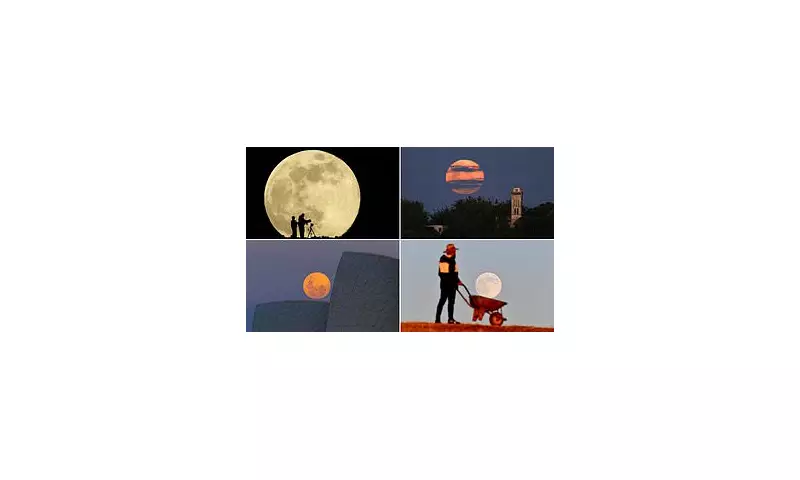
The astronomical curtain closed on 2025 with a spectacular celestial display as the final Supermoon of the year, known as the Cold Moon, graced the night sky on Thursday, 4 December. This luminous event officially heralded the arrival of winter, casting an ethereal glow over cities from London to Sydney.
A Global Spectacle: The Cold Moon in Pictures
From the iconic silhouette of St Paul's Cathedral in London to the sails of the Sydney Opera House, photographers worldwide captured the moon's spherical beauty. The glowing orb provided a poignant backdrop to diverse scenes: a family peered through a telescope in Gran Canaria, starlings performed a murmuration in Rome, and it rose above the historic Koutoubia mosque in Marrakech. In a more sombre image, the Cold Moon was seen over a displaced persons camp in Gaza, highlighting the shared sky above a divided world.
The Science of the Supermoon and the Solstice
While not a formal astronomical term, 'Supermoon' is widely used to describe a full Moon at its closest point to Earth, or perigee. This proximity makes it appear roughly 14% larger and 30% brighter than the year's smallest full Moon (at apogee). This occurs because the Moon's orbit is elliptical, or egg-shaped, not a perfect circle.

The Cold Moon phase is intrinsically linked to the winter solstice, which this year falls on 21 December at 3:03pm. It traditionally marks the shift to frostier weather and the longest nights, serving as a luminous beacon in the deepening dark.
Don't Miss It: Viewing Tips and the Moon Illusion
For any stargazers who missed Thursday's peak, the Moon will remain full and impressive on Friday night, rising between approximately 4pm and 6pm depending on your location. As it climbs above the horizon, it may appear unnaturally large—a trick of the mind known as the 'Moon illusion'.
Scientists theorise this illusion may stem from how we perceive the sky as a flattened dome, making a low Moon seem larger and farther away. Alternatively, its proximity to familiar horizon objects like trees or buildings creates a compelling size comparison. This low position also scatters light through Earth's atmosphere, often granting the Moon a captivating orange or golden hue.
So, look to the eastern sky this evening. This final full Moon of 2025 offers a last chance to witness one of the year's most accessible and awe-inspiring astronomical events, a shared moment of wonder under a single, brilliant satellite.