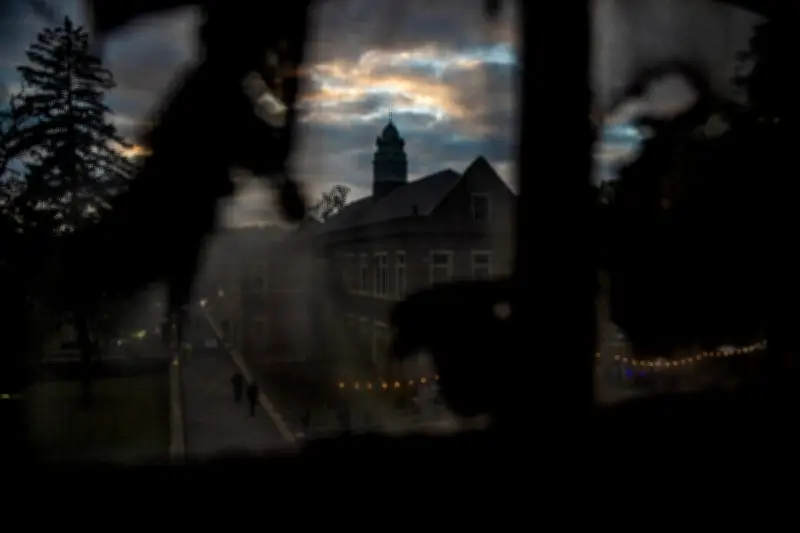
A controversial haunted house near Philadelphia, Pennsylvania, taps into its dark history every fall to scare tens of thousands of visitors. In 1968, a local news station documented appalling conditions for disabled people in the red brick buildings on the banks of Schuylkill River. Residents were found naked and emaciated at what was then known as the Pennhurst state school and hospital. The institution shut its doors permanently in 1987 after a lawsuit over inhumane conditions.
By 2010, a Halloween attraction stood in its place, and Pennhurst asylum's previous owner suggested during its early years that he wanted to spook guests by repurposing the hospital's surgical lights and medical cabinets to use as props.
In 2026, fears more real than ghosts float above the property. The site's owners have submitted a proposal to local officials to make way for a datacenter complex: three buildings, spread across nearly 2m sq ft, powered by methane gas.
The proposed facility has sparked local backlash in the township of East Vincent, especially because it would sit less than 600ft from a veterans' home. Donald Hyman, a 62-year-old resident, is concerned that air pollution from an on-site power plant and backup generators could disrupt his recovery from congestive heart failure.
Hyman and four veterans living at the Southeastern Veterans' Center told the Guardian they also worry that the noise could trigger residents with post-traumatic stress disorder and that the construction process could expose them to harmful contaminants in the soil and water.
"You're trying to force something on us we don't want," Hyman says. "We don't want it, period."
The complicated politics of data centers
The developers, Pennhurst Holdings, hit a major roadblock in May, as local officials rejected their datacenter plan amid sweeping opposition from residents. But they plan to appeal the decision in court.
The proposed datacenter – and many similar projects planned across Pennsylvania – has embroiled state lawmakers trying to hit pause in a fight with Josh Shapiro, their Democratic governor and a presidential hopeful who wants to make Pennsylvania a leader in the nation's fight for AI supremacy.
Pennsylvania's datacenters have scrambled politics as usual: a liberal governor is pushing growth, as Donald Trump has, while the governor's conservative challenger is aligning herself with a Democratic state senator's proposal to restrict new business.
Katie Muth, a Democratic state senator whose district includes East Vincent, introduced a bipartisan moratorium bill on new construction for large datacenters on 29 May, whereas Shapiro is courting major out-of-state investment. Community pushback is so intense that Shapiro is taking note though, and on 27 May he unveiled new voluntary guidelines he says will address residents' accountability concerns, incentivizing developers to build responsibly.
Meanwhile, Stacy Garrity, the state treasurer Shapiro's Republican opponent in the governor's race, has staked out a more extreme position on regulating AI by calling for a moratorium. While Garrity advocated for putting datacenters in rural communities as recently as January, she characterized Shapiro's guidelines as "damage control" after he "rolled out the red carpet" for massive projects – a claim his office has dismissed as "desperate" because of Garrity's "long record of supporting completely unregulated datacenter development".
The brawl over the East Vincent site has become an emblem of the complicated national politics of datacenters in the US. The rapid spread of multibillion-dollar datacenters to power the US's AI boom has sparked fierce pushback in cities and a growing number of state governments. The US is home to more datacenters than any other country, about 4,200, according to Data Center Map, which amounts to some 40% of the global total. Thousands more are planned or under construction as just four Silicon Valley giants spend about $700bn on AI infrastructure this year alone. The US federal government has advocated for no limitations on growth, with Trump issuing an executive order in December meant to prevent states from enacting laws restricting AI in almost any form.
Locals want to hit pause
In packed meetings across Pennsylvania, residents are trying to stop datacenters from becoming their new neighbors. They're pressuring local officials to pass protective local ordinances and block developers' proposals – sometimes it works.
Many Pennsylvania residents feel overwhelmed by the pace of development. They want more time. Beth Livensperger, who is fighting a proposed datacenter in Lehigh valley, says a statewide moratorium would help her find other locals to build opposition and allow for more research on the environmental and public health effects: "I'm 100% for it: it would give time for the politics to settle out a little more."
About 42% of Pennsylvanians don't want to live next to datacenters, according to an Emerson College poll published in December; 34% support these facilities being built in or near their communities. Nationally, seven in 10 Americans oppose the construction of AI datacenters in their local areas, according to a Gallup poll published in May.
Americans across the country are likewise worried about how much these energy-guzzling facilities are driving up utility prices and harming the environment. Pennsylvanians have felt the pain in their electric bills. Federal data shows that power prices rose about 20% between November 2024 and 2025 in Pennsylvania – one of the highest rates nationwide.
How would a moratorium on datacenters work?
Muth wants to buy East Vincent and other communities like it some time. On 29 May, she introduced a three-year moratorium on building large datacenters and the infrastructure required to run them. The bill would apply to constructing new "hyperscale" datacenters that use at least 20 megawatts, and proposed expansions to existing ones that would tip them over this power threshold. Muth joins lawmakers in at least 12 other states and Democratic senators in Congress in fighting for temporary bans on new datacenters.
Pennsylvanians opposing datacenters have won a few local fights – but residents say even those victories can feel tenuous. In Montour county, more than 200 residents packed a fire station for a town hall to protest the power company Talen from trying to rezone hundreds of acres of agricultural land for industrial use. County commissioners ultimately denied Talen's request.
But the company said in February that it will incorporate feedback and continue to pursue a datacenter complex. Sam Burleigh, a resident who fought against the rezoning request, said he has heard from a few farmers in the area that they've been approached by developers with "an ungodly amount of money" for their land.
Archbald, a town in Lackawanna county nestled between two mountain ranges, is home to the highest number of datacenter proposals in Pennsylvania: six of them are expected to cover almost 15% of the borough.
Residents are angry about how close they would be to schools and homes. The pressure has gotten to local officials, as three of the seven-member local planning board resigned, with two citing concerns about their safety, according to the Washington Post.
Shirley Barrett, the town's mayor, wishes it would all slow down: "This debate has destroyed this community," Barrett told the Post. "We want answers, but we have no clue what is going on because this is all happening so quickly."
Archbald's datacenter politics got so messy, even the governor showed up. Shapiro visited and spoke with residents in May about their concerns, as well as his new accountability standards for datacenters.
The governor endorses responsible growth over a moratorium
None of the state-level moratoria have succeeded so far, and it's unlikely Pennsylvania's measure will either, given that Shapiro is keen to cash in on economic growth fueled by gains in AI. The governor has said he shares residents' concerns about datacenters but has stopped short of calling for a moratorium, instead choosing incentives for responsible development through voluntary accountability guidelines, which have garnered mixed reactions from environmental groups.
Shapiro issued an executive order in 2024 to fast-track state permits for key economic development and infrastructure projects, including some datacenters. In his February budget address, he announced a new framework that would affect the fast-track program. The state would now consider offering "greater speed and certainty in permitting, and access to state tax incentives" for datacenters that meet particular environmental, affordability and transparency standards.
The guidelines, released in full last month, ask developers to provide a community outreach plan, commit to creating a certain number of jobs, and minimize air pollution by using a backup energy system that relies on zero-emission energy storage.
A public records request from residents in Montour county – first reported on by Heatmap and also obtained by the Guardian – uncovered that Amazon got a first look at the guidelines before the public did.
Rick Siger, the secretary of Pennsylvania's department of community and economic development, wrote in an email addressed to Amazon Web Services colleagues that the governor's office wanted to engage Amazon to make the guidelines "strong and workable". He said that the "principles are intended to be voluntary, and the governor is not proposing to ban or even discourage datacenters".
Shapiro announced last summer that Amazon would be making "the largest private sector investment" in the state's history: $20bn in two datacenter complexes in Luzerne county and Bucks county, the latter just a one-hour drive from East Vincent. The following month, Dave McCormick, a US senator flanked by Trump at the state's energy and innovation summit in Pittsburgh – shared that companies had announced more than $90bn of investments "in datacenters, energy and power infrastructure, and workforce and AI training projects" in the state.
The governor's office says his new guidelines are about balancing innovation and accountability, and in May he removed a proposed data center complex in Archbald from the fast-track program – citing a lack of transparency and responsiveness.
'Good neighbors'
Datacenters' biggest advocates argue that a temporary moratorium would permanently shut down projects because of the unpredictability it would inject into an industry with investments counted in the billions. These facilities are the "backbone of the 21st century economy", powering everything from online classrooms to telehealth appointments, says Dan Diorio, a spokesperson for the Data Center Coalition.
As for community backlash, Diorio is explaining their projects to residents in community meetings and making sure they're in compliance with environmental regulations, he says.
"At some point, the facts have to matter. Datacenters are going above and beyond to be good neighbors," Diorio says. "Ultimately the residents and local officials and others are going to feel how they feel, and we can't magically fix that, but we're doing everything we can to hopefully reassure them."
Julie McNamara, the associate policy director at Union of Concerned Scientists' Climate & Energy program, notes there is no precedent for datacenters, given the scale and speed of their spread. "They are not playing in a regulatory framework that had them in mind – so it is absolutely a moment of gaps and loopholes," she says. "Regulators are scrambling to keep up: there hasn't been anything in place – really, truly – for these types of facilities yet."
East Vincent's conflict resolves–for now
The East Vincent Township Supervisors eventually decided unanimously to reject developers' datacenter proposal. Residents like Larry Schenk, who lives less than half a mile away from the proposed datacenter complex in East Vincent, were still skeptical about whether the government would side with angry residents.
Schenk is intimately familiar with the massive machines powering the AI boom. He's been inside many of them, as a systems engineer, and wanted to make sure his elected officials understood what they may be signing up for.
"The community has lost their faith in the process," Schenk said, before the 3-0 vote on 21 May. "There's a feeling we're being intentionally kept in the dark, or prevented from having our opinions heard." At a hearing on April 20 that would help decide the land's fate, residents had booed local officials to show their opposition.
An attorney for Pennhurst Holdings, which owns the land and the haunted house, said the company was not surprised by the denial of their application but that it remains to be seen whether "East Vincent Township has met their obligation to allow a datacenter in their township or not".
Pennhurst Holdings has not disclosed which tech company would eventually use the datacenter but did say that the project will create 1,000 construction jobs and 200 permanent ones. The developers acknowledged that the complex would be located near the veteran center and 2,500ft from other nearby homes, stressing in a statement to the Guardian that it will meet "all environmental, sound and emission standards" set by the township and state.
The company also said it had conducted an environmental investigation of the entire site, and that the site and tunnels have been remediated for industrial use. Some of the veterans dispute claims from local officials that the site has been "cleaned up".
Pennhurst Holdings also said that its plan to bring on-site gas-fueled generators and a power plant was a response to residents' concerns about increasing utility prices and that this change aligns with Shapiro's guidelines and call for developers to "bring their own power" or pay entirely for their datacenters' energy. Trump has called for the same in attempts to avoid Americans footing higher electricity bills.
This promise does little to consider emissions and poor air quality, said Muth.
"The battle is likely not over," she said.