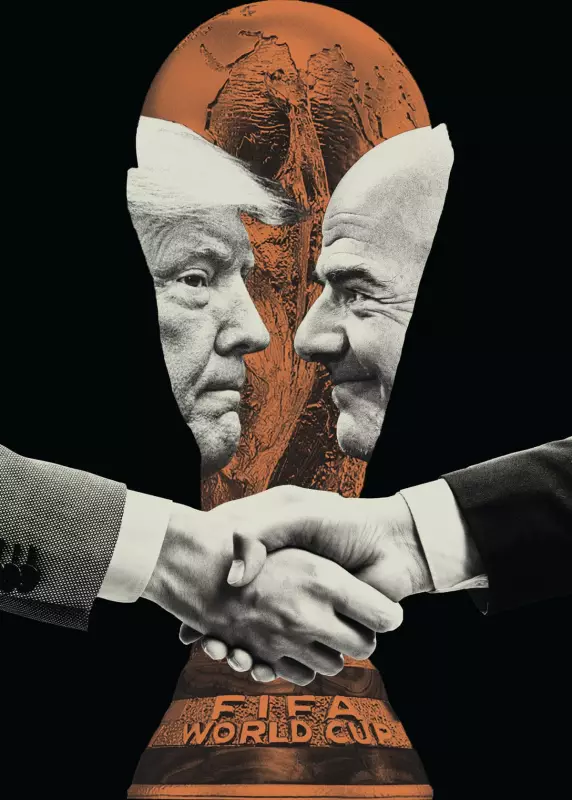
The Unlikely Alliance: Football's Boss and America's President
Gianni Infantino, the Swiss-Italian lawyer who leads world football's governing body FIFA, has cultivated an increasingly conspicuous relationship with US President Donald Trump that is raising eyebrows across the sporting and political worlds. For a man who repeatedly insists that "football cannot solve the world's political problems," Infantino appears to spend considerable time in the company of powerful politicians - particularly the controversial American leader.
The FIFA president's political instincts were evident from his teenage years. At just 18, Infantino ran for presidency of his local amateur football club, FC Brig-Glis, in his Swiss hometown. Despite being the underdog against two older candidates, the freckled red-haired teenager won through a combination of ambitious promises - including that his mother Maria would wash all the players' kits weekly for as long as he remained president.
A Pattern of Political Cosiness
Infantino's presence at October's Sharm El-Sheikh peace summit raised questions about FIFA's evolving role in global politics. Photographs from the event show the football administrator standing among world leaders including Egypt's Abdel Fattah al-Sisi, Turkey's Recep Tayyip Erdoğan, and Britain's Keir Starmer - the only attendee without a formal political role.
During the COVID-19 pandemic, Infantino travelled to Washington to attend the signing of the Abraham Accords. He has also been photographed kicking a football with Vladimir Putin in the Kremlin and attended a heavyweight boxing fight with Saudi Arabia's Mohammed bin Salman. However, it is his relationship with Trump that has developed most significantly.
Infantino featured prominently at Trump's second inauguration earlier this year and has been a frequent guest at both Mar-a-Lago and the Oval Office. In December 2024, Ivanka Trump opened the draw for FIFA's new $1 billion Club World Cup tournament held in the US. More significantly, FIFA recently opened a new office in Trump Tower in New York, making world football's governing body an official tenant of a company owned by the sitting US president.
Business or Ideology?
Infantino maintains that maintaining close relations with the president of a country co-hosting the 2026 men's World Cup - an event responsible for over 80% of FIFA revenues - is simply part of his job. Yet the relationship appears to transcend mere diplomatic necessity.
The contrast with his predecessor Joe Biden is striking. Infantino met Biden briefly at a 2022 G20 summit and visited the White House in 2024 for an hour-long meeting with national security adviser Jake Sullivan. Meanwhile, he has spent far less time with the leaders of Canada and Mexico, the other two World Cup co-hosts.
Most controversially, Infantino assured Trump in January that they would "make not only America great again, but also the entire world" - effectively endorsing the president's campaign slogan despite FIFA's ethics code requiring political neutrality.
Human rights groups have expressed concern about this relationship. Nick McGeehan of FairSquare told The Guardian: "The key point is that Infantino is the symptom rather than the problem himself. His job is to accumulate power and money, and redistribute it to the associations to make sure they benefit as much as possible."
The Financial Imperative
Infantino took over FIFA leadership in 2016 following the corruption scandal that engulfed his predecessor Sepp Blatter. Inheriting an organisation with fleeing sponsors and damaged credibility, he faced the dual challenge of restoring FIFA's reputation while rebuilding its financial foundations.
His popularity within FIFA relies heavily on generating maximum revenue. This explains the expansion of the men's World Cup from 32 to 48 teams in 2026, a model the women's tournament will follow in 2031. It also underpins FIFA's new Club World Cup, designed to capitalise on club football's commercial success.
The 2026 World Cup promises to be the most lucrative in history. Fuelled by dynamic pricing, the most expensive tickets will cost nearly five times their equivalents at Qatar 2022. Parking spaces for the final in New Jersey will cost $175 each. Crucially, none of this revenue will be subject to tax, flowing directly into FIFA's accounts.
For an organisation that only generates substantial income once every four years, Infantino's relationship with Trump represents both personal affinity and business necessity. As one anonymous source told Politico: "He loves dictators and billionaires. When he sees people with money, he melts."
Controversies and Criticisms
Infantino's leadership style has drawn criticism from various quarters. The Club World Cup was created despite protests from global players' union Fifpro, which warned that adding another competition to an already saturated calendar would damage player welfare. FIFA responded by refusing to deal with Fifpro and instead working with smaller bodies that the union describes as "fake unions."
Rights groups have criticised Infantino's inaction regarding Iran's football federation, which continues to restrict women's access to games. A complaint from the Palestinian football federation about teams from illegal West Bank settlements playing in the Israeli league has remained unresolved for over two years.
Meanwhile, Infantino's approach to human rights concerns has often been confrontational. Ahead of the 2022 Qatar World Cup, he delivered an extraordinary speech claiming: "Today I feel Qatari. Today I feel Arab. Today I feel African. Today I feel gay. Today I feel disabled. Today I feel like a migrant worker."
Last December, FIFA awarded the 2034 men's World Cup to Saudi Arabia without any competing bids. The organisation assessed Saudi Arabia's human rights record as a "medium risk," a verdict Amnesty International described as "an astonishing whitewash" of the country's labour rights record.
The Personal Touch
Those who have worked closely with Infantino describe a complex figure capable of switching between casual banter and intense seriousness. FIFA employees in Zurich speak of his impatience and abruptness, while associates note his preference for powerful company.
Despite the controversies, even critics acknowledge Infantino's genuine passion for football. In May, he was observed sitting on the pavement outside the White House, utterly engrossed in watching his beloved Inter Milan's Champions League comeback against Barcelona on his phone.
The relationship between Infantino and Trump appears mutually beneficial. Trump reportedly had little interest in football until a 2017 call with Infantino, who explained the sport's access to the world's largest television market. Infantino has skillfully appealed to Trump's instincts, even presenting him with souvenir red and yellow cards during a 2018 Oval Office meeting, jokingly suggesting they could be used on the assembled press.
The symbolism of their relationship was perfectly captured during an August White House visit when Infantino allowed Trump to handle the World Cup trophy - an honour traditionally reserved for tournament winners. The president fumbled with the cup, described it as a "beautiful piece of gold," and asked if he could keep it.
As world football prepares for the 2026 World Cup draw in Washington on December 5, all eyes will be on the inaugural FIFA Peace Prize announcement. Given the developing relationship between football's administrator and America's president, few would be surprised if Donald Trump receives the honour - a outcome that would shock many observers more than any result in the tournament's 104 games.