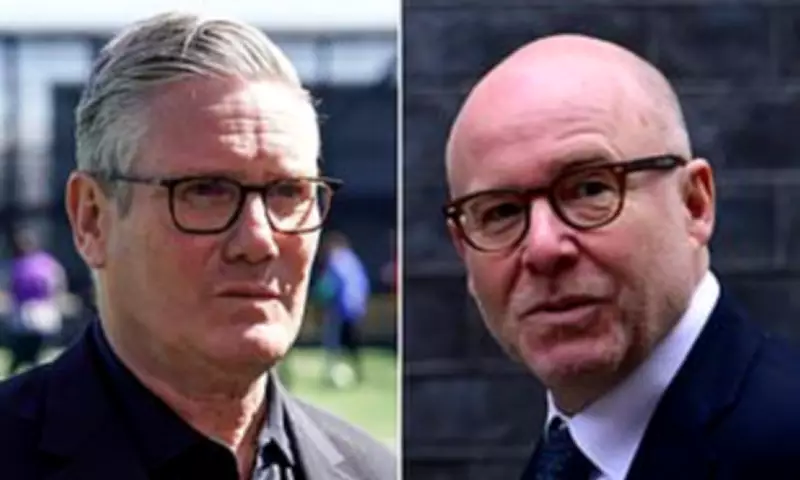
War heroes have strongly criticised Keir Starmer's closest advisor for pursuing legal claims against Iraq veterans despite being warned they were lies. Richard Hermer, the Attorney General, pursued what has been described as a 'witch hunt' against British troops when he was a senior lawyer in 2008.
False Allegations Against Soldiers
Soldiers who had bravely served their country on the battlefield were subjected to false allegations that they had tortured and murdered civilians after the 2004 Battle of Danny Boy in southern Iraq. Emails have now revealed that Lord Hermer was warned the claims were 'nonsense', and even expressed his own doubts about their veracity.
In one astonishing message to colleague Martyn Day, a leading human rights lawyer he was working with, the Attorney backed moves to publicise the lawsuits with an interview on Radio 4's Today programme. He noted it must leave 'some wiggle room if the killings did not in fact happen'. The publicity drive was part of an effort to secure taxpayer-funded compensation settlements before their Iraqi clients were exposed as liars at the Al-Sweady inquiry in 2014.

Veterans Call for Resignation
Military Cross winner Brian Wood, who was among the soldiers falsely accused of war crimes by Lord Hermer's clients, called on the Attorney General to resign. He told the Daily Telegraph: 'I have gone through hell for years. It's disgusting that Hermer is Attorney General. He pursued us in a witch hunt and yet is now the senior lawyer in Government. That is just wrong...he was representing the people trying to kill us.'
Iraq veteran Philip Ingram backed the resignation demand and described Lord Hermer's actions as 'absolutely disgusting'. 'I think this is even bigger than the Mandelson scandal,' he said. 'Keir Starmer's closest advisor was clearly trying to get more clients to fuel his ego and fill his pockets, even while rightly suspecting their claims were false.'
'It's quite clear that he knew it was total nonsense, but was pushing it with no consideration the dreadful impact these lawsuits had on the soldiers who had put their lives on the line. It seemed to be almost a sport to him. It's lower than low. This individual is not fit to hold a British passport, never mind to be the Attorney General providing advice to our country.'
'You can understand why this country is in such a mess, when we've got a Prime Minister who doesn't have any principles and relies on advice from his people like Lord Hermer.' He added that the Attorney, who also represented jihadi bride Shamima Begum, is 'anti-British' and 'a danger to this country'.
Mr Ingram, who retired with the rank of colonel after a 26-year career in the armed forces, was a senior officer responsible for interrogations in Iraq. He said the suggestion that troops were harming or murdering civilians is 'obviously nonsense'. 'We went over the top in making sure that our interrogations met human rights standards. I had one eye on law the whole time I was there, it's something that soldiers always consider carefully. Sadly, thanks to people like Lord Hermer, we have to spend the rest of our lives looking over our shoulder.'
Political Reactions
Last night, Tory leader Kemi Badenoch accused Lord Hermer of 'dragging British troops through the courts'. 'The troops were innocent. Keir Starmer's judgement is not,' she said. Shadow justice secretary Nick Timothy added: 'Lord Hermer is a disgrace. And the fact that Keir Starmer brought him into government tells you everything you need to know about the PM.'
Reform's shadow home secretary Zia Yusuf said Lord Hermer had 'hounded' soldiers and ruined their lives 'as a blood sport'. 'This is one of many emails he sent which show what an awful man he is. Hermer is a traitor to his country,' he said.

SAS hero Robin Horsfall, who was part of the famous assault team that rescued 19 hostages from the Iranian Embassy in London in 1980, said cash-grabbing 'lawfare' against soldiers will continue as long as the Government keeps funding it. 'It's been an ongoing problem for the armed forces for the last generation. The Government funds law companies to investigate the behaviour of soldiers they have sent to fight their filthy wars, so they can punish them for not fighting them nicely enough. This damages recruitment, because the people who would normally encourage their sons and daughters to join the British Army don't have any confidence that they'll be supported in the long run.'
Lord Hermer's Defence
A spokesman for Lord Hermer insisted he was not 'involved substantially' in representing the six Iraqi detainees who were probed in the Al-Sweady inquiry, and that he was not aware that his clients were telling 'deliberate lies' until long afterwards. In his 2008 email to Mr Day, Lord Hermer referred to disgraced solicitor Phil Shiner, who was later struck off and convicted of fraud. He wrote: 'I think the line to Phil works in getting the balance between making sure that the big story is out there whilst giving us some wriggle room if the killings did not in fact happen. Do you need to be slightly more explicit in the press release about "evidence raising serious concerns of executions of prisoners" in order to generate sufficient interest or will the Today interview naturally bring in the punters later that morning?'
However, he also said the claims must be investigated properly to disprove them if necessary, writing: 'If they [soldiers] are innocent they deserve the fullest investigation so that that can be made crystal clear.' Lord Hermer's spokesman said it was wrong to criticise him over the email, adding: 'The Attorney did a small amount of work at the start of this case, where he made clear that serious allegations at the time needed further investigation. And the Attorney argued it would be unfair on armed services personnel if they didn't have the opportunity to show their innocence through a proper investigation. Over a 30-year legal career, the Attorney General represented many clients - including British military personnel, such as a British soldier killed by IRA terrorists, and injured servicemen in the Iraq war. Any suggestion that the Attorney acted improperly during his private career is false.'