JD Vance's Failed Budapest Mission as Orban Ousted in Hungarian Election Landslide
US Vice President JD Vance made a dramatic last-minute intervention in Budapest, urging Hungarian voters to re-elect Viktor Orban just days before Europe's longest-serving leader suffered a crushing electoral defeat. Vance's high-profile visit, intended to bolster Orban's faltering campaign, ultimately proved ineffective as Peter Magyar secured a decisive victory that will reshape Hungary's political landscape.
Vance's Desperate Plea for Orban
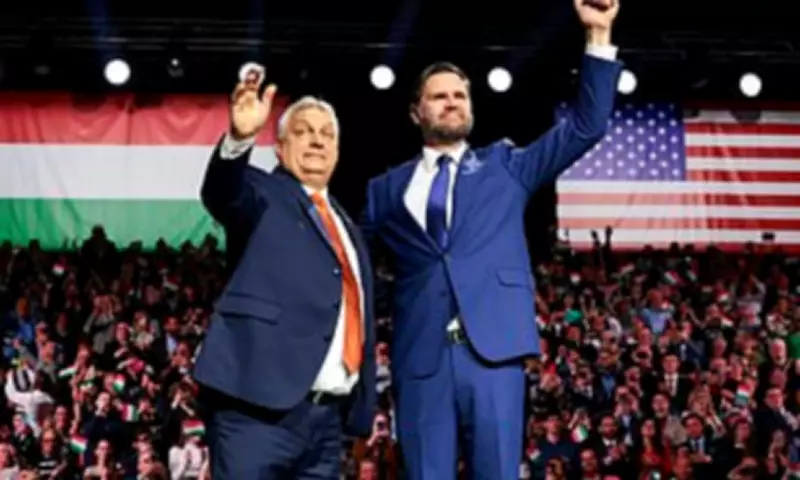
Speaking at an Orban campaign rally on Tuesday, Vance declared, 'I won't tell the people of Hungary how to vote' before immediately contradicting himself by urging supporters: 'We've got to get Viktor Orban re-elected as prime minister of Hungary, don't we?' The vice president lavished praise on Orban, branding him a defender of national sovereignty and Western civilization who had done 'more than any leader in Europe to bring about a successful resolution to the war between Russia and Ukraine.'
During the rally, Vance took a phone call from former president Donald Trump, who voiced unequivocal support for Orban. 'I love Hungary and I love that Viktor,' Trump declared. 'I'm with him all the way, the United States is with him all the way.' Vance then implored Hungarians to 'go to the polls this weekend and stand with Viktor Orban.'

Scathing Attacks on EU and Ukraine
Vance used his platform to launch a scathing attack on the European Union, accusing Brussels of attempting to rig the Hungarian election. He claimed the EU had presided over 'one of the worst examples of foreign election interference that I have ever seen or ever even read about... because they hate this guy.' The vice president asserted that 'part of the reason' for his visit was because 'interference that's come from the bureaucracy in Brussels has been truly disgraceful.'
Despite his strong rhetoric, Vance notably avoided mentioning the Iran war during his visit, despite Orban having developed closer ties with Tehran during his premiership. The trans-Atlantic relationship between Orban and Trump had been viewed as increasingly important as relations thawed over the Iran conflict.
Historic Electoral Reversal
Vance's intervention came as Orban trailed in the polls by an average of ten points, according to Politico Europe's aggregated Poll of Polls. The hard-right leader, who had held an iron grip over Hungary for sixteen years, was facing growing discontent from Hungarians seeking closer ties with the European Union and greater distance from Russia.
The election results exceeded even the most pessimistic predictions for Orban's Fidesz party. Magyar secured a landslide victory, claiming 138 parliamentary seats compared to Orban's mere 55—a fifteen-point margin that will allow the new prime minister to remove many of his predecessor's constitutional reforms and reset Hungary's global relations.
Celebrations and Concessions
Jubilant Hungarians partied through the night as it became clear Orban would lose his grip on power. Crowds gathered across the country chanting 'Russians go home' as they celebrated what many viewed as a new era for the nation. 'We did it,' Magyar told a cheering crowd beside the River Danube in Budapest. 'Together we overthrew the Hungarian regime.'
Orban conceded defeat on Sunday, telling his supporters: 'The result of the election is clear and painful.' The 62-year-old, who was Europe's longest-serving leader, added: 'We don't have the weight of governing the country so we have to rebuild our communities. We never give up, this is one thing people know about us, we never give up. The days ahead of us are for us to heal our wounds.'
European Leaders Celebrate Democratic Shift
Top European figures immediately celebrated the political upset. Ursula von der Leyen, president of the European Commission, declared: 'Hungary has chosen Europe. Europe has always chosen Hungary. A country reclaims its European path. The Union grows stronger.'

British Prime Minister Sir Keir Starmer congratulated Magyar on his victory, writing: 'This is an historic moment, not only for Hungary, but for European democracy. I look forward to working with you for the security and prosperity of both our countries.' French President Emmanuel Macron and German Chancellor Friedrich Merz similarly welcomed the result, with Macron describing it as 'a victory of democratic participation, of the Hungarian people's attachment to the values of the European Union.'
Magyar's Mandate and Orban's Legacy
Magyar, a 45-year-old former member of Orban's Fidesz party, ran on a platform of opposing Russia and strengthening ties with European allies. During his victory speech, he declared that the 'healing' of the nation would begin immediately and that Orban's 'puppets' needed to go. He added that Hungary 'will no longer be a country without consequences' and that those who 'stole from the country have to face consequences.'
The election represented a referendum on Orban's political transformation from a liberal, anti-Soviet firebrand to a Russia-friendly nationalist admired by the global hard-right. His move toward authoritarianism had seen harsh crackdowns on minority rights and media freedoms, along with accusations of siphoning public funds to allied business elites—allegations he consistently denied.
Analysts Question Vance's Impact
András Bíró-Nagy of Budapest think-tank Policy Solutions suggested that Orban 'expected too much from its friendship with the Trump administration' and 'overestimated the likely impact of this visit.' He concluded that the probable electoral effect of Vance's intervention was 'close to zero.'
The Hungarian election attracted record turnout, with 66 percent of eligible voters casting ballots within just five hours—far higher than in the 2022 election. While Magyar's supporters celebrated the defeat of one of Europe's fiercest EU critics, many of Orban's loyal followers were seen weeping upon hearing his concession.
Magyar's stunning victory gives him significant authority to reset Hungary's relationships with both Brussels and Moscow, potentially ending years of strained EU relations and moving the country firmly back toward Western alignment.