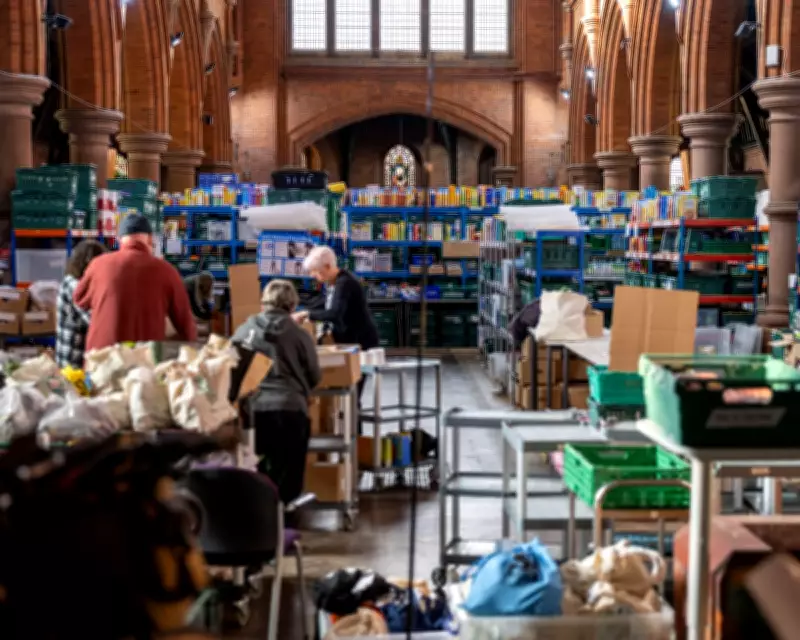
The stark reality of deepening poverty across the United Kingdom has been laid bare in a series of powerful letters from experts and charity leaders, who warn that the normalisation of deprivation is eroding national resilience. The correspondence, responding to recent analysis showing record numbers living in 'very deep poverty', paints a troubling picture of a society where millions are living in survival mode.
A Decade and a Half of Austerity Takes Its Toll
Liam Purcell, CEO of Church Action on Poverty, highlights how successive governments have knowingly worsened millions of lives through sustained austerity policies. 'We have allowed poverty to become normalised in our country,' he states, condemning the ideological dimension of this crisis. Purcell argues that politics remains dominated by individuals with little understanding of low-income living, creating a fundamental ignorance that perpetuates the problem.
The erosion extends beyond personal finances to community infrastructure. Countless shared neighbourhood spaces have been closed or sold off, reducing opportunities for community togetherness precisely when it is most needed. This dual assault on both financial security and social cohesion has created what Purcell describes as a society where ultra-individualism has become the norm.

Local Solutions Show Promise But Need Scaling
Despite the bleak national picture, some local initiatives offer glimmers of hope. Poverty truth commissions at regional and city levels have fostered new understanding within some councils and public bodies. Localised participation projects have successfully removed barriers, allowing people's voices to be heard as never before.
'The UK must reinvest in our social security system,' Purcell insists, 'but it must also find new ways to harness the wisdom of people who access that system.' He believes that if this wisdom can be properly utilised, social security and politics as a whole could become constructive rather than antagonistic.
Immediate Relief Measures Offer Some Hope
Professor Peter Taylor-Gooby, Director of the East Kent poverty study, provides specific context about the relentless rise in demand from destitute families at food banks and other agencies in East Kent. He points to several measures due to take effect in April that could provide significant relief.
These include the removal of the two-child benefits cap, expansion of free school meals, uprating of universal credit and minimum wage at about one-and-a-half times inflation, alongside the new Crisis and Resilience Fund and increased support for councils in areas of most need. Taylor-Gooby estimates these measures will lift approximately a tenth of children below the poverty line in Thanet, Dover and Canterbury above it, representing what he calls 'the biggest single improvement since Gordon Brown's poverty reduction policies in 2000-05.'
The Resilience Argument: Beyond Guns and Butter
Dr Simon Nieder from Chesterfield offers a particularly compelling perspective on the national security implications of widespread poverty. He challenges the traditional 'guns and butter' debate about welfare versus defence spending, arguing that something more fundamental is at stake.
'National resilience depends on whether people have enough stability to endure shock,' Nieder explains. He warns that millions living in survival mode, dependent on food banks and experiencing chronic insecurity, indicate a society that has been quietly spending its resilience. 'This is not an argument against defence spending,' he clarifies. 'It is a warning that a country which normalises precarity in peacetime weakens its capacity to respond to a crisis in wartime.'
The letters collectively underscore the urgent need for systemic change. While immediate relief measures offer some hope, experts agree that much more needs to be done to address the root causes of poverty and rebuild both individual security and national resilience.