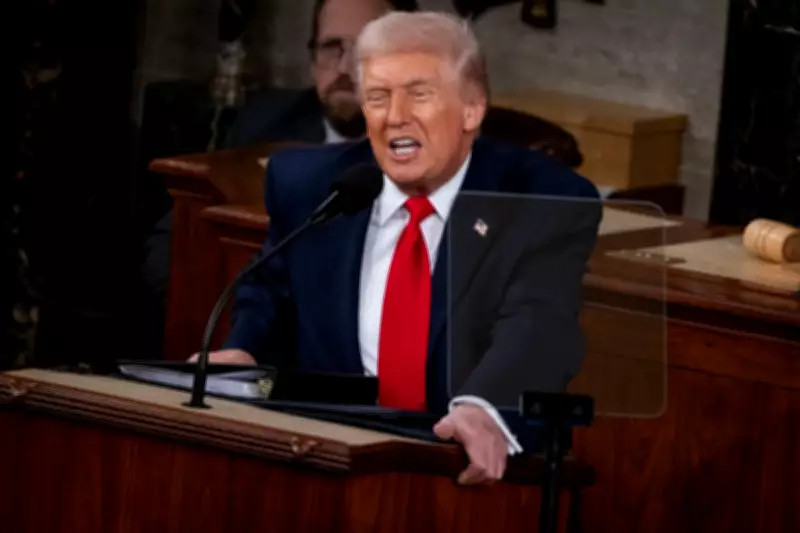
Trump's State of the Union Address Focuses on Midterm Election Influence
Donald Trump delivered his State of the Union address to a joint session of Congress in Washington DC on Tuesday, using the platform to rail against imagined fraud in America's elections. With Republicans facing grim poll figures ahead of the 2026 midterms, Trump promised aggressive action to tilt the vote in his favor, citing long-debunked claims of cheating by Democrats.
Election Fraud Claims and Legal Moves
In his speech, Trump asserted, "They want to cheat. They have cheated. And their policy is so bad that their only way to get elected is to cheat. And we're going to stop it." This rhetoric has translated into tangible efforts this year, including FBI agents seizing 2020 election documentation in Fulton county, Georgia, and the Department of Justice pursuing voter data from state elections officials nationwide.
Historically, the incumbent party tends to suffer losses in midterm elections. Since World War II, the president's party has lost an average of 26 seats in the House and four seats in the Senate. Such outcomes in 2026 could flip control of both chambers, a scenario Trump appears determined to prevent through extraordinary measures.

Potential Strategies to Influence the Midterms
Representative Joe Morelle of New York, the ranking Democrat on the House administration committee, commented, "I think he understands – and I'm pretty confident that he knows this – that they'll lose the midterms and lose them significantly. So, in true Donald Trump fashion, the question then is, 'well, how do I rig the results?'"
Here are some ways Trump might attempt to influence or obstruct the midterm elections:
- States Adopt Voting Restrictions: Trump called for the passage of the Save America Act, which would require states to turn over voter data to the Department of Homeland Security, restrict mail-in ballots, impose voter ID at polls, and mandate proof of citizenship at registration. While the bill faces a Democratic filibuster in the Senate, states could adopt its provisions, though constitutional challenges are likely.
- Executive Orders on Voter ID: In the absence of congressional action, Trump has suggested issuing an executive order to enforce measures like voter ID and proof of citizenship. However, previous attempts have been blocked in court, as the Constitution places election administration primarily with states.
- Accusations Against Elections Officials: Following the FBI raid in Fulton county, Trump hinted at prosecutions, with the affidavit citing potential violations if "deficiencies" in the 2020 election were intentional. The county has contested these claims, but officials fear being targeted.
- Seizure of Voting Machines: An investigation by Tulsi Gabbard into voting machines and foreign interference could create a pretext for Trump to order seizures under national security grounds, despite legal experts noting the president lacks authority over election equipment.
- Federal Agents at Polls: Trump confidant Steve Bannon suggested sending ICE agents to surround polling locations, though federal statutes bar such actions. The Minnesota governor received a letter tying voter data access to immigration enforcement, described as a "ransom note" by state officials.
Legal and Constitutional Challenges
Legal experts emphasize that many of these strategies face significant hurdles. Jasleen Singh of the Brennan Center for Justice wrote, "The president does not have the authority to regulate elections, including voting equipment guidelines." Similarly, the Institute for Responsive Government notes that mail voting includes multiple safeguards, making fraud claims unfounded.
As the midterms approach, Democrats are left to speculate on further authoritarian moves by an administration that shows contempt for political precedent and legal norms. The ongoing efforts highlight a deepening divide over election integrity and the potential for unprecedented interference in the democratic process.