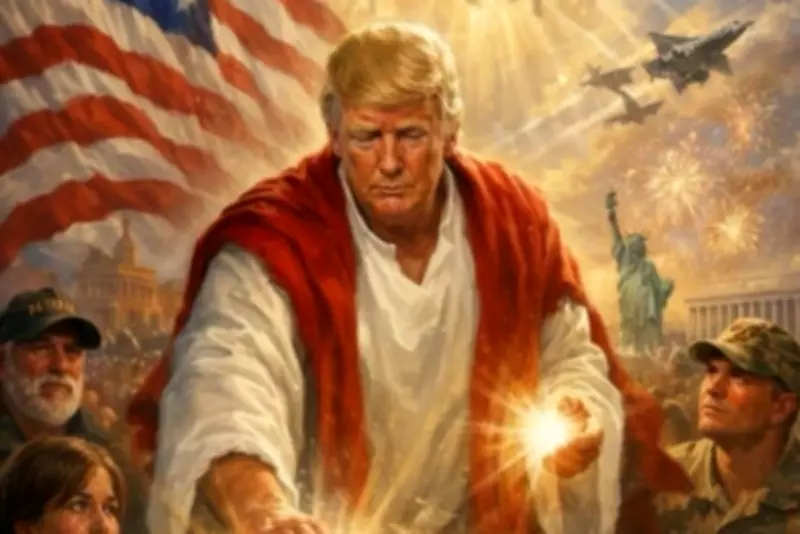
In an extraordinary escalation of his self-mythologising, former US President Donald Trump has posted an artificial intelligence-generated image depicting himself as a Messiah-like figure healing the sick, complete with blinding light emanating from his hand. This digital provocation follows a pointed personal attack on Pope Leo XIV, whom Trump labelled "weak" on crime and foreign policy in a Truth Social post.
A Calculated Divinity or Political Hubris?
David Aaronovitch observes that in less charitable historical periods, someone declaring themselves Jesus Christ might have been institutionalised. Today, such a figure could become president. This phenomenon represents a departure from even the most fervent religious revivals in American history. During the Second Great Awakening, when prophets preached across pre-Civil War America, only Mormon founder Joseph Smith attempted a presidential run—and was murdered before the election.
"Perhaps Smith's mistake was to get the order mixed up," Aaronovitch notes. "Like Donald Trump, he should have gained the presidency first and proclaimed his divinity afterwards."

The Evangelical Bargain and Catholic Calculations
Despite Trump's apparent moral contradictions—he once described the Ten Commandments as a "to-do list" to which he added his own commandments like mocking the afflicted—white evangelicals have consistently supported his three presidential campaigns. They viewed him as an imperfect vessel for advancing religious priorities, particularly through Supreme Court appointments restricting abortion and expanding religious privileges.
The dynamics differ significantly with American Catholics, who comprise approximately one-fifth of the US population. About 60% of white Catholics supported Trump in the 2024 election. His direct criticism of their spiritual leader creates unprecedented tension. "What Catholic who wasn't already totally committed to Trump would now be more likely to support him or his nominees?" Aaronovitch questions.
The Manufactured Miracles and Messianic Parallels
Trump's journey toward sainthood within certain circles has been carefully cultivated. His campaign marketed a $59.99 Bible (with signed copies at $1,000) to help cover legal expenses. When an assassin's bullet grazed him in July 2024, supporters framed the event as a compressed Easter narrative—crucifixion to resurrection within ten seconds.
Trump's "senior faith advisor" Paula White-Cain explicitly drew parallels between Trump and Jesus, declaring: "Because He rose... you rose up, and you will be victorious in all you put your hands to." Even childhood Sunday school attendance has been recast as evidence of early piety.
The Papal Response and Political Reckoning
Pope Leo XIV has stated he has "no fear" of Trump's administration despite the personal criticism. Trump suggested the Pope was only elected because he is American, claiming church leaders believed this would help them "deal with President Donald J. Trump."
Following outcry over the AI Jesus image, Trump deleted the post—a rare retreat suggesting possible recognition of overreach. Aaronovitch references Suetonius' account of Caligula attempting to move the statue of Zeus at Olympia, causing the figure to laugh violently and workmen to flee. "There is a point at which hubris becomes a death wish," he warns, suggesting even Trump's most devoted followers might eventually question messianic pretensions that challenge core religious authority.
The fundamental question remains whether Trump's combined assault on papal authority and appropriation of Christian iconography represents a strategic miscalculation that could alienate Catholic voters, or merely another chapter in his unconventional relationship with America's religious constituencies.