Trump's Controversial Day: AI Jesus Post and DoorDash McDonald's Press Event
In a series of bewildering moves, President Donald Trump ignited a feud with Pope Leo XIV, posted and deleted an AI-generated image of himself as Jesus Christ, and then hosted an impromptu press event featuring a DoorDash delivery of McDonald's food. The events unfolded on Monday, April 13, 2026, leaving political observers and the public alike scratching their heads at the surreal spectacle.
Trump's Truth Social Post Criticizes Pope as "WEAK"
The day began with Trump taking to Truth Social to launch a scathing attack on Pope Leo XIV, labeling him "WEAK" on crime, accusing him of "catering to the Radical Left," and criticizing his foreign policy as "terrible." To emphasize his point, Trump shared an AI-generated image depicting himself as Jesus Christ, bathed in angelic light, kneeling to heal the sick while bomber planes flew overhead and fireworks exploded alongside an American flag.
Christian Outcry Leads to Deletion and Bizarre Press Event
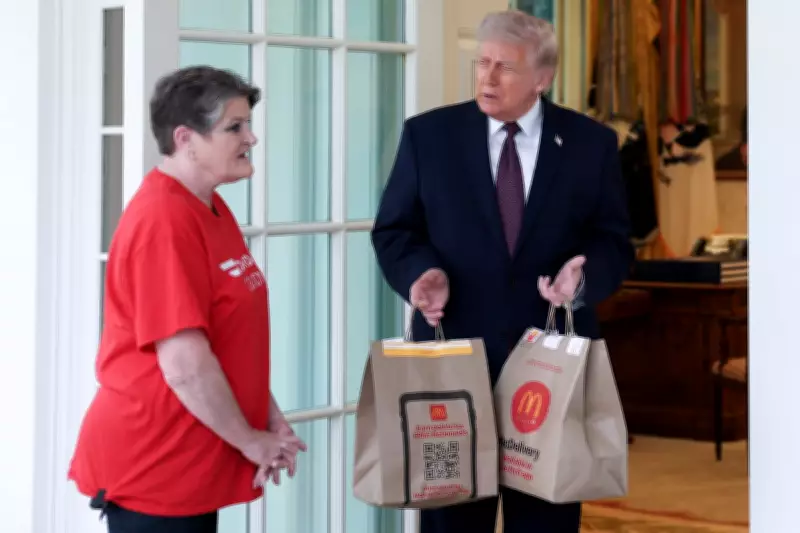
Following a predictable outcry from Christian groups, Trump deleted the AI Jesus post by noon. Shortly after, he summoned a group of confused White House reporters to his doorstep for an unplanned press event. The centerpiece of this event was a woman identified as "Sharon," wearing a T-shirt that read "DoorDash Grandma," who delivered paper bags of McDonald's food directly into Trump's hands.

As Sharon praised Trump's "no tax on tips" policy, the president fielded questions from reporters on topics ranging from Iran and a delicate ceasefire to trans athletes in women's sports. Trump mused about blockading the Strait of Hormuz while holding the greasy bags, and Sharon stood awkwardly beside him, her professional smokey eye makeup suggesting careful preparation. Trump handed her a hundred-dollar bill, adding to the theatrical nature of the moment.
Symbolism and Reality TV Politics
The DoorDash Grandma event appeared designed to overshadow the AI Jesus controversy, portraying Trump as relatable—tipping well, ordering fast food, and showing affection for the elderly. During the presser, Trump claimed the deleted post was meant to depict him "as a doctor" related to the Red Cross, blaming "fake news" for misinterpreting it. He shifted topics to Iran's nuclear capabilities, vowing to prevent nuclear weapons and extract uranium "dust" from the ground.
However, the event's authenticity was quickly questioned. Sharon Simmons, identified as a political operative in government documents, likely did not make a spontaneous delivery via the DoorDash app to the White House. Her brief appearance echoed the reality TV tactics often employed by the Trump administration, part of a "flood the zone" strategy devised by Steve Bannon to dominate news cycles with chaos.
Political Fallout and Reactions
The AI Jesus post drew sharp criticism from religious figures. Archbishop Paul S. Coakley, president of the US Conference of Catholic Bishops, expressed disappointment, while Marjorie Taylor Greene stated she was "praying against" Trump's actions. Evangelicals, some reportedly "quiet quitting" Trump and the MAGA movement, expressed dismay.
Vice President JD Vance, a devoted Catholic who recently announced a memoir about his conversion, likely found the situation embarrassing, especially given Trump's comment that he preferred Pope Leo's "MAGA" brother Louis. The week prior had seen Melania Trump denying connections to Jeffrey Epstein, adding to the ongoing political theater.
In summary, Trump's day blended religious controversy, AI imagery, and fast-food publicity in a bizarre display that left many questioning the boundaries between politics and performance art. As the administration continues to "flood the zone," the public is left to navigate a landscape where symbolism often overshadows substance.