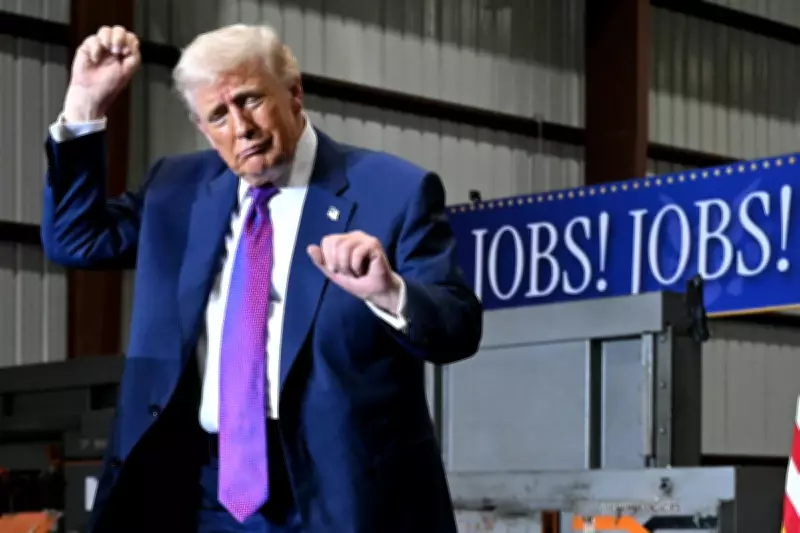
President Donald Trump has revealed he once entertained the idea of awarding himself the prestigious Congressional Medal of Honor, the United States' highest military decoration for valor. During a lengthy speech at a steel plant in Rome, Georgia, on Thursday, the President recounted his 2018 visit to an Iraqi air base, claiming he was "so brave" that he contemplated the self-award.
The Controversial Remarks in Georgia
Addressing a large audience as part of his campaign efforts in Georgia's 14th Congressional District, Trump embarked on one of his characteristic discursive monologues. He recalled being informed that defeating ISIS would require four years during his first term, prompting his trip to Iraq. "I flew to Iraq. I was extremely brave. So brave I wanted to give myself the Congressional Medal of Honor," Trump declared to the crowd.
The President elaborated, stating, "I said to my people, am I allowed to give myself the Congressional Medal of Honor?... Some day I'm gonna try. I'm gonna test the law." These remarks came during an hour-long address that primarily focused on manufacturing and economic issues, before diverging into foreign policy discussions.

Understanding the Congressional Medal of Honor
The Congressional Medal of Honor represents the most esteemed military award in the United States, reserved exclusively for service members who demonstrate extraordinary courage "above and beyond the call of duty," according to the Congressional Medal of Honor Society. Historically, recipients have performed acts of immense bravery under fire, such as 1st Lt. Thacker, who exposed himself to enemy fire in Vietnam to protect his unit, and Staff Sergeant Earl D. Plumlee, who charged toward insurgents in suicide vests in Afghanistan to safeguard fellow soldiers.
While civilians can qualify for the separate Citizen Honor Award for acts of heroism, the Congressional Medal of Honor remains strictly for military personnel. Notably, President Trump has no military service record and did not experience combat during his brief three-and-a-half-hour visit to Al Asad Air Base in Iraq in 2018.
Context and Reactions
Trump acknowledged the improbability of his suggestion, noting that meeting recipients who had lost limbs made it "a stretch" to consider himself worthy. He told the audience, "you know I'm having fun," and expressed concern that "fake news" outlets might misinterpret his comments out of context.
The speech also touched on economic matters, with Trump asserting his administration had transformed a struggling economy inherited with "high prices and high inflation" into a success story. However, recent polling data from Pew Research indicates only 28 percent of Americans currently hold a positive view of the economy.
Broader Foreign Policy Claims
Throughout his second term, Trump has positioned himself as a peacemaker, referencing this ambition in his inaugural address and advocating for a Nobel Peace Prize. He has been credited with brokering a ceasefire between Israel and Hamas, though the agreement's stability is questioned by some observers due to the inclusion of autocratic leaders on the U.S. 'Board of Peace' and insufficient funding for Gaza's reconstruction.
Simultaneously, the President has issued threats against various nations, including Canada, Greenland, and Panama, and recently warned Iran of "bad things" if a peace deal is not reached within ten days. These actions highlight the complex and often contradictory nature of his foreign policy approach.
The Georgia event, marked by a banner reading "Jobs! Jobs! Jobs!," aimed to support a replacement for former MAGA figure Marjorie Taylor Greene, yet Trump's tangential remarks about military honors have garnered significant attention, underscoring his penchant for provocative statements.