Trump Intensifies Public Dispute with Pope Leo XIV Over Iran Policy
President Donald Trump launched another verbal assault against Pope Leo XIV on Tuesday evening, vigorously defending his administration's military actions in Iran while directly challenging the spiritual leader's calls for peace. The escalating conflict between the American president and the head of the Catholic Church has captured international attention, revealing deep divisions over foreign policy and religious leadership.
The Core of the Conflict: Iran and Nuclear Weapons
In a lengthy post on his Truth Social platform, Trump wrote: 'Will someone please tell Pope Leo that Iran has killed at least 42,000 innocent, completely unarmed, protesters in the last two months, and that for Iran to have a Nuclear Bomb is absolutely unacceptable.' This statement represents the president's most direct justification yet for military intervention in the region, framing it as both a humanitarian necessity and a strategic imperative.
The president's comments come amid growing tension between the White House and Vatican, with Pope Leo XIV having repeatedly condemned aggressive rhetoric from American leadership in recent weeks. During a Saturday address at St Peter's Basilica, the pontiff delivered a powerful message: 'Enough of the idolatry of self and money! Enough of the display of power! Enough of war!'

Controversial Imagery and Personal Attacks
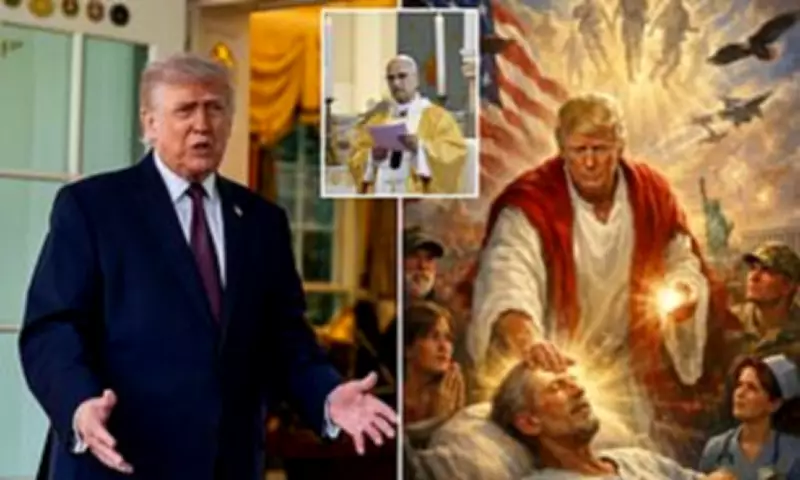
The conflict took an unusual turn when Trump posted an AI-generated image on Sunday night that appeared to depict himself as Jesus Christ. The controversial picture showed the president dressed in red and white robes, healing a man with his hand while the American flag waved prominently in the background. Although Trump later deleted the image, claiming he viewed it as representing himself as a Red Cross doctor, the post triggered significant backlash among both his usual supporters and Catholic communities across social media platforms.
In the same Truth Social rant, Trump branded Pope Leo XIV as 'WEAK on Crime, and terrible for Foreign Policy.' The president made several personal attacks against the pontiff, suggesting he was only made Pope 'because he was an American' and asserting: 'If I wasn't in the White House, Leo wouldn't be in the Vatican.'
Diverging Philosophies on Leadership and Peace
Trump elaborated on his criticisms during a press conference at Joint Base Andrews in Maryland, stating: 'I'm not a big fan of Pope Leo. He's a very liberal person, and he's a man that doesn't believe in stopping crime.' The president specifically accused the leader of the 1.4 billion-member Catholic Church of 'toying with a country that wants a nuclear weapon.'
In contrast, Pope Leo XIV maintained his commitment to peaceful resolution during remarks aboard the papal flight to Algiers, where he began a ten-day tour of four African countries. The pontiff told Reuters: 'I don't want to get into a debate with him. I don't think that the message of the Gospel is meant to be abused in the way that some people are doing.' He added firmly: 'I will continue to speak out loudly against war, looking to promote peace, promoting dialog and multilateral relationships among the states to look for just solutions to problems.'
International Reactions and Political Fallout
The public dispute has prompted widespread condemnation from political figures across the globe, including some of Trump's traditional allies. Iranian President Masoud Pezeshkian defended the Pope on social media platform X, stating: 'I condemn the insult to [Pope Leo] on behalf of the great nation of Iran, and declare that the desecration of Jesus, the prophet of peace and brotherhood, is not acceptable to any free person.'
Spanish Prime Minister Pedro Sánchez offered support for the pontiff, noting: 'While some fill the war with war, Leo XIV sows peace with courage. It will be an honor to receive him in Spain in a few weeks.' Even Italian Prime Minister Giorgia Meloni, typically a Trump ally, called the American president's remarks 'unacceptable' and affirmed: 'The Pope is the head of the Catholic Church, and it is right and normal for him to call for peace and to condemn every form of war.'

Military Developments and Diplomatic Context
The verbal conflict coincides with significant military developments in the region. The United States military announced on Tuesday that a blockade of the vital Strait of Hormuz waterway has been 'fully implemented,' effectively halting all trade coming into and out of Iran. Admiral Brad Cooper, commander of US Central Command, confirmed the development on social media as reports emerged of Chinese and other vessels being forced to turn back from the strategic passage, through which approximately one-fifth of the world's oil supply normally flows.
Diplomatic efforts continue alongside military actions, with US officials reportedly preparing for a second round of peace talks with Iranian counterparts in Pakistan. Vice President JD Vance is expected to lead these negotiations once again, following inconclusive discussions over the weekend. Meanwhile, European nations are accelerating contingency planning for NATO operations, developing what some officials refer to as 'European NATO' plans that would supplement American military assets with European resources amid growing concerns about Washington's reliability as an alliance partner.
The ongoing confrontation between President Trump and Pope Leo XIV represents more than a personal disagreement; it highlights fundamental differences in approaches to international conflict, the role of religious leadership in political discourse, and competing visions for global stability in an increasingly volatile geopolitical landscape.