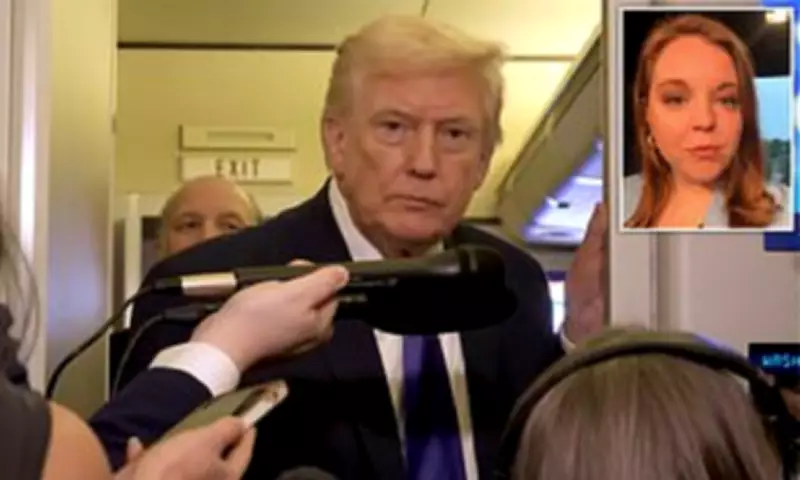
Former President Donald Trump engaged in another heated confrontation with a female journalist aboard Air Force One this Friday, just days after a similar tense exchange with CNN's Kaitlan Collins in the Oval Office. The latest incident involved Washington Post reporter Natalie Allison, who was attempting to question Trump about his ongoing immigration crackdown when the former president interrupted her.
Trump Interrupts Immigration Question
As Allison began asking about how "a number of people in the MAGA base" viewed his immigration policies, Trump immediately stopped her to inquire which news organization she represented. Upon learning she worked for the Washington Post, the former president launched into criticism of the publication.
"You are having a hard time getting readers," Trump told Allison. "Washington Post is doing very poorly." He then added personal criticism, stating "You have a very bad attitude" before telling her to proceed with her question.

Immigration Policy Discussion
When Allison attempted to ask her question again, focusing on whether some supporters wanted "to see all illegal immigrants deported" rather than just "violent criminals," Trump interrupted once more. He defended his base, stating "My base has never been strong. My base is me and other very good people. People that love our country."
The former commander in chief insisted his "America First" supporters "couldn't be more thrilled" with his administration's performance, citing crime reduction, border security, and economic achievements. "We have crime down to the lowest level that it's been at 125 years," Trump claimed. "We have a border that's totally closed. We have all the things that our base wanted, and we have the best economy in history."
When Allison pressed about whether he would support "mass deportations of people who are otherwise law-abiding," Trump responded: "We want to see everybody, but we're focusing on the criminals. We're focusing on killers." He added that those removed from the country "can come back if they do it properly," though he provided no elaboration on what this process would entail.
Previous Confrontation with CNN Reporter
This latest exchange followed Trump's Tuesday confrontation with CNN correspondent Kaitlan Collins, who had asked about Jeffrey Epstein's victims and newly released documents related to the convicted sex offender. Trump attempted to redirect the conversation, stating "I think it's really time for the country to get onto something else. Now that nothing came out about me – other than it was a conspiracy against me, literally, by Epstein and other people."
When Collins persisted, Trump attacked both the reporter and her network. "You are the worst reporter," he declared. "CNN has no ratings because of people like you." He added personal commentary about Collins' demeanor, claiming "I've known you for 10 years. I don't think I've ever seen a smile on your face."
Pattern of Confrontations
These incidents represent a continuing pattern of Trump confronting female journalists who ask difficult questions. In November, Bloomberg reporter Catherine Lucey faced similar treatment when asking about Epstein files, with Trump telling her "Quiet, quiet piggy!" during an Air Force One encounter.
The Washington Post confrontation occurred against the backdrop of significant organizational challenges at the newspaper. Just two days prior to Trump's comments, the Post announced mass layoffs affecting more than 300 journalists across various departments. These cuts have substantially reduced the paper's international reporting capacity, eliminated its sports department, scrapped its books desk, and suspended its flagship podcast.
Amazon founder Jeff Bezos purchased the Washington Post in 2013 for $250 million, but the publication has struggled with declining subscriptions and web traffic amid ongoing efforts to achieve profitability. The layoffs represent one of the most significant restructuring efforts in the newspaper's recent history, fundamentally changing its editorial operations and capacity.

Trump's criticism of the Post's readership challenges came as the newspaper faces these substantial organizational changes, creating a convergence of political criticism and media industry pressures that highlight the complex relationship between political figures and news organizations in contemporary American politics.