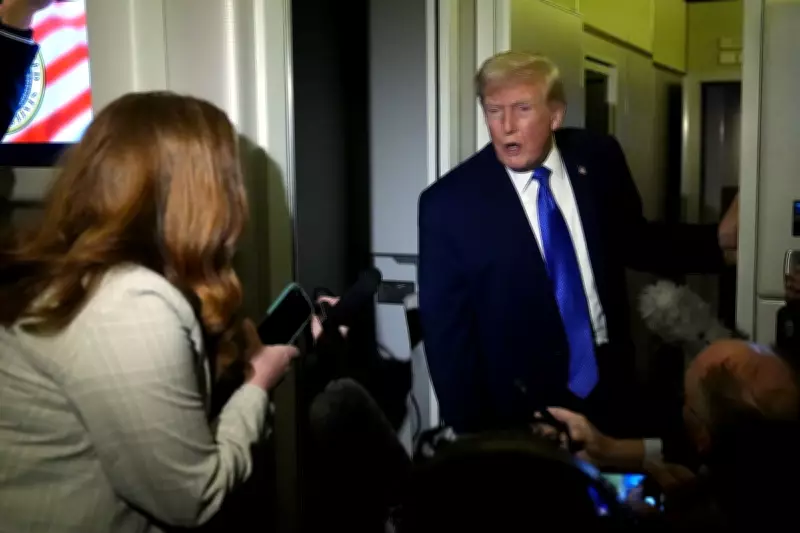
Former President Donald Trump has launched a scathing attack on two of his political adversaries, Representative Alexandria Ocasio-Cortez and California Governor Gavin Newsom, following their appearances at the prestigious Munich Security Conference. Trump, speaking to reporters aboard Air Force One, branded the pair as "incompetent" and an "embarrassment to the nation" after they criticized his administration during the high-profile international event.
Trump's Fiery Critique from Air Force One
During an impromptu press gaggle while travelling, Trump was questioned about the remarks made by Ocasio-Cortez and Newsom at the global security gathering. "I watched AOC answering questions in Munich; this was not a good look for the United States," Trump declared. "I watched 'Gavin Newscum' answering questions in Genev-Munich." The former president appeared to mistakenly reference Geneva before correcting himself to Munich, highlighting his dismissive tone towards the California governor.
Trump emphasized that their performances reflected poorly on America internationally. "And this was a bad look for our country," he continued. "These two people are incompetent." In a notable contrast, Trump offered a backhanded compliment to former First Lady Hillary Clinton, stating "At least Hillary was competent, she's just Trump deranged." This concession acknowledged her capabilities while maintaining his characteristic criticism of her political stance.

Social Media Amplification and Diplomatic Claims
The criticism extended beyond the airborne press conference. On his Truth Social platform, Trump further suggested that neither Ocasio-Cortez nor Newsom should critique the United States while overseas, claiming they had "made fools of themselves" on the international stage. In the same social media post, he praised the diplomatic achievements of Secretary of State Marco Rubio, creating a clear contrast between his administration's approach and the criticisms voiced in Munich.
Notably, Trump himself did not attend the Munich Security Conference, which stands as the world's largest gathering focused on international security policy. His absence provided a backdrop against which the remarks of his critics gained additional prominence and his subsequent reactions carried particular weight.
Ocasio-Cortez's High-Profile International Debut
For Representative Alexandria Ocasio-Cortez, the Munich conference represented her most significant overseas trip to date. The 36-year-old New York congresswoman, widely speculated to be considering a future White House bid, used the platform to deliver a fiery address challenging Trump's political legacy. She argued that the former president was "looking to withdraw the United States from the entire world so that we can turn into an age of authoritarianism."
In discussions with The New York Times, Ocasio-Cortez downplayed presidential speculation, stating that focusing on her potential candidacy was "missing the point." Instead, she emphasized the global crisis facing democracies. "Global democracies are on fire the world over, and established parties are falling to right-wing populist movements," she told the newspaper. Her proposed solution centered on addressing economic inequality, asserting that "extreme levels of income inequality lead to social instability and drives in the sense in authoritarianism, right-wing populism and very dangerous domestic internal politics."
Newsom's Assessment of Trump's International Impact
California Governor Gavin Newsom, another potential presidential contender, offered his own pointed analysis during the Munich conference. He suggested that Trump's attempts to divide America's European allies had ironically produced the opposite effect. "I believe Europe feels more united today than it has in some time," Newsom told attendees to applause. "And perhaps maybe that is the one contribution of Donald Trump."

Newsom characterized Trump's political influence as "temporary" and sought to reassure European allies about the future of transatlantic relations. "It's not dead, it's dormant," he stated regarding the partnership. "You may need to sleep with one eye open. It will take time, but it's certainly not dead." This metaphorical language underscored his belief in the resilience of international alliances despite current political tensions.
Broader Political Implications and Context
The exchange highlights several key dynamics in contemporary American politics:
- The ongoing ideological conflict between Trump's populist conservatism and progressive figures like Ocasio-Cortez
- The international dimension of domestic political rivalries, with criticisms voiced on global platforms
- The positioning of potential presidential candidates ahead of future election cycles
- The role of social media in amplifying political disputes beyond traditional media channels
Trump's characterization of Ocasio-Cortez and Newsom as incompetent stands in stark contrast to their rising prominence within the Democratic Party. Both figures have established themselves as influential voices, with Ocasio-Cortez representing the progressive wing and Newsom governing America's most populous state. Their Munich appearances signal an increasing willingness to engage with international audiences on matters of global security and democratic values.
The former president's concession regarding Hillary Clinton's competence, while still criticizing her as "Trump deranged," reveals a nuanced assessment that acknowledges political opponents' capabilities even while disparaging their perspectives. This layered criticism reflects the complex personal and political relationships that continue to shape American politics years after the 2016 election.
As the 2026 political landscape continues to evolve, such exchanges between prominent figures from opposing parties will likely intensify, particularly on international stages where America's global role remains a subject of intense debate and divergent visions for the nation's future direction.