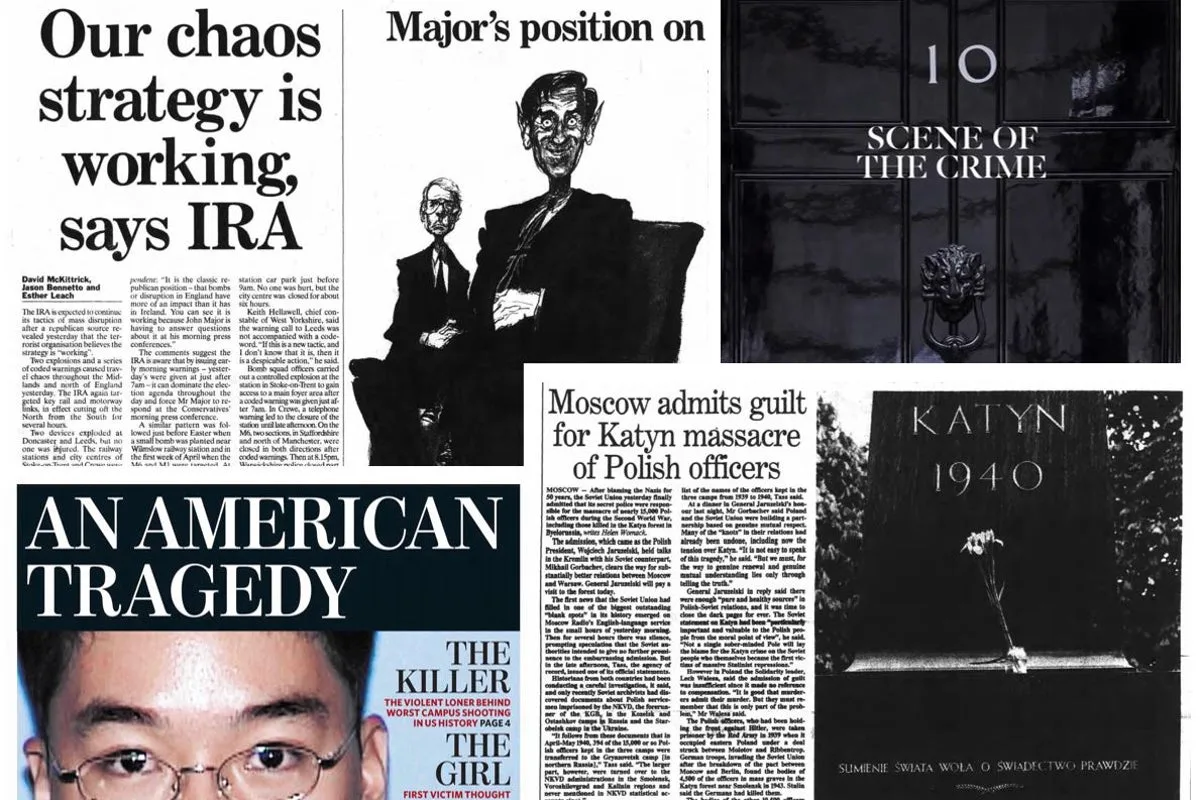
This Week in History: Deception, Massacres, and Tragedy
This Week in History: Deception, Massacres, Tragedy

This Week in History: A Retrospective of Global Turning Points

Between 13 and 19 April, history has witnessed a series of profound and often devastating events that have shaped the modern world. From political deception and brutal massacres to tragic school shootings and cultural destruction, this week serves as a stark reminder of humanity's capacity for both cruelty and resilience. The Independent's front pages have captured these moments, offering a powerful retrospective on how they unfolded and their lasting impact.

14 April 1990: Soviet Admission of Katyn Massacre

In a historic reversal after five decades of denial, the Soviet Union finally admitted that its own secret police were responsible for the Katyn massacre of nearly 15,000 Polish officers during World War II. This admission came alongside Soviet leader Mikhail Gorbachev issuing a 48-hour ultimatum to Lithuania, threatening an economic blockade if the republic refused to annul its declaration of independence. The dual events highlighted the crumbling Soviet empire's attempts to maintain control while confronting its dark past.

19 April 1992: Secret Witness in Lockerbie Bombing Trial

A former Libyan government official emerged as a crucial secret witness in the Lockerbie bombing trial, placed under US protection in a safe house to prevent Libyan intelligence from silencing him. This geopolitical drama unfolded against the backdrop of traditional Easter processions in Malaga, where people donned centuries-old robes and tall, pointed hats, creating a striking visual contrast on The Independent's front page.

Wide Pickt banner — collaborative shopping lists app for Telegram, phone mockup with grocery list

18 April 1993: Serb Assault on Srebrenica

Bosnian Serb forces launched a devastating assault on Srebrenica, shelling the town from all sides and engaging in hand-to-hand combat as the UN Security Council convened an emergency session. With the humanitarian situation rapidly deteriorating, pressure mounted on Western leaders to authorise retaliatory airstrikes to halt the brutal advance, foreshadowing the genocide that would later unfold in the region.

19 April 1997: IRA's 'Chaos Strategy'

The IRA claimed its strategy of mass disruption was "working" after a series of explosions and coded bomb warnings caused massive travel disruption across the Midlands and north of England. Key rail and motorway links between the North and South were severed for several hours, creating widespread paralysis and highlighting the ongoing tensions in Northern Ireland's peace process.

16 April 2003: Unanswered Questions After Iraq War

As the initial combat phase of the US-led invasion of Iraq drew to a close, The Independent dedicated its front page to a list of urgent, unanswered questions. The paper demanded accountability on issues ranging from the whereabouts of Saddam Hussein and the alleged weapons of mass destruction to the true civilian death toll and the underlying geopolitical motives for the war.

18 April 2007: Virginia Tech Massacre

The Virginia Tech massacre, which claimed 32 lives, remains the deadliest school shooting in US history. The Independent investigated the harrowing human stories behind the tragedy, profiling the "violent loner" responsible, his first victim, a defensive gun dealer, and a heroic Holocaust survivor professor who died saving his students.

16 April 2019: Notre-Dame Cathedral Fire

The world watched in horror as a catastrophic fire ripped through the Notre-Dame Cathedral in Paris, collapsing its iconic spire and destroying its historic oak roof in just 63 minutes. The event sparked a monumental global fundraising and restoration effort to rebuild the beloved Parisian landmark, symbolising both loss and collective determination.

13 April 2022: Partygate Scandal

Boris Johnson became the first sitting prime minister to be found to have broken the law after the Metropolitan Police fined him, his wife Carrie, and chancellor Rishi Sunak for attending a lockdown-breaching gathering at 10 Downing Street. The explosive Partygate scandal irreparably damaged his political authority, triggering a mass cabinet revolt that forced his resignation just three months later.

This week in history demonstrates how moments of deception, violence, and tragedy intersect with political reckonings and cultural resilience, leaving indelible marks on global consciousness.

Pickt after-article banner — collaborative shopping lists app with family illustration




