

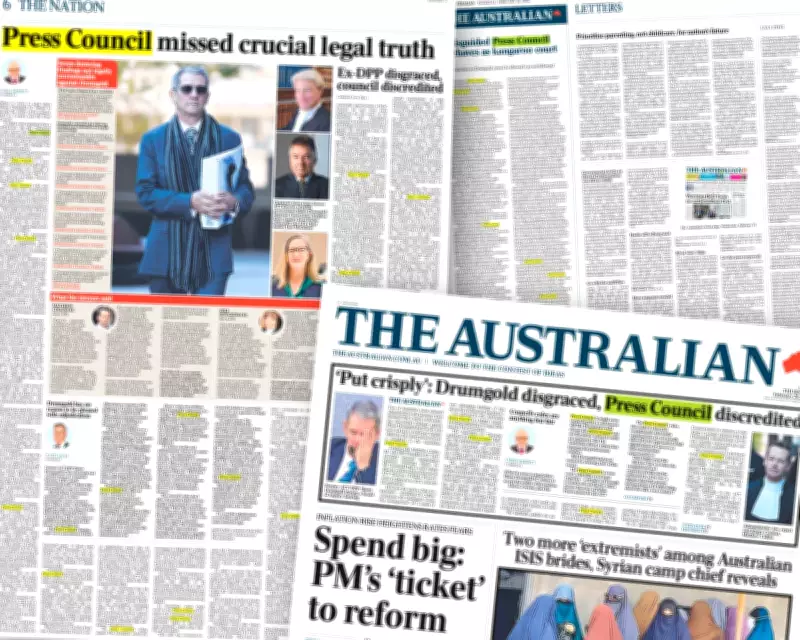
The Australian's Press Council Tantrum: A 4,000-Word Riposte Over Drumgold Ruling
In an unprecedented display of media defiance, The Australian newspaper has unleashed a blistering 4,000-word counterattack against the Australian Press Council (APC). This extraordinary response follows the council's ruling that the Murdoch-owned broadsheet published three misleading, unfair, and inaccurate articles about former ACT prosecutor Shane Drumgold.
A Front-Page Fury
The newspaper's tantrum, as critics have labelled it, manifested on Thursday with a comprehensive riposte. This included a front-page story, a detailed timeline, two comment pieces, and a thundering editorial that openly questioned the APC's competence and integrity. The intensity of this backlash is particularly striking given News Corp's dominant role within the council, contributing up to 70% of its annual $1.7 million budget.
Columnist Janet Albrechtsen authored all three contentious pieces, with New South Wales editor Stephen Rice co-byline on one. The APC highlighted that failing to disclose Albrechtsen's involvement in the inquiry into the Bruce Lehrmann trial, where Drumgold served as prosecutor, was "a significant omission." In 2024, the ACT Supreme Court found that Walter Sofronoff's extensive communications with Albrechtsen created an impression of bias during the inquiry, noting 273 interactions that suggested potential influence.

Drumgold's Pursuit of Accountability
Drumgold lodged a complaint with the APC, arguing that Albrechtsen's articles misrepresented the court's findings. Despite The Australian commissioning two independent legal opinions in a last-ditch effort to sway the council, the APC ruled in Drumgold's favour. The council clarified that these legal opinions were irrelevant, as its focus was solely on whether editorial standards had been breached.
In response to the newspaper's outburst, Drumgold posted on LinkedIn: "Who needs the truth, when you have a whole newspaper … Sorry seems to be the hardest word." The APC defended its process, stating that its findings "were not the result of a legal process, let alone a court, 'kangaroo' or otherwise," but stemmed from a thorough examination of the stories and clear breaches of principles.
Other Media Highlights from the Week
Michael Rowland's ABC Departure: Veteran newsman Michael Rowland announced his exit from the ABC after nearly four decades, but headlines sensationalised his reasons. Outlets like Sky News and 7News inaccurately claimed he quit to care for his sick wife, based on a throwaway comment. Rowland clarified that his wife, Nicki, had been unwell but has recovered, criticising the lack of fact-checking.
Educational Divide Exposed: A story in South Australia's Sunday Mail highlighted the stark contrast between public and private schools, with public students in stuffy transportable classrooms while private counterparts enjoy multimillion-dollar facilities. However, a headline typo "Bridge the eductional gulf" marred the report.
Anna Murdoch-Mann's Passing: The media world mourned Anna Murdoch-Mann, who died at 81. Described by the Australian Financial Review as "the central domestic presence" in Rupert Murdoch's empire, her role was foundational during News Corp's growth in the 80s and 90s. She was also a journalist and novelist, authoring three books.
Contrarian Commentary: Libertarian commentator Brendan O'Neill defended Prince Andrew in a piece titled "The pursuit of Andrew has become a medieval witch hunt," criticising media coverage as a cruel scalp-hunt in the cancel culture era.
ABC Documentary Launch: The ABC's new news documentary unit debuts with Diabolical: the Epstein Files, airing on 2 March. The series features interviews with key figures and aims to deliver comprehensive journalism, as part of the network's shift away from axed programs like Q+A.






