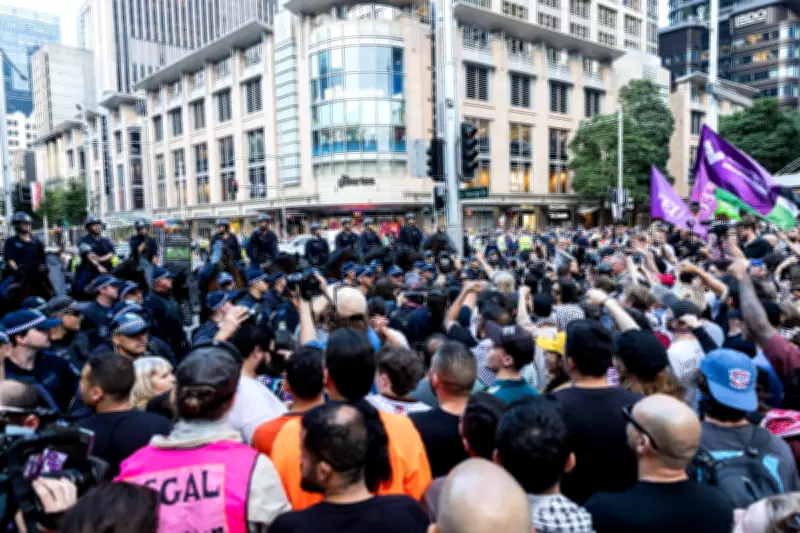
Sydney Protest Clash: MP Criticises Legal Framework and Police Tactics
Stephen Lawrence, a New South Wales Labor Member of the Legislative Council, has declared that the recent violent confrontation at an anti-Herzog rally in Sydney was nearly unavoidable. He attributes this to the current legal framework, which grants the state significant power to suppress protests. Lawrence, who participated in the demonstration, observed what he described as instances of excessive police force, alongside some assaults on officers.
Moving Beyond Political Rhetoric
In the aftermath of the Town Hall riot, Lawrence refuses to engage in typical political posturing, which often involves effusive praise for police or harsh condemnation of protesters. He expresses deep respect for both the challenging work of law enforcement and the right of citizens to protest peacefully. Lawrence emphasises that most individuals in both groups are fundamentally decent, though imperfect, and deserve the benefit of the doubt.
As a parliamentarian, Lawrence strives to maintain objectivity, believing he represents all people in NSW. Over the past three years, this approach has led him to consistently defend police while also advocating for protest rights. However, he acknowledges that many community members will quickly form opinions, often highlighting the faults of the side they politically oppose.

Excessive Force and Inevitable Conflict
Lawrence recounts witnessing what appeared to be excessive force by police during the protest, which he attended alongside hundreds of Labor party members. He clarifies that his stance is not an attempt to find a "sensible centre" or achieve political compromise. Instead, he argues for moving beyond a false dichotomy that portrays police as either perfect or protesters as entirely dangerous.
The protest involved large crowds with strong disagreements over the contentious state visit, creating a clash between legal restrictions, police operational decisions, and protesters' desire to march to state parliament. Lawrence asserts that conflict was almost inevitable, a prediction he made in parliament last year. The core issue, he contends, is the legal framework that placed police and protesters in this precarious situation.
Current Legal Landscape and Historical Parallels
Under Sydney's current public assembly restriction declaration, continuously extended by the police commissioner, there is no independent arbiter to determine lawful protest routes. Police hold sole authority to decide if a protest can proceed within the declared area. Lawrence draws parallels to the 1978 Mardi Gras riot, where similar dynamics led to violence, arrests, and widespread social concern.
He notes that the 1978 protest involved a stigmatised minority, with prejudice playing a significant role. The recent protest also included several minority groups, but Lawrence points out that the broader protest movement has been thoroughly demonised. Following the 1978 excesses, lessons were learned, leading to parliamentary law reform that transferred authority over street protests from police to independent courts and limited police "move on powers" for lawful demonstrations.
Unlearned Lessons and Political Context
Lawrence laments that these lessons have since been unlearned, with society adopting a view that the state can legitimately suppress mass protests, despite the obvious potential for violence. He links contentious legislative reforms to the political ebb and flow of the community, highlighting a pernicious shift in public debate following the Bondi atrocity. This included the appalling suggestion that the attack was caused by lawful, peaceful protest, which has influenced subsequent developments.
Lawrence finds hope in the shadow attorney general, Damien Tudehope, recently rejecting this link, seeing it as a glimmer of potential for bipartisan sanity in NSW. The Town Hall riot is expected to be closely examined by NSW police, accountability agencies, and likely criminal courts as charges against protesters and possibly police are processed.