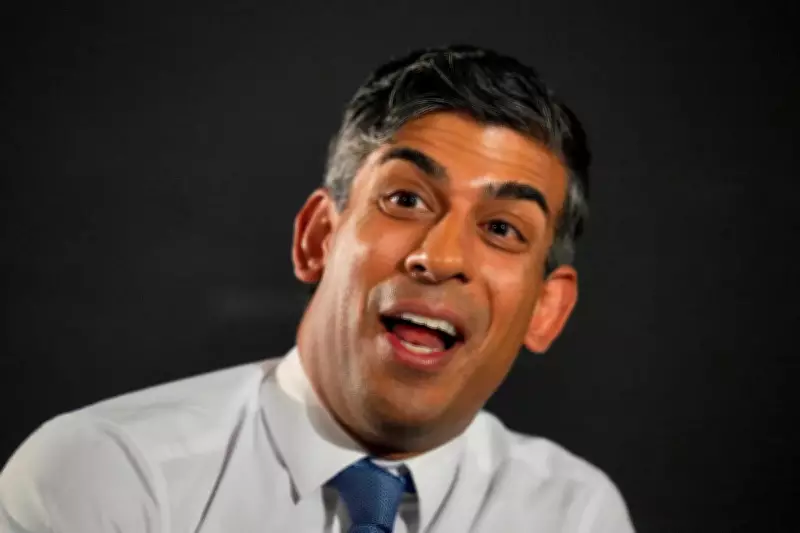
Rishi Sunak, the former Conservative prime minister, has outlined a vision for how Britain can adapt to the rapid rise of artificial intelligence. Now an advisor to Anthropic, Microsoft, and Goldman Sachs, Sunak warns that AI is already replacing human workers in fields like law, accountancy, and creative industries. He cites business leaders discussing 'flat growth'—expanding without increasing employment.
What is Rishi Sunak saying?
'Watch out!' would be a fair summary. With some authority, he warns that not only can AI replace the work of humans in areas such as law, accountancy and the creative industries, but that this is already happening. Business leaders, he says, have been telling him about the concept of 'flat growth' – expanding business without adding to the workforce. 'They're talking about this concept that they think that they can continue to grow their businesses without having to significantly increase employment, because they're starting to see how they can deploy AI,' he says. As has been widely noted, there is a particular threat to entry-level graduate posts. Given that AI is already becoming a pervasive new technology, the implications for any economy will be profound. 'There are reasons to be worried and think about the future,' he says. 'But we are able to do something about this.'
What can we do about AI?
He may not have been much good at projecting a vision of Britain during his relatively brief premiership, but he is certainly doing so now. He suggests rebalancing the tax system by phasing out national insurance and replacing it with taxes on corporate profits would help by making humans cheaper to employ and ensuring that public services and the state can function even in a world where employment as we understand it is drastically reduced.

How could it work?
He doesn't spell this out, but it is clear that in a society in which AI plays a commanding role in economic activity, the share of national income derived from company profits (capital, paid to shareholders) will increase while that from wages (labour, paid to workers) will fall. Left uncontrolled, that change would eventually create an incredibly divided society with a workless class subsisting on very low incomes, while the owners of the AI 'machines' will harvest all the revenues from whatever business they are in. Even skilled work, such as carpentry, surgery or mechanics, could be done by AI-driven robots; they could become soldiers too (and in Ukraine, something like this can already be glimpsed). Only by redistributing AI-generated profits back to humans can living standards be remotely protected.
But would such a system of redistribution work?
Perhaps in a bountiful world, where AI has partly resolved the problem of economic scarcity, there would be more than enough to go round, and no one much would need to work at all. A kind of 'leisure hive', once the stuff of science fiction, could be built. This was the sort of speculative future Sunak discussed with Elon Musk at the UK AI summit he hosted as prime minister a few years ago.
Would any jobs survive?
Yes. AI itself is generating entirely new types of work and, as Sunak says, the trick would be to balance human and AI activity in teams. 'We should be thinking about, well, how do we tip the balance in favour of AI being used in that positive way… to help people do their jobs better [rather than replacing them],' he says.
What is the government doing about it?
Sunak has joined deputy prime minister David Lammy in promoting investment in the UK tech sector. He says he is a 'big believer' in 'Londonmaxxing' and 'Britmaxxing', adding: 'We are an AI superpower.' He also points to the presence of companies such as DeepMind, Anthropic and OpenAI in Britain. However, it's also true that the UK-US Tech Prosperity Deal signed last year, which planned to bring in £31bn of investment, has stalled, and OpenAI has paused its Starlink UK project.

What will AI do to politics?
It is already being disruptive because the answers it gives to political questions are themselves affected by the way the AI agent has been taught and what information it has been 'fed'. AI cannot tell a voter which party has 'fairer' policies or can be 'trusted'. It may be that AI agents will never replace elected politicians and governments as we know them, and they will be among the last people to hang on to their way of life. At any rate, Mr Sunak has positioned himself nicely for the new world he envisages.