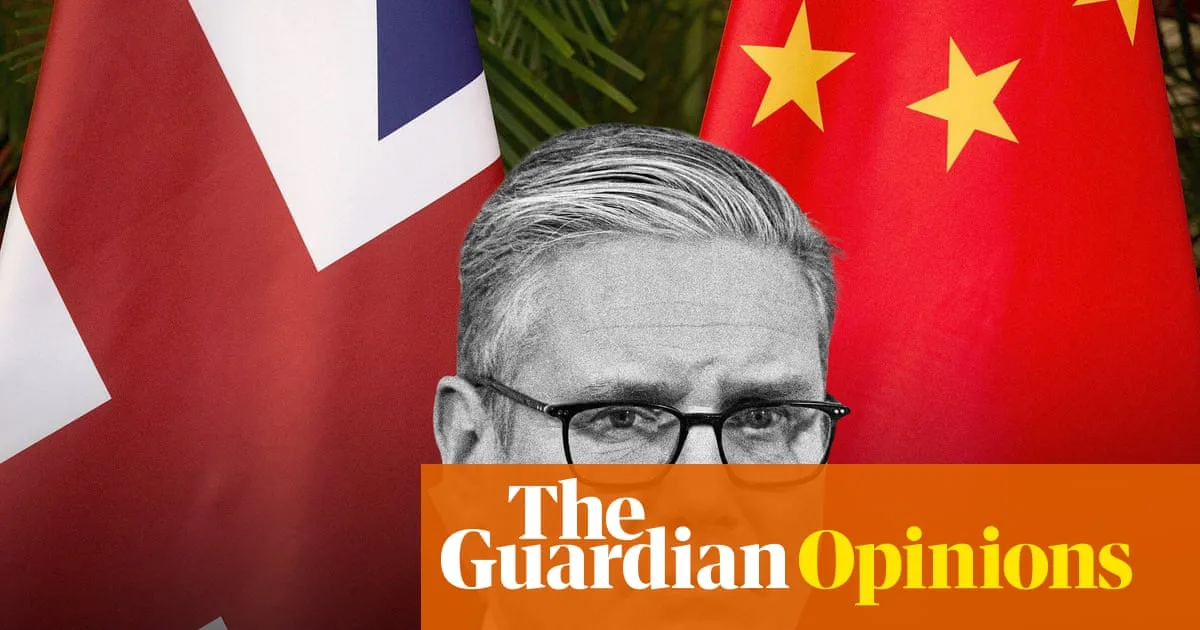
Composite: Guardian Design/AFP/Getty Images/Alamy
From the Burnham Row to the China Visit: Avoiding Hard Choices is the Starmer Doctrine
There comes a point in a prime minister's career when foreign travel offers welcome respite from domestic troubles. Even when relations with the host country are delicate, as Britain's currently are with China, the dignified protocols of statecraft can make a beleaguered politician feel valued and important.
Keir Starmer finds himself in transition between these two zones of political life. His position isn't yet seriously threatened by the ongoing row over Andy Burnham's thwarted ambition to stand in the Gorton and Denton byelection. However, he will undoubtedly appreciate that a flight to Beijing places thousands of miles between him and Labour MPs who are petitioning to reverse the party's national executive committee ruling against the Greater Manchester mayor's candidacy.
The Foreign Policy Preference
Starmer reasonably believes that the first visit by a UK prime minister to China since 2018 represents a far more significant matter than internal party disputes about rulebook weaponisation. Yet he would be unwise to underestimate how much these internal battles matter within Labour's ecosystem.
The prime minister is somewhat unusual in having reached the party's summit with limited experience of its internal culture, traditions, and the unintended consequences that can spiral from procedural conflicts. While there was considerable machination to consolidate Starmer's position in opposition – marginalising the left and managing candidate selections to build a cadre of future loyalists – much of this work was outsourced to his chief of staff, Morgan McSweeney.
Once installed in Number 10, Starmer felt little obligation to engage with internal Labour politics. Nor did he cultivate relationships with those new MPs who he assumed would dutifully enact government policy. Many ministers have expressed disappointment at how rarely they see the prime minister, while officials have been surprised by his apparent lack of interest in political matters, even by Westminster's obsessive standards.
The Appeal of International Diplomacy
This disposition helps explain why Starmer quickly developed an appreciation for the foreign affairs dimension of his role. International summitry places pragmatism firmly in the foreground. Whether the mission involves resetting relations with the European Union, managing interactions with Donald Trump, or, as this week demonstrates, building bridges with Beijing, there's limited advantage in arriving burdened with ideological baggage.
To a leader who perceives himself as a master problem-solver, the current global disorder resembles a complex puzzle consisting of overlapping pieces that might be calmly and methodically arranged to serve the national interest.
This perspective provides him with a ready answer to critics who wish he would more forcefully challenge leaders fundamentally opposed to democratic principles, such as Xi Jinping, or those who casually despise them, like Donald Trump. Starmer dismisses calls for what he terms "performative" condemnations that would achieve little beyond diminishing British influence with global superpowers.
The Balancing Act
The prime minister did eventually feel compelled to criticise Trump last week, specifically regarding demands for Greenland made with menacing undertones and belittling remarks about the role of UK armed forces in Afghanistan. Yet he consistently avoids connecting individual offences into a broader critique of the US president's authoritarian tendencies.
Similarly, Starmer can formulate diplomatic language that implies criticism of China concerning espionage activities, support for Vladimir Putin, the erosion of civil rights in Hong Kong, and other repressive measures, all while avoiding overtly confrontational tones.
To the extent that the UK government possesses a foreign policy doctrine, this represents its core. Beyond the theatre of war in Ukraine and the specific enmity with Putin, principles are to be declared but not presented as obstacles to cooperation.
The Doctrine of Non-Choice
Starmer articulated this approach clearly in a speech last December, pledging to use engagement on every front to maximise Britain's interests while refusing to acknowledge that conflicting priorities might sometimes emerge. "We don't trade off security in one area for a bit more economic access somewhere else," he declared.
He observed that the remainder of this century would be dominated by "the US, the EU and China, all interacting with each other" and that "our future will be determined by how we navigate this dynamic." Yet here too, he envisioned no hard choices or necessary sacrifices, suggesting instead that partnership with everyone would bring universal prosperity.
Starmer has frequently insisted that Britain faces no geopolitical dilemma regarding alignment with Washington or Brussels. Now he extends this reasoning to the risk of US displeasure at his courtship of China. "I am often invited to simply choose between countries," he remarked in an interview ahead of his Beijing trip. "I don't do that."
The Limits of Pragmatism
Like any balancing act, this approach functions effectively until significant force is applied from one direction or another. Starmer is already encountering limitations regarding what can be achieved with the EU from a position of mid-Atlantic ambivalence. Negotiations continue slowly on topics already agreed in principle – defence cooperation, agricultural imports, and similar matters – but Brussels demonstrates limited appetite for marginal adjustments to the existing Brexit settlement and diminishing confidence that Starmer possesses the will to pursue more substantial changes.
On the American front, Trump's threat of tariffs as punishment for siding with Denmark over Greenland, coupled with his derision toward a previously agreed deal concerning the Chagos Islands, serves as a stark warning: the fruits of diplomatic sycophancy can be discarded in a presidential tantrum. Meanwhile, constructive cooperation with China remains perpetually vulnerable, potentially only one major spy scandal away from angry decoupling.
A Consistent Pattern
Pragmatism represents a necessary component in pursuing any policy, but for Starmer it has become the policy itself – an end rather than a means. It stands as the paramount virtue, presented as superior to rigid dogma, which is reasonable, but also, less convincingly, as the definitive response to any demand for clarity of principle or purpose.
This pattern manifests consistently. Starmer's initial promise to Labour when seeking leadership was ecumenism between factions; he didn't believe he would need to choose between left and right. Only once persuaded that Corbynism proved toxic to swing voters did he authorise its systematic removal by the party machinery. Even then, he didn't truly win an argument about what was right in principle – he shut it down based on electoral practicality.
During the 2024 general election campaign, Starmer told voters they could achieve national renewal without painful fiscal choices. Subsequently, he spent a year implementing austerity measures, declaring them necessary while failing to articulate a compelling cause that might justify the hardship.
The International Road Ahead
This approach has demonstrably faltered on the domestic front, and it will eventually encounter similar limitations internationally. In an age defined by power bloc rivalries, pragmatic engagement in every direction represents a denial of strategic dilemmas, postponing crises rather than averting them. Yet this remains the Starmer way: he is the politician who avoids politics, the problem-solver reluctant to name problems explicitly, the leader whose first choice is consistently to avoid making choices altogether.




