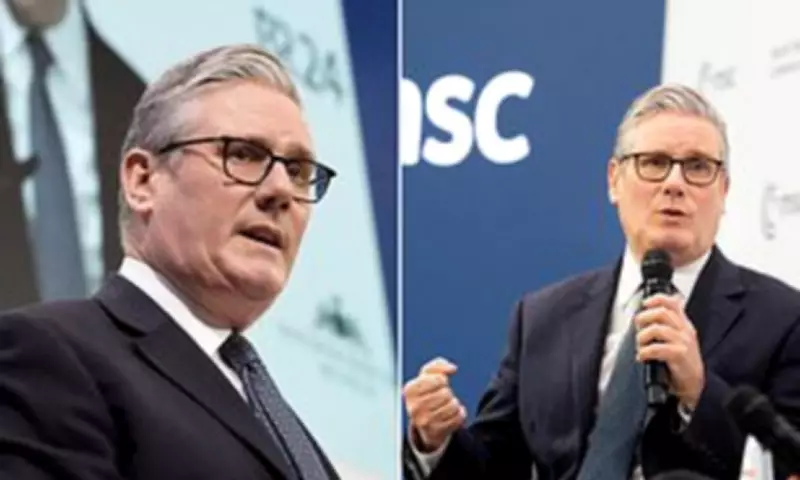
In a defiant address at the Munich Security Conference, Prime Minister Sir Keir Starmer has robustly defended his government's unity while outlining a vision for the United Kingdom to "urgently" move closer to Europe. The embattled leader, facing persistent rumours about his political survival, loftily dismissed questions regarding his vulnerable position, insisting his administration remains steadfastly united on key issues.
A Call for Deeper European Integration
Sir Keir's speech, delivered to an audience of European and world leaders, marked a significant shift in post-Brexit policy. He declared that the UK is "ready" to align more closely with Europe, not only in defence and security but also economically. Many observers perceive this as a potential betrayal of Brexit voters and a subtle snub to the United States, though the Prime Minister framed it as being "in all of our interests."
"My message today is the United Kingdom is ready. We see the imperative. We see the urgency," Starmer stated. "We want to work together to lead a generational shift in defence industrial co-operation. Now this includes looking again at closer economic alignment."

Economic Alignment with the Single Market
The Prime Minister emphasised that the UK already aligns with the single market in certain sectors to reduce food and energy prices. He advocated for exploring further alignment in other areas where mutually beneficial. "We must look at where we could move closer to the single market in other sectors as well, where that would work for both sides," he said.
Sir Keir argued that deeper economic integration would yield greater security, stronger growth for both the UK and EU, increased defence spending, and position Britain at the forefront of European industrial renewal. "The status quo is not fit for purpose," he asserted, acknowledging political trade-offs while vowing to fight for the national interest.
Political Attacks and Leadership Defence
During his Munich appearance, Starmer also launched pointed attacks against domestic political rivals Reform UK and the Green Party. Using evocative language reminiscent of Sir Edward Grey's 1914 warning about lamps going out across Europe, he suggested voting for these parties risked division and capitulation, potentially endangering European security.
"We must level with the public and build consent for the decisions we will have to take to keep us all safe," Starmer warned. "Because if we don't, the peddlers of easy answers on the extreme left and the extreme right are ready. They will offer their solutions instead."
Mounting Scandals and Leadership Challenges
The Prime Minister's Munich intervention comes amid escalating turmoil within his government. Starmer has faced consecutive scandals, including ongoing questions about his knowledge regarding former US ambassador Peter Mandelson's connections to convicted paedophile Jeffrey Epstein. The controversy led to the resignation of his chief of staff, Morgan McSweeney.
Further damaging revelations emerged this week concerning Starmer's decision to award a peerage to former Labour communications chief Lord Doyle, despite awareness of Doyle's ties to a convicted child sex offender. Labour ministers, including Culture Secretary Lisa Nandy, have publicly questioned the Prime Minister's judgment.
Leadership challenges from former deputy Angela Rayner and Health Minister Wes Streeting have been rumoured for months, while Scottish Labour leader Anas Sarwar recently called for Starmer's resignation. Conservative leader Kemi Badenoch has labelled the situation "Labour's psychodrama," highlighting the government's instability just eighteen months into Starmer's premiership.
By-Election Pressures and National Security Stance
Political analysts interpret Starmer's aggressive rhetoric against Reform and the Greens as an attempt to shore up support ahead of the crucial Gorton & Denton by-election in Manchester. A Labour defeat in this traditionally safe seat, which they won with a 13,000 majority last election, could trigger a leadership challenge and further destabilise the government.

In his Munich address, Starmer also called for reduced military reliance on the United States, advocating for a more "European NATO" based on interdependence rather than overdependence. "We are not the Britain of the Brexit years any more," he declared. "There is no British security without Europe and no European security without Britain. That is the lesson of history — and it is today's reality too."
Reform UK responded critically, accusing Starmer of making Britain "weaker and less secure" while failing to increase defence spending. The Green Party dismissed his attacks as "cheap smears" from a "caretaker prime minister running scared." Despite the mounting pressures, Starmer concluded his Munich appearance defiantly: "I ended the week much stronger than I started it — and that's a very good place to be."