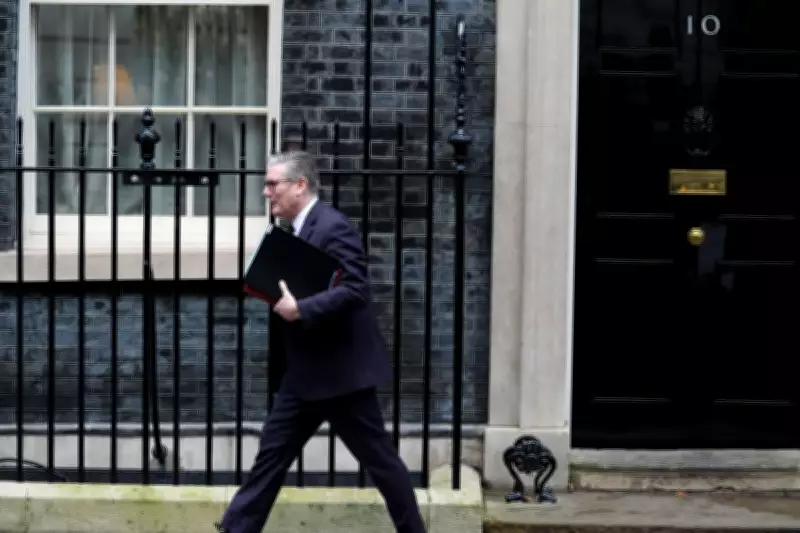
Starmer's Premiership Hangs in Balance Amid Mounting Criticism
Prime Minister Sir Keir Starmer is confronting what may become the most critical week of his political career, with his leadership authority being openly questioned by Labour MPs and public confidence appearing to wane. The immediate catalyst for this crisis stems from his controversial decision to appoint Lord Peter Mandelson as ambassador to the United States, a move that has exposed deep fractures within the governing party.
The Mandelson Appointment Fallout
Lord Mandelson's selection has proven particularly damaging due to his documented connections with convicted financier Jeffrey Epstein, associations that continued even after Epstein's conviction for child sex offences. While former chief of staff Morgan McSweeney has accepted responsibility for providing what he called "wrong" advice regarding the appointment, critics have emphasized that Sir Keir made the final decision with full awareness of these problematic links.
The Prime Minister's scheduled appearance before the Parliamentary Labour Party on Monday occurs against a backdrop of intense speculation about potential leadership changes, with his political future appearing increasingly uncertain.

A Political Journey Marked by Challenges
Sir Keir's relatively recent entry into frontline politics has become a recurring theme in discussions about his current difficulties. Having served as director of public prosecutions between 2008 and 2013, he entered Parliament as MP for Holborn and St Pancras in May 2015. His political ascent continued when Jeremy Corbyn appointed him as a shadow home office minister, though he later resigned from the frontbench following the tumultuous aftermath of the 2016 EU referendum.
When Sir Keir stood for Labour leadership after the party's crushing 2019 general election defeat, he campaigned on a distinctly left-wing platform that included commitments to renationalise water and energy sectors while abolishing university tuition fees. His election as leader in April 2020 marked the beginning of a leadership journey that many observers noted began with limited political experience compared to previous party leaders.
Early Leadership Struggles and Reinvention
The initial phase of Sir Keir's leadership proved challenging from the outset. Following Labour's humiliating defeat in the Hartlepool by-election in 2021, the Prime Minister seriously contemplated resigning, describing the loss as feeling like "I had been kicked in the guts" and viewing it as a "personal rejection." Only the intervention of his wife Victoria and close allies persuaded him to continue.
This period also saw Labour suffer significant losses in council elections across England, prompting former minister Lord Adonis to describe Sir Keir as merely a "transitional figure" lacking the necessary "political skills" for high office. Meanwhile, critics on the party's left openly celebrated what they perceived as his struggles.
Following his left-leaning leadership campaign, Sir Keir began what critics characterized as a systematic abandonment of core principles, gradually dropping key policies as he shifted steadily toward the political center. Supporters, however, viewed this transformation as pragmatic leadership focused entirely on returning Labour to government, believing that meaningful change could only be achieved from positions of power rather than opposition.
Path to Power and Governing Challenges
The early years of Sir Keir's leadership unfolded against the backdrop of the Covid-19 pandemic, while Labour's subsequent rise in opinion polls owed much to Conservative Party turmoil under Boris Johnson and Liz Truss. After the Hartlepool nadir, Sir Keir systematically strengthened his control over the party through a series of by-election victories and a significant 2023 shadow cabinet reshuffle that promoted numerous Blairite figures.

His authority within Labour was further demonstrated by the relatively muted response to his eventual abandonment of the flagship £28 billion green investment pledge, a policy that had become vulnerable to Conservative accusations of fiscal irresponsibility. The war in Gaza presented additional challenges, resulting in several frontbench dismissals related to ceasefire positions, though internal critics remained largely sidelined as Labour established commanding poll leads during the 2024 general election campaign.
Labour's landslide victory in 2024—the party's third-best performance in its history and strongest showing since 2001—secured Sir Keir's place among the elite group of Labour leaders to have achieved power. Supporters credited his forensic examination of pandemic handling and his reassuring response to financial chaos under Liz Truss as key factors in the party's electoral appeal.
Governing Difficulties and Policy Reversals
Despite this electoral triumph, Sir Keir's tenure in Number 10 has been characterized by consistently poor polling performance for both the Prime Minister and his party. Damaging local election results in 2025 contributed to growing unease as the government struggled to address cost-of-living pressures and inspire public optimism about the future.
Policy inconsistency has emerged as a persistent feature of the administration, with Labour's substantial parliamentary majority failing to prevent ministers facing significant backbench pressure. Within just three weeks of taking power, Chancellor Rachel Reeves took the politically risky step of tightening eligibility criteria for winter fuel payments—a previously universal benefit assisting older people with energy costs. Following poor local election results, however, the government reversed course, announcing that all pensioners earning up to £35,000 would become eligible.
This pattern of announcement and reversal has repeated across multiple policy areas. In September, Sir Keir announced a mandatory digital ID scheme for proving right-to-work status in Britain, only to make the scheme optional in January following opposition criticism and public polling indicating limited appetite for the measure.
Similarly, after Ms Reeves eliminated pandemic-era business rate discounts for pubs in her budget, pub owner anger prompted a January announcement of a £300 million "lifeline" for the sector. Farmers protesting inheritance tax changes for estates worth over £1 million—a notable concern given Labour's success in rural constituencies—eventually secured a December increase of the threshold to £2.5 million.
Broader Policy Retreats and Internal Tensions
Beyond these specific examples, the government has retreated from numerous other policy positions, including welfare reform initiatives, grooming gangs inquiry parameters, workers' rights compromises, and plans to end the freeze on income tax thresholds. Internal party tensions surfaced weeks after the general election when seven Labour MPs lost the whip for supporting an amendment to scrap the two-child benefit cap—a policy widely viewed as a relic of Conservative austerity. The Chancellor's subsequent decision to remove the cap in her budget pleased many Labour members but raised further questions about decision-making processes within Number 10.
Defiance Amid Political Jeopardy
As Sir Keir navigates what observers describe as a week of significant political jeopardy, he remains defiant about his future. Addressing staff in Number 10, he emphasized their shared "driving purpose" of "public duty" and expressed particular frustration about what he perceives as undermining of "the belief that politics can be a force for good and can change lives."
Regarding the controversial Mandelson appointment, the Prime Minister stated: "I have been absolutely clear that I regret the decision that I made to appoint Peter Mandelson. And I've apologised to the victims which is the right thing to do." Despite this acknowledgment, the combination of policy U-turns, judgment concerns, and growing public scepticism continues to cloud his premiership's future as he confronts one of the most challenging periods of his political career.