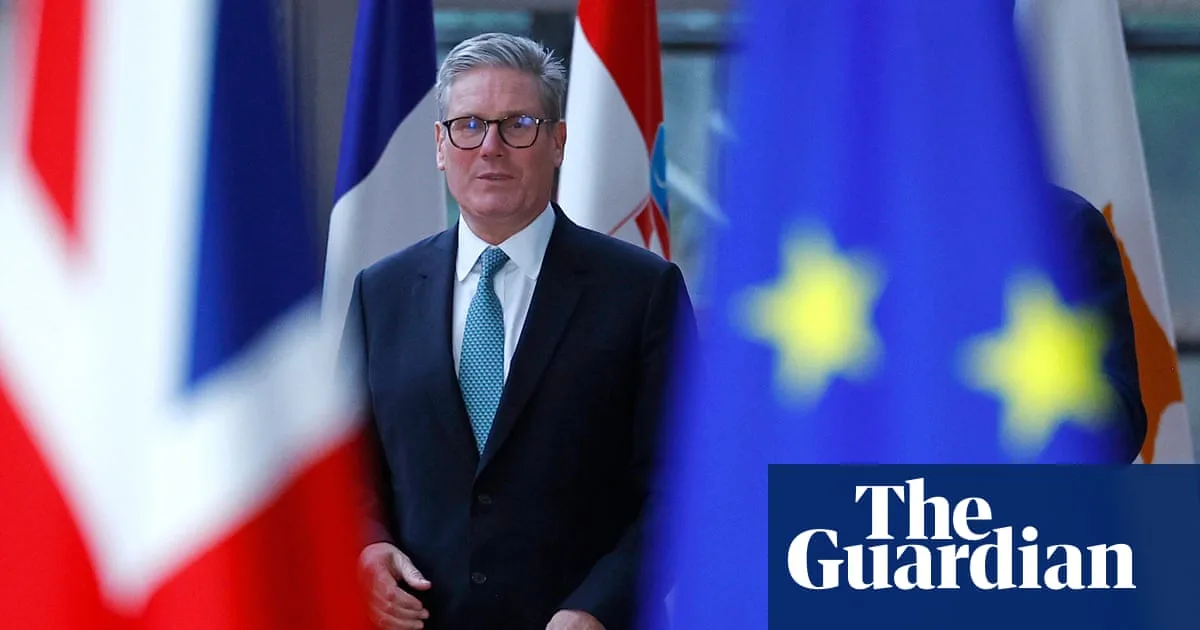
Keir Starmer has called for a deeper partnership with the European Union, citing the instability caused by Donald Trump’s war with Iran. The prime minister said the moment required a more ambitious deal with Brussels to strengthen trade and defence, marking his strongest signal yet of a reorientation towards Europe and away from the US.
Speaking at a press conference on Wednesday, Starmer said Brexit had done “deep damage” to the UK economy and that he would seize the opportunity to repair that harm at a new summit in early summer. “The opportunities to strengthen our security and cut the cost of living are simply too big to ignore,” he said, adding that he wanted to explore closer ties beyond what was agreed at the Lancaster House summit last May.
Starmer’s comments came as Trump again said he was considering pulling the US out of Nato, which he described as a “paper tiger”. The US president has frequently lambasted the UK and European nations for failing to support US-Israeli strikes on Iran. In another barb, Trump told the Daily Telegraph he believed King Charles would have backed his strikes on Iran; the king is scheduled to visit the US later this month.
Starmer said he would not be put under pressure by Trump’s Nato comments and that he wanted to reassure British people they would not get “dragged in” to the wider conflict. “Whatever the pressure on me and others, whatever the noise, I’m going to act in the British national interest in the decisions that I make,” he said.
The prime minister said Britain should strengthen cooperation with the EU on defence, security, energy and the economy, including the single market. “I’m ambitious that we could do more in relation to the single market, because I think that’s hugely in our economic interests,” he said. The summit is expected to take place in Brussels in June or July, though talks have stalled on areas such as youth mobility and a sanitary and phytosanitary deal.
A government source said the UK wanted to “remove the Tory Brexit barriers that killed growth and hiked prices”, adding: “We won’t let the dogmatic approach favoured by Kemi Badenoch or Nigel Farage ignore the benefits of a pragmatic, ambitious partnership with Europe.” The Cabinet Office has been examining sectoral regulatory alignment, which could reboot exports in areas from medical devices to chemicals.