US Senate Rejects Bid to Restrict Trump's Iran War Authority
The United States Senate has decisively rejected a legislative attempt to curb President Donald Trump's ability to wage military action against Iran. This vote comes in the immediate aftermath of a significant and aggressive joint strike conducted by the United States and Israel over the weekend, which has already resulted in the tragic deaths of six American service members.
Bipartisan Effort Falls Short in Senate Vote
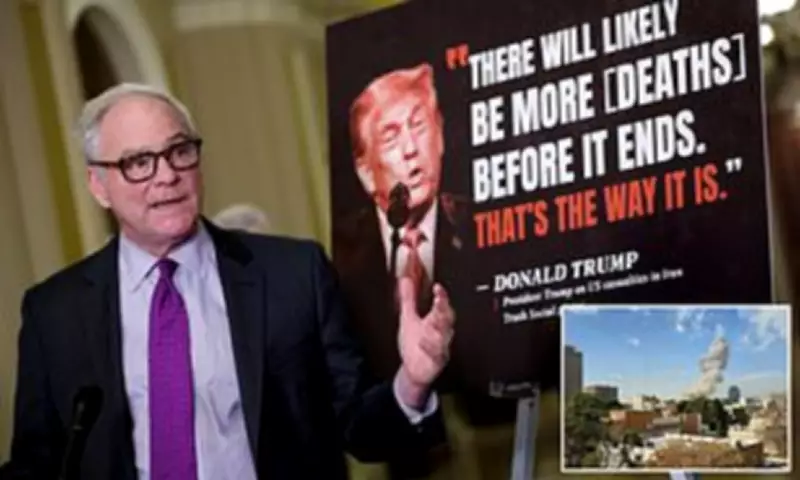
With a final vote tally of XX to XX, the proposed War Powers resolution on Iran failed to secure passage, requiring only a simple majority to succeed. The measure was championed by a coalition of Democratic and Republican senators, including Tim Kaine of Virginia, Adam Schiff of California, Chuck Schumer of New York, and Republican Rand Paul of Kentucky.
Senator Tim Kaine delivered an impassioned plea to his colleagues during the debate, stating, 'I prayed that my colleagues would vote to end this dangerous and unnecessary war.' He emphasized the human cost, adding, 'We owe it to those in uniform, their families, and all Americans to not make the same mistakes that we made in Iraq and Afghanistan.'

Lawmakers Decry Lack of Congressional Authorization
Senate Minority Leader Chuck Schumer sharply criticized the administration's approach, describing the conflict as having 'no clear objectives, no plan, and no authorization from Congress.' He asserted that Congress has a constitutional duty to rein in presidential belligerence.
Congressman Adam Schiff echoed these sentiments, arguing that if the President believes the threat justifies war, he must formally present his case to Congress. Schiff stated, 'Congress must demand that the president... come to Congress and make his case for this war.'
In a statement on social media platform X, Senator Rand Paul highlighted the foundational constitutional principle, noting, 'the constitution conferred the power to declare or initiate war to Congress for a reason, to make war less likely.'
House Republican Leadership Opposes Concurrent Resolution
Speaking to reporters on Capitol Hill, House Republican Speaker Mike Johnson voiced strong opposition to the War Powers resolution, arguing that its passage 'would be a terrible, dangerous idea.' A separate vote on a similar resolution is anticipated in the House of Representatives later this week.
Public Opinion Shifts as Conflict Escalates
Recent polling indicates a notable decline in public support for President Trump's actions. A new Daily Mail/J.L. Partners poll shows the President's approval rating has dropped to 44 percent, marking a four-point decrease since Friday and representing the lowest rating recorded in their tracking to date. This sharp decline correlates with growing American unease over the escalating Middle East conflict and the loss of American lives.
A separate Reuters/Ipsos survey published on Sunday found that 43 percent of Americans disapprove of Trump's attack on Iran, with 29 percent undecided. Approximately half of those surveyed believe the president is too willing to use military force to advance U.S. interests, and 56 percent view his readiness to deploy military power as excessive.
Bipartisan House Effort Seeks to Provide a Check
The War Powers Resolution was introduced in the House by an unusual bipartisan pairing: Republican Thomas Massie of Kentucky and Democrat Ro Khanna of California. Their legislative effort aims to provide a congressional check on presidential war powers and discourage unilateral military strikes without legislative approval. This initiative followed the joint US-Israeli operation launched on Saturday, which targeted senior Iranian military figures.
Congressman Massie, a libertarian-leaning Republican known for his independent stance, commented pointedly on social media, 'PSA: Bombing a country on the other side of the globe won't make the Epstein files go away...'

President Trump Defends Military Action
In an eight-minute address delivered from his Mar-a-Lago resort in Florida on Saturday, President Trump defended the decision to order a 'major' strike on Iran. He cited the breakdown of nuclear negotiations as a key factor, stating the objective was 'to defend the American people by eliminating imminent threats from the Iranian regime.'
The President reiterated his unwavering stance that Iran must never obtain a nuclear weapon. While acknowledging that previous military actions in his second term had not resulted in American casualties, he soberly warned that 'the lives of courageous American heroes may be lost and we may have casualties... That often happens in war.' He framed the mission as a necessary sacrifice for future security, calling it a 'noble mission.'
Trump also condemned the Iranian regime for fostering 'mass terror' globally and referenced the regime's violent suppression of domestic protesters, to whom he had promised aid in mid-January. In a notable development, videos surfaced showing Iranians expressing gratitude towards Trump following the attacks.
The conflict continues to unfold, with the Senate's rejection of the War Powers resolution cementing the President's current authority to direct military operations against Iran without new congressional authorization.