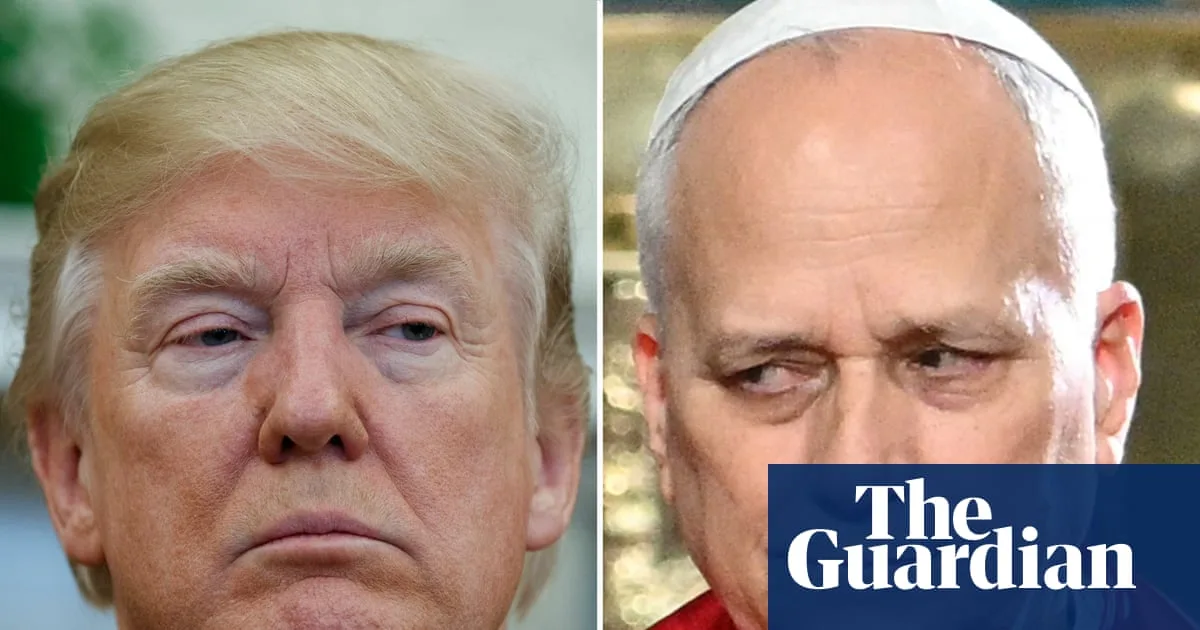
Donald Trump’s attacks on Pope Leo XIV are polarising the diverse Catholic community in the United States, as faith and politics come to a head. Maryellen Lewicki, who meets weekly for Bible study with a group of Catholic women in Decatur, Georgia, said the president’s name arises despite their efforts to keep politics out. “We have one person that we pray for during the course of the week,” she said. “What my friend said is that she prays for the president every day, that God will remove that hard heart of his and replace it with a softer one that has love.”
The pope has been broadly critical of war, but pointedly so of American attacks in Iran. On Palm Sunday, Leo, who is American, condemned the use of religion to justify violence, saying God “does not listen to the prayers of those who wage war”. His comments follow months of papal criticism about the treatment of refugees in the US, and a statement by American archbishops in February opposing the administration’s actions on refugee and immigration policy – unusually forceful by the church’s historic standards.
Trump’s reaction described Leo as “weak on crime” and suggested that Leo’s papacy is due to Trump, polarising many. Taylor Marshall, an outspoken Catholic conservative with a considerable YouTube following, said: “If you’re an American, you don’t want to see your president having a feud with the pope. And if you’re Catholic, it’s kind of hard. If you voted for Trump three times and you want to be a Catholic and you want to be faithful and submit to the Holy Father … it’s kind of a tough situation to see the leader of your nation feuding with the leader on Earth of the Catholic church. It is for me.”

Marshall ascribed Trump’s conduct to the president’s difficulty processing the soft power of an American pope, and the challenge that poses to Trump’s sense of self as the most powerful person in the world. The pope “is in charge of 1.4 billion – not million, billion – people and he has the nerve to interject his moral authority into the activity of President Trump? I really think that is the origin story. It’s a philosophical conundrum that President Trump was never prepared for and I think he’s still trying to figure out how to navigate it.”
About 53 million Americans are Catholic, forming the largest Christian denomination in the US. Catholic voters have split their vote between the parties over the years; Trump won 52% of the Catholic vote in 2016 and 55% in 2024, a 12-point margin over Kamala Harris. But 52% chose Joe Biden, who became the second Catholic president in US history. White Catholics and Hispanic Catholic voters diverge sharply: white Catholics have aligned more with Republicans over the last decade, while more than 60% of Hispanic Catholics vote Democrat. About 40% of Catholics are Hispanic.
The papacy has grown more critical of American policy since the end of Benedict’s leadership, with Francis making the treatment of immigrants and refugees central to church teachings. Yet about half of Catholics still chose to vote for Trump. “For the better part of the last hundred years, there have been Catholics at the heart of every conservative revolution that has kind of unfolded in this country,” said one observer.