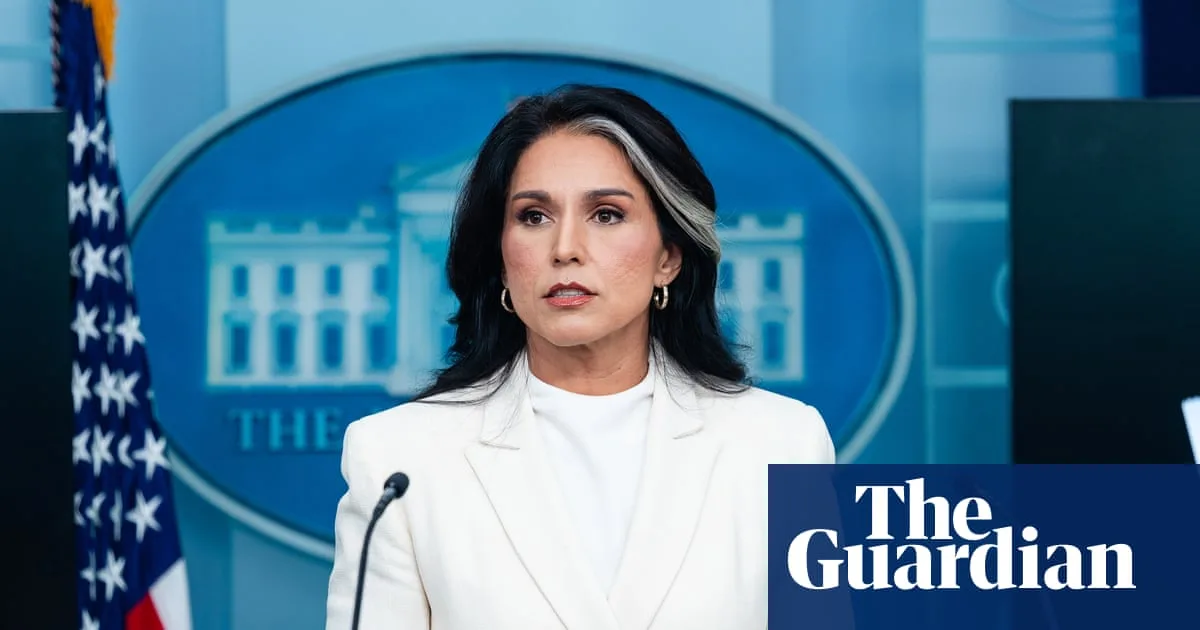
Secret Whistleblower Allegation Against Intelligence Chief Finally Disclosed to Lawmakers
A confidential whistleblower complaint targeting Director of National Intelligence Tulsi Gabbard, which had been secured in a locked safe for months, has ultimately been presented to congressional leaders following an extended eight-month deadlock. Inspector General Christopher Fox, serving as the intelligence community's watchdog, personally delivered the highly classified document to a select group of lawmakers on Monday evening, as reported by CBS News.
Restricted Congressional Review Under Tight Security Protocols
The sensitive materials were examined on a strict 'read-and-return' basis exclusively by members and staff of the Gang of Eight, the bipartisan congressional group responsible for overseeing America's intelligence agencies. The original complaint was filed in May by an intelligence community staffer against DNI Gabbard, alleging deliberate political suppression of a highly classified report.
The whistleblower further contended that an intelligence agency's legal office failed to refer a potential criminal matter to the Justice Department, again for perceived political motivations. No additional specifics from the complaint have been made public, with Fox emphasising that only one previous case in memory necessitated such rigorously controlled disclosure procedures to Congress.
Inspector General's Assessment and Administrative Closure
In a letter approved for public release on Tuesday, Fox informed lawmakers that his predecessor had 'administratively closed' the complaint in June without pursuing further action. 'If the same or similar matter came before me today, I would likely determine that the allegations do not meet the statutory definition of "urgent concern,"' Fox stated in his written assessment.
Fox, a former aide to Gabbard who assumed the Inspector General role after Donald Trump replaced Joe Biden's watchdogs, briefed Congress after obtaining final approval from the DNI chief on Friday. This development follows the Wall Street Journal's Monday revelation about the complaint's existence, which the publication described as 'a cloak-and-dagger mystery reminiscent of a John le Carré novel.'
Bipartisan Reactions and Political Accusations
House Intelligence Committee Chairman Rick Crawford, an Arkansas Republican, issued a statement concurring with both the previous and current Inspectors General's conclusions regarding the complaint's lack of credibility. 'The ensuing media firestorm, fed by speculation and little fact, was an attempt to smear Director Gabbard and the Trump Administration,' Crawford asserted.
Conversely, a spokeswoman for Senate Intelligence Committee Vice Chairman Mark Warner, a Democrat, argued the incident highlighted Gabbard's professional shortcomings. 'This timeline makes unmistakably clear that Director Gabbard does not understand the basic obligations of her role – the predictable result of placing someone out of her depth in one of the nation's most sensitive positions,' stated Rachel Cohen.
Contradictory Initial Assessments and Official Responses
Inspector General Tamara Johnson, a career civil servant, initially determined the complaint met the legal threshold for 'urgent concern.' However, just three days later, after receiving additional information, Johnson authored another memorandum concluding the whistleblower's allegations lacked credibility.
A Gabbard spokeswoman acknowledged the complaint's existence on Monday while characterising it as 'baseless and politically motivated.' The DNI office denied obstructing the whistleblower's allegations but explained they were managing unique circumstances to resolve the classified complaint appropriately.
DNI spokeswoman Olivia Coleman declared: 'This is a classic case of a politically motivated individual weaponizing their position in the Intelligence Community, submitting a baseless complaint and then burying it in highly classified information to create false intrigue, a manufactured narrative, and conditions which make it substantially more difficult to produce "security guidance" for transmittal to Congress.'
Broader Context of Gabbard's Diminished Role
The controversy emerges as Gabbard appears increasingly marginalised within the Trump administration regarding significant national security matters, including Venezuela and Iran. Instead, Gabbard has been assigned to verify Trump's claims of election fraud stemming from the 2020 presidential contest.
A White House joke reportedly circulating suggests Gabbard's DNI title stands for 'Do Not Invite,' particularly following Nicolas Maduro's recent capture. Secretary of State Marco Rubio allegedly advocated for her exclusion from certain missions, with administration officials concerned Gabbard might not support Operation Absolute Resolve given her 2019 arguments against Venezuelan intervention.
CIA Director John Ratcliffe has frequently appeared as the most senior intelligence official in White House photographs alongside the President, Rubio, and Defense Secretary Pete Hegseth, despite Gabbard's nominal position as Trump's principal intelligence adviser overseeing America's eighteen spy agencies.
The situation follows Trump's public reprimand of Gabbard in June after she testified before Congress that Iran was 'not building a nuclear weapon,' comments presented to the President as he contemplated strikes on Iranian nuclear facilities alongside Israel. 'I don't care what she said,' Trump told reporters aboard Air Force One at the time.




