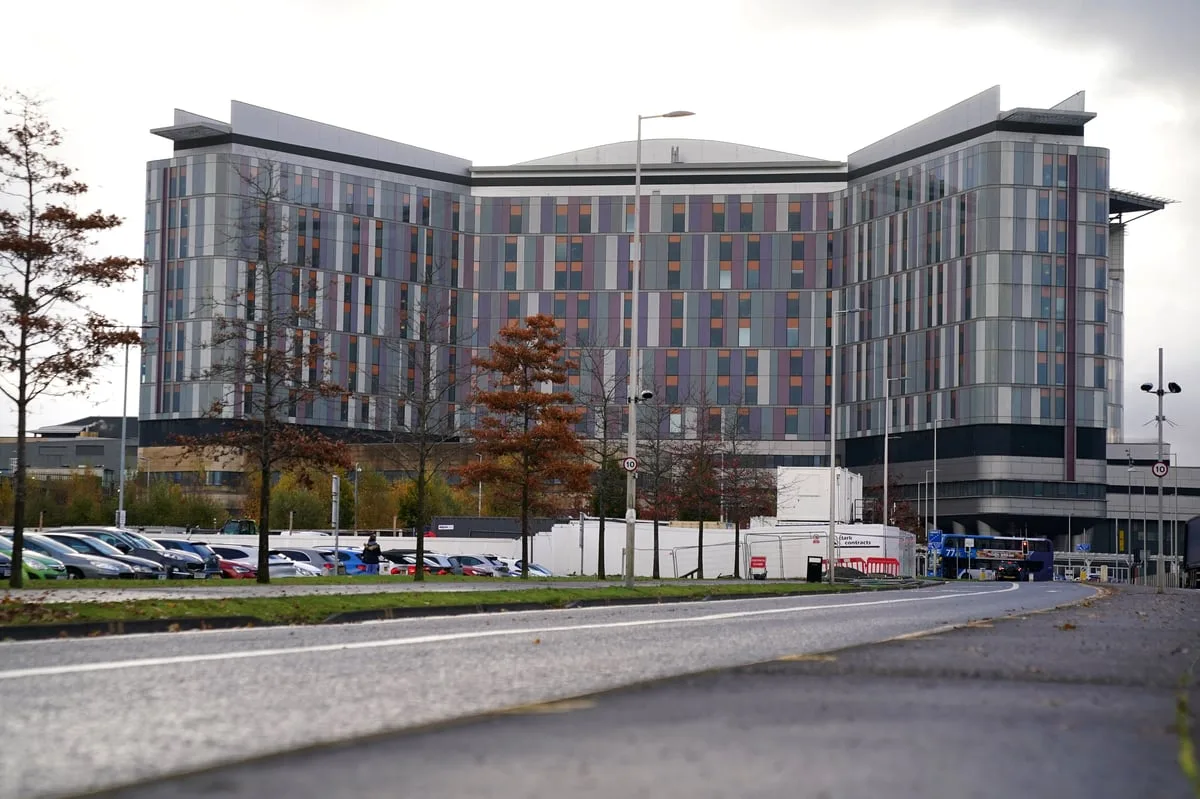
Sarwar's Holyrood Bombshell: Scottish Government Notes Reveal 'Political Pressure' on Hospital Opening
Sarwar's Holyrood Bombshell Reveals Hospital 'Political Pressure'

While the Scottish Parliament at Holyrood has often been criticised for lacking the theatrical rhetoric, philosophical duelling, and barristerial sharpness that once characterised Westminster's House of Commons as the gold standard of democratic debate, moments do occasionally pierce through what some describe as a miasma of mediocrity. These rare instances serve as beacons burning through the fog, reminding observers that this is, after all, a parliament designed for robust scrutiny. This week, Scottish Labour leader Anas Sarwar stepped out of the political murk with a torch in hand, delivering a performance that could have set fire to ice.

A Dramatic Confrontation Over Hospital Safety

Following last week's display of righteous rage over the Glasgow hospital deaths scandal, Sarwar adopted a cooler, more calculated temper for this week's First Minister's Questions. He began by skilfully luring First Minister John Swinney into an exchange concerning whether political pressure had influenced the premature opening of the Queen Elizabeth University Hospital (QEUH). This move set the stage for a dramatic parliamentary confrontation.

Swinney, relying on a well-worn defence, read from a statement by counsel to the Lord Brodie inquiry, asserting: 'There is no evidence of external pressure on NHS Greater Glasgow and Clyde to open the hospital early or before it was ready to be opened.' As the First Minister sat down, seemingly confident, Sarwar rose with a chilling warning: 'John Swinney is about to regret saying that.'

The Bombshell Document

A sudden, palpable quiet fell across the chamber. Sarwar, maintaining an impeccable poker face, noted the Scottish Government's notorious care 'to avoid putting things in writing so there is no paper trail.' As brows furrowed and MSPs shifted uneasily in their seats, the Labour leader produced a clutch of papers with a theatrical flourish.

'I have in my hand official Scottish Government meeting notes,' Sarwar declared, a line that likely caused panic in the corridors of St Andrew's House. The notes, penned by a government official, detailed a series of meetings between the Scottish Government and NHS Greater Glasgow and Clyde in December 2019 and January 2020.

Contained within was the killer line that directly contradicted the First Minister's testimony: 'Political pressure was also being felt and no consideration was given to delaying the opening of the hospital despite the issues being faced with completion and operation.' The revelation landed with the force of a political earthquake.

Sarwar's Relentless Pursuit of Truth

With his prey already mortally wounded by the documentary evidence, Sarwar moved in for the final blow. He demanded the First Minister explain why NHS officials felt under political pressure to rush the opening of a hospital where building defects have since been linked to multiple patient deaths – adding the pointed question: 'or would he rather answer in the presence of his lawyer?'

Some might consider this approach overkill, but Sarwar has spent years fighting for answers about the hospital scandal, often being treated dismissively. He has earned, through persistent campaigning, what he might call 'a spot of blood on his knuckles.' His accusation was stark: 'Politics was put before patient safety. Was it worth it?' He declared there had been 'a decade of lies, deceit, and cover-up' where children, and possibly adults, had died.

Swinney's Robotic Response

John Swinney's response proved telling in its inadequacy. Faced with incontrovertible evidence, he simply repeated his previous statement verbatim, including the counsel's assertion about no external pressure. The First Minister displayed what critics might describe as the spontaneity of a spreadsheet – an automaton programmed for every eventuality who, when called to think independently, reverts to a pre-loaded script.

Like a frustrated dad dealing with faulty technology, Sarwar dealt a few metaphorical dunts to his opponent, declaring the First Minister had been 'found out.' After FMQs, Swinney was rolled out again to brief reporters, insisting the Sarwar memo contained nothing new and was already a matter of record – a claim that seemed to highlight his administration's defensive posture rather than address the substance of the allegation.

This parliamentary showdown represents another significant victory for Anas Sarwar's forensic approach to opposition politics. The question remains whether such dramatic revelations will bring him any closer to uncovering the full truth about the hospital tragedy – or indeed, to the doors of Bute House itself.




