

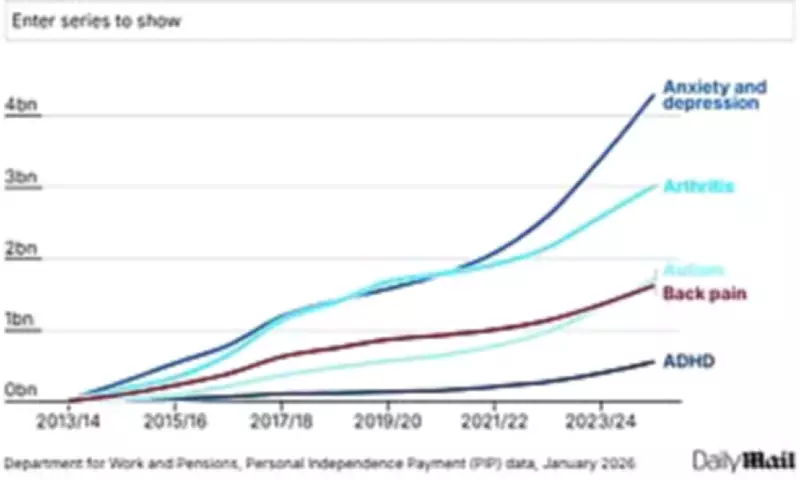
The staggering scale of Britain's benefits expansion has been exposed through newly released government data, revealing enormous sums being allocated to support individuals with conditions including anxiety disorders and chronic back pain.
Projected Costs Reveal Alarming Trajectory
Official projections paint a concerning financial picture, with the annual expenditure on Personal Independence Payment (PIP) expected to surge dramatically. When Labour assumed office, the PIP bill stood at £25.9 billion, but current forecasts indicate this will escalate to an astonishing £44.9 billion by the conclusion of this decade.
This represents a substantial increase from the £13.7 billion cost recorded during the 2019-20 financial year. Government officials have expressed particular concern about the growing number of claimants with what they describe as 'low-level' health issues being supported through taxpayer funding.

Breakdown of Condition-Specific Spending
The Department for Work and Pensions, under the leadership of Pat McFadden, has quietly released a detailed analysis of PIP expenditure categorized by medical condition for the 2024-25 period. This marks the first occasion such granular data has been made publicly available.
The figures reveal several significant trends:
- Payments for anxiety and depression reached £4.3 billion during the year, representing a substantial increase from the £1.6 billion recorded in 2019-20
- Expenditure on ADHD and ADD conditions has risen dramatically from £137 million before the pandemic to £560 million
- Spending related to autism spectrum conditions has surged from £565 million to £1.72 billion
- Back pain claims have nearly doubled, increasing from £869 million to £1.63 billion over the same period
- Arthritis continues to represent one of the largest categories, rising from £1.68 billion to just over £3 billion
Political Response and Reform Efforts
The escalating costs have emerged against a backdrop of political tension regarding welfare reform. Keir Starmer has explicitly ruled out including any legislation to curb benefits in the upcoming King's Speech, reportedly due to concerns about potential rebellion from Members of Parliament.
This decision follows the embarrassing defeat of previous attempts to reduce welfare expenditure by approximately £5 billion. Labour veteran Stephen Timms has been commissioned to conduct a comprehensive review of the PIP system, though his findings are not expected until autumn, with the government clarifying that the review is not primarily focused on achieving financial savings.
Shadow Work and Pensions Secretary Helen Whately has been particularly vocal in her criticism, stating: 'This exposes a welfare system that has completely lost its bearings. Claims for low-level conditions that barely featured a decade ago now dominate the PIP caseload, and spending has spiralled as a result.'
Current Claim Trends and Government Response
New applications for PIP continue to rise at a significant pace, with current data indicating approximately 250 new claims for anxiety and depression being submitted daily. The overall number of new PIP claims now exceeds 1,000 per day.
A Government spokeswoman has defended their approach, stating: 'The rate of spending on PIP has slowed this year, and we are reforming the broken system we inherited. Our reforms will save the taxpayer around £2 billion by the end of the decade.'
The government has emphasized several initiatives aimed at addressing the situation, including increased implementation of face-to-face assessments designed to better evaluate claimant needs. They have also highlighted the Connect to Work programme, which aims to support approximately 300,000 individuals with health conditions or disabilities in securing employment.
Broader Economic Context
The Office for Budget Responsibility delivered a sobering assessment during the November Budget, warning that the total expenditure on sickness-related benefits is projected to reach £109 billion by 2030. This forecast comes alongside other significant fiscal developments, including the removal of the two-child benefit cap and the implementation of additional tax increases.

It is important to note that the released figures do not account for inflationary effects, meaning the real-terms increase in spending may be even more substantial than the nominal figures suggest. The government maintains that PIP expenditure has been increasing in real terms for several years, necessitating the current reform efforts.
As the debate continues, the fundamental question remains how to balance necessary support for individuals with genuine disabilities against the need for fiscal responsibility and sustainable welfare systems.





