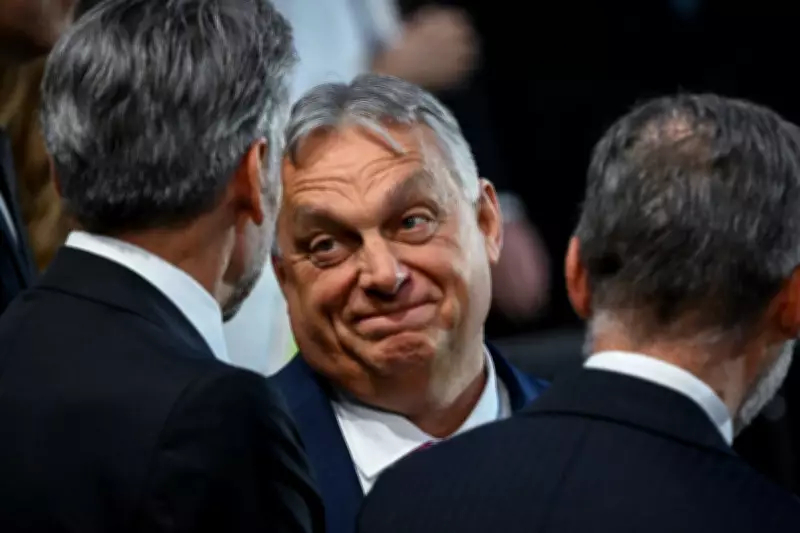
Hungary's Political Transformation: A New Dawn for European Unity and Ukrainian Aid
In a seismic political shift, Viktor Orban's 16-year tenure as Hungary's prime minister has concluded with a decisive election defeat. Péter Magyar's landslide victory marks not just a domestic transformation but a pivotal moment for European geopolitics, with Ukraine emerging as the most significant beneficiary.
The End of an Era and Its Continental Implications
As jubilant crowds celebrated across Budapest's Danube bridges, the implications extended far beyond Hungary's borders. Orban, often labelled "the dictator" in Brussels circles, had positioned himself as a disruptive force within the European Union, frequently aligning with the interests of Donald Trump and Vladimir Putin while maintaining formal EU and NATO membership.
This contradictory stance created what analysts describe as Hungary's identity crisis—attempting to balance alliances with both Western institutions and authoritarian regimes. Magyar's victory decisively resolves this tension, with the new government immediately signaling a return to Hungary's traditional role as a reliable European partner.

Ukraine's Critical Breakthrough
The most immediate consequence of Hungary's political realignment concerns Ukraine's defense against Russian aggression. For years, the European Union has maintained a substantial 90-billion-euro assistance package intended to support Ukraine's military efforts, soldier salaries, and economic stability. However, Orban's government repeatedly exercised its veto power, blocking this crucial financial lifeline.
With Orban's departure, this obstruction ends. The EU can now proceed with delivering meaningful support to Kyiv at what experts describe as a critical juncture in the conflict. This development comes as Ukraine continues its remarkable resistance against Russian invasion, demonstrating bravery and ingenuity despite persistent resource constraints.
The timing proves particularly significant given recent global economic pressures. Trump's foreign policy decisions regarding Iran have driven world oil and natural gas prices to unprecedented heights, inadvertently providing the Russian economy—and consequently Putin's war machine—with an unexpected financial boost. European assistance now becomes even more vital to counterbalance this advantage.
Magyar's Hungary: A New Direction
Contrary to some initial assumptions, Péter Magyar does not represent a radical departure from all conservative principles. The new prime minister maintains socially conservative positions, including resistance to accepting large numbers of refugees. However, he fundamentally diverges from his predecessor in recognizing that Hungary's future prosperity and security depend on rejecting Russian influence.
"Magyar understands there is no future for Hungary or Europe in becoming a Russian vassal state," notes one European diplomat. "He represents a more authentic Hungarian patriotism than Orban ever could—one rooted in national interest rather than ideological posturing."
This shift means Hungary will no longer serve as what critics called a "fifth column" for Putin within European institutions. The practice of Orban's government leaking classified EU and NATO discussions to the Kremlin has ended, restoring trust among Hungary's Western partners.
Broader European Lessons
Orban's political demise carries implications beyond Hungary. His failed attempt to simultaneously court Putin, Trump, and European institutions while depending on Chinese investment reveals the inherent contradictions of what some termed "Orbanism." This model—combining Christian nationalist populism with pragmatic economic dependencies—has proven unsustainable.
European analysts suggest this outcome serves as a cautionary tale for similar movements across the continent, including Germany's AfD, France's National Rally under Marine Le Pen, and various far-right groups inspired by Nigel Farage. The Hungarian experience demonstrates that shifting alliances based on questionable ideologies prove less durable than partnerships grounded in clear national interests and democratic cooperation.

As Hungarians echoed their 1956 anti-Soviet uprising with chants of "Russians, go home!" they reaffirmed their nation's commitment to European solidarity. This return to shared values strengthens the EU's foundational principle: that democratic nations achieve more through pooled sovereignty and mutual trust than through isolation or contradictory alliances.
With Hungary rejoining the European mainstream, the continent moves closer to unified support for Ukraine's defense and eventual reconstruction. As one Brussels official summarized: "Europe has regained a reliable partner, Ukraine has gained a crucial ally, and every European citizen benefits from a more cohesive union."