Government ministers in Ireland have mounted a robust defence of their actions regarding soaring energy costs and widespread fuel protests, as they prepare to face a critical no confidence motion in parliament on Tuesday. The political fallout from last week's disruptive demonstrations continues to reverberate, with ministers offering varying perspectives on the situation while commuters faced further delays on Monday morning.
Defending Government Action Amid Crisis
Ministers have staunchly defended the government's response to the energy crisis, which has been exacerbated by the ongoing conflict involving Iran and the subsequent closure of the Strait of Hormuz. Agriculture Minister Martin Heydon acknowledged the "frustration out there" among citizens, noting that people had been driven to protest due to "a really significant shock to their energy bills." He countered claims circulating on social media that the government "don't understand" and are "not listening," asserting that officials are "reacting in real-time" to the Middle East conflict.
Heydon made a clear distinction between legitimate protest and disruptive blockades, stating: "I absolutely, fundamentally respect and will passionately fight for people's right to protest and tell me they disagree with me, but when people block critical infrastructure, that is different."

Substantial Financial Package Announced
On Sunday evening, the government unveiled a substantial €505 million package aimed at assisting fuel-dependent workers affected by the dramatic rise in fuel costs. This comes in addition to €250 million worth of measures announced nearly three weeks earlier, bringing the total intervention to approximately three-quarters of a billion euros.
Foreign Affairs and Defence Minister Helen McEntee emphasized that Ireland's response has been among the most significant in Europe, stating the package represents "the highest per capita in Europe." However, both Social Protection Minister Dara Calleary and Minister Heydon cautioned that such substantial financial intervention would inevitably impact the government's budget planning for October.
"We have to be very honest with people, that an intervention of three-quarters-of-a-billion euro is not without its consequences in terms of future decisions," Heydon explained during an interview with RTE Radio.
Ongoing Disruption and Police Response
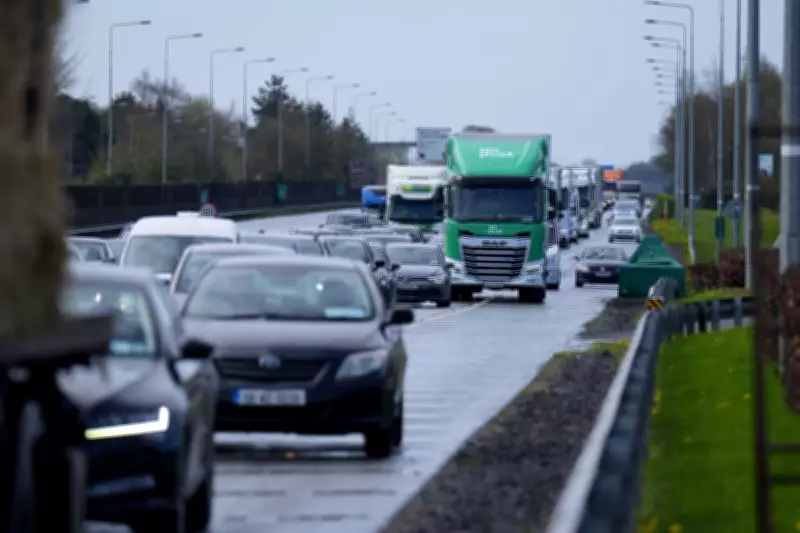
Despite the announcement of financial measures and the clearance of blockades at fuel depots and Ireland's only oil refinery over the weekend, disruption persisted into Monday. Slow-moving convoys continued to affect major motorways including the M50 southbound, the M1 southbound in County Louth, and the M9 at Athy in County Kildare. Some forecourts remained without fuel, with industry representatives warning that normal supply would take several days to restore.
Garda Commissioner Justin Kelly issued a message thanking police officers for dismantling "illegal blockades which were interfering with access to our critical national infrastructure." He strongly condemned "attempts in person and online to threaten and intimidate gardai who are engaged in their lawful work."
Internal Government Tensions Surface
Minister McEntee revealed that "things at a senior level can be improved" when questioned about whether Justice Minister Jim O'Callaghan had informed her that police would be requesting military assistance to remove blockades. This move reportedly angered many involved in the demonstrations.
Meanwhile, Media Minister Patrick O'Donovan announced he would ask the media regulator to examine how broadcasters and news outlets reported on the protests. "We were in the middle of a national crisis and carte blanche was given to some people and obviously that then fed into a huge amount of legitimate concern," he told a local radio station in Limerick. The National Union of Journalists criticized this move as "sinister and deeply disturbing."
Protesters' Perspective and Political Fallout
The protests, largely led by hauliers, farmers, and agricultural workers, began with coordinated action on Tuesday featuring slow-moving convoys, outright stoppages on major motorways, and blockades of critical infrastructure. While most blockades had been disbanded by police by midday on Sunday, the movement's momentum continued.

John Dallon, a Kildare farmer and agriculture contractor who participated in the Dublin protest, expressed mixed feelings about the government's response. While welcoming measures on green diesel, he criticized the lack of action on kerosene. "This protest is out of my hands, it escalated to somewhat so big, and I don't know where it's going to end, but it's the government's fault," he told Newstalk radio.
Dallon added: "We achieved something small, but this is something way bigger now, and I have no control over it... It's gone to the stage that it seems like, looking out there, that the people of the island of Ireland have no confidence in this government anymore."
Opposition Prepares No Confidence Motion
The seventh day of disruption on Monday sets the stage for Tuesday's parliamentary showdown. The main opposition party Sinn Fein plans to table a no confidence motion criticizing the government for not reconvening the Dail last week and failing to engage directly with protesters. The motion also calls on the government to take the "maximum action necessary" to reduce fuel prices.
Sinn Fein finance spokesman Pearse Doherty dismissed the government's measures as "laughable," stating: "Again, they come up short, and that's why so many people are annoyed this morning. Indeed, the government made matters worse. They went from insulting people, to demeaning them, to threaten them with the army, to refuse to talk to people and try and resolve this."
People Before Profit's Richard Boyd Barrett described the upcoming vote as a "big test" for independents supporting the coalition government. As the political tension mounts, the government faces simultaneous challenges: addressing the immediate energy crisis, managing ongoing protests, and surviving a parliamentary test of confidence that could determine its future.