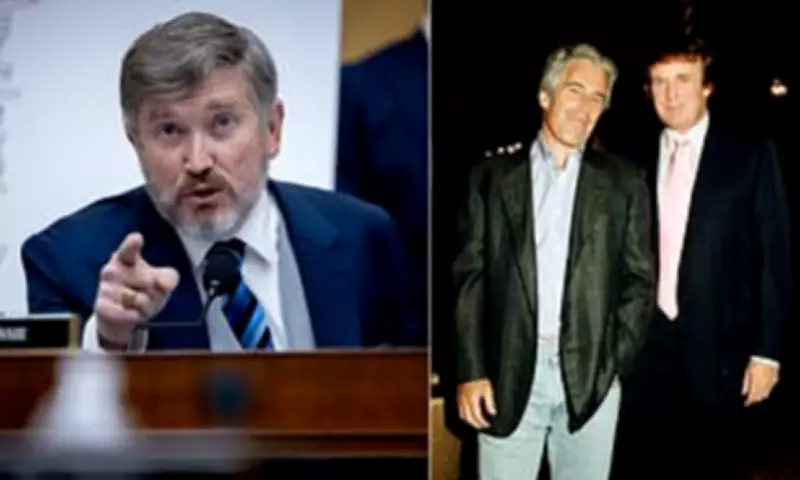
Republican Congressman Escalates Epstein Transparency Dispute
Republican Representative Thomas Massie has delivered a stunning political rebuke, publicly labeling Donald Trump's presidency as the "Epstein administration" during a nationally televised interview on ABC's This Week program. The Kentucky congressman launched this extraordinary attack while accusing Attorney General Pam Bondi of systematically failing to release all records connected to the deceased financier and convicted pedophile Jeffrey Epstein.
Transparency Promises Unfulfilled
Massie did not mince words during his Sunday morning appearance, directly accusing the Department of Justice of failing to deliver the transparency that President Trump had repeatedly promised regarding the Epstein investigation. "Donald Trump told us that even though he had dinner with these people in New York City and West Palm Beach, that he would be transparent, but he's not," Massie stated bluntly. "He's still in with the Epstein class. This is the Epstein administration."
The congressman's remarkable comments represent a dramatic escalation in what has become a bitter confrontation between conservative lawmakers and the Trump administration. This dispute centers on mounting frustration over perceived delays, excessive redactions, and access restrictions surrounding the Epstein files that Congress has demanded be made public.

Deepening Republican Fractures
The extraordinary public criticism from a sitting Republican congressman has laid bare a deepening fracture within the GOP regarding how to handle the politically sensitive Epstein investigation. What began as simmering discontent among some lawmakers has now transformed into a full-blown internal revolt, with Massie emerging as one of the Justice Department's most persistent and vocal critics.
Massie suggested during his interview that entrenched wealth and political influence were actively working against efforts to expose the complete truth about Epstein's network. "There are billionaires that are friends with these people, and that's what I'm up against in D.C.," the congressman revealed, highlighting what he perceives as systemic resistance to full disclosure.
Bipartisan Pressure and Legislative Action
The Kentucky Republican has helped lead a rare bipartisan discharge petition alongside Democratic Representative Ro Khanna that successfully forced the government to release its Epstein-related evidence. This legislative measure ultimately passed Congress and was signed into law by President Trump, but only after widespread pressure from lawmakers across the political spectrum.
Despite this legislative victory, Massie and other concerned lawmakers insist that crucial information remains inaccessible to both Congress and the public. "They took down some of the most significant documents, two of them involving Virginia Giuffre's case," Massie explained during his ABC interview. "We want to be able to look at all these files. They can't keep those documents down after they've already produced them."
Political Repercussions and Retaliation
Massie's rebellion has not come without significant political consequences. His opposition to Trump and his leadership role in forcing file releases have transformed him into a political target within his own party. President Trump has openly vowed to support a primary challenger against Massie, escalating their feud and signaling that loyalty on the Epstein issue has become a defining litmus test within Republican ranks.
When questioned by ABC News anchor Martha Raddatz about whether he maintains confidence in Attorney General Pam Bondi, Massie responded with characteristic bluntness: "I don't think Pam Bondi has confidence in Pam Bondi."
Justice Department Defense and Partisan Clashes
The Justice Department has consistently maintained that its investigation uncovered no criminal wrongdoing by powerful individuals beyond Epstein and his associate Ghislaine Maxwell, who remains imprisoned following her conviction. However, this official conclusion has done little to quell suspicions among lawmakers demanding full disclosure of all investigative materials.

During a particularly combative House Judiciary Committee hearing last week, Attorney General Bondi fiercely defended both President Trump and the Justice Department against a barrage of criticism from lawmakers. "You sit here and you attack the president and I'm not going to have it," Bondi told committee members. "I am not going to put up with it."
Bondi repeatedly clashed with Democratic representatives and Republican critics alike, accusing them of weaponizing the Epstein case for political gain while insisting her department had acted entirely appropriately. She confronted Massie directly during the hearing, accusing him of political opportunism and suggesting he was suffering from "Trump derangement syndrome."
Democratic Concerns About Redactions
Democratic Representative Jamie Raskin, who serves on the House Judiciary Committee, has joined Massie in criticizing the Justice Department's handling of the Epstein documents. Raskin blasted what he described as an unacceptable approach to redacting sensitive information. "We didn't want to see any redactions of the names of co-conspirators, accomplices, enablers, abusers, rapists, simply to spare them potential embarrassment, political sensitivity or disgrace of some kind," Raskin stated.
The Maryland Democrat emphasized that the released documents appeared "filled with redactions of names and information about people who clearly are not victims and may fall into that other category" of potential accomplices or enablers within Epstein's network.
Historical Context and Ongoing Scrutiny
While President Trump himself has not been accused of any wrongdoing in connection with Jeffrey Epstein, his past friendship with the financier and references to his name within investigative materials have fueled persistent political scrutiny and public debate. Photographs showing Trump and Epstein together at social events, including at Trump's Mar-a-Lago estate in Palm Beach during the late 1990s, continue to circulate and generate discussion.
Jeffrey Epstein was found dead in his Manhattan jail cell in 2019 while awaiting trial on federal child sex trafficking charges, with his death officially ruled a suicide by authorities. The subsequent investigation and document releases have created one of the most politically charged controversies of recent years, intersecting with issues of wealth, power, accountability, and transparency in government.
The recent Judiciary Committee hearing, marked by shouting matches, bitter exchanges, and mutual accusations, underscored how deeply the Epstein case has become entangled in partisan warfare. Attorney General Bondi has positioned herself as one of President Trump's most aggressive defenders, while lawmakers like Massie continue to demand what they describe as genuine transparency rather than carefully managed disclosures.