Secret Flight on Russian Oligarch's Jet Revealed
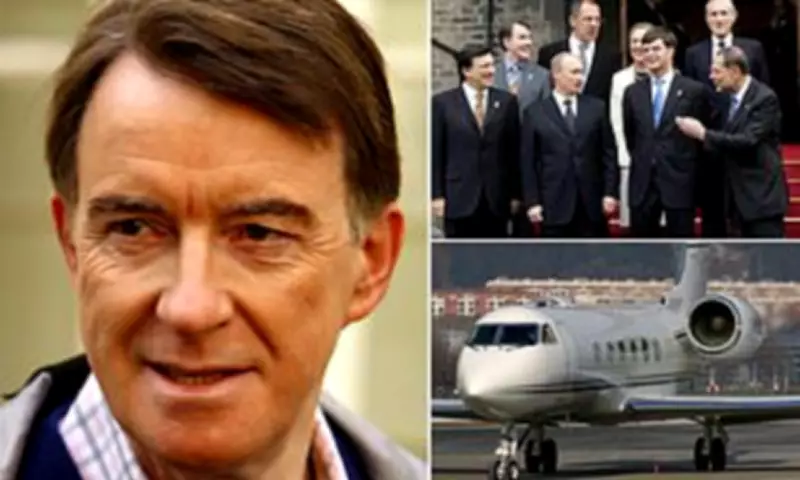
In the early hours of November 25, 2004, a Gulfstream IV executive jet touched down at Rotterdam Airport under cover of darkness. On board were three crew members and a solitary male passenger whose identity remained concealed for years. The Daily Mail can now exclusively reveal that passenger was Peter Mandelson, the former New Labour strategist and Cabinet minister who had just begun his new role as European Union trade commissioner.
The Mysterious Journey to The Hague
This clandestine flight occurred during Mandelson's first week in his prestigious Brussels position. Later that same day, Commissioner Mandelson would attend the crucial EU-Russia summit at the Binnenhof Palace in The Hague, where President Vladimir Putin was leading the Russian delegation. Trade discussions between East and West formed the central agenda, with aluminium tariffs expected to feature prominently.
The aircraft that transported Mandelson was registered in Bermuda with call sign VP-BNN and formed part of a fleet controlled by Oleg Deripaska, the metals oligarch who would soon be recognized as Russia's wealthiest individual. At his financial peak in 2008, Deripaska's assets reportedly reached $28 billion, though questions persisted about how he accumulated such fortune so rapidly.

Unexplained Urgency and Undeclared Travel
The flight's routing remains puzzling: the Gulfstream collected Mandelson from Brussels, brought him to England for several hours, then completed the final leg to The Hague. A flight crew member who has requested anonymity told the Daily Mail that Mandelson displayed unusual agitation at Luton Airport, arriving hours before his scheduled departure slot and demanding immediate takeoff.
"We had a slot time, but he turned up hours before that and demanded we go anyway, which we could not do," the crew member revealed. "There were a couple of female staff who handled hospitality for business jet passengers. I said: 'These charming ladies will look after you', yet Mandelson was quite ratty in return. Deripaska was always very genteel in comparison."
The crew member added insight into Mandelson's apparent urgency: "Of course we found out later what it was. Deripaska's business was aluminium and there was a discussion in The Hague about tax on the metal – and that is what Mandelson was so anxious to get to. I don't know how he would influence it himself, but he just wanted to be there without any delay."
Regulatory Oversight and Kremlin Connections
The European Commission has confirmed it possesses no record of this flight being declared by Mandelson, as regulations required. When questioned about such oversights, the flight crew member observed: "It's common in Russia for oligarchs to lend politicians their private jets. Naturally, they expect something in return."
While no direct evidence establishes an immediate quid pro quo, the EU's subsequent reduction in aluminium tariffs – discussed at that very Hague summit – substantially benefited the Russian economy and Deripaska specifically. The oligarch owned Rusal, the world's largest aluminium producer at the time.
Broader Context of Controversial Associations
This revelation forms part of a broader pattern concerning Mandelson's relationships with controversial figures. The former commissioner's connections to convicted paedophile Jeffrey Epstein have recently drawn significant attention, with Mandelson mentioned nearly 6,000 times in three million files released by the US Department of Justice.
Epstein files from November 2010 show email correspondence where Epstein sought Russian visa assistance through Mandelson's connections. Mandelson responded: "Ben can get visa thru OD. Needs scans of your passports." Investigators believe "Ben" refers to Benjamin Wegg-Prosser, co-founder of Mandelson's lobbying firm Global Counsel, while "OD" represents Oleg Deripaska.
Further emails revealed Mandelson writing: "OD office helping on visas. Told him he sd meet u and of course he wants to. He's travelling at moment." Wegg-Prosser resigned as Global Counsel's chief executive last week following these latest Epstein revelations.

Historical Precedents and Legal Battles
Public scrutiny of Mandelson-Deripaska relations intensified in October 2008 during the "Yachtgate" scandal, when Mandelson holidayed on Corfu while Deripaska's super-yacht was anchored nearby. Mandelson spent three nights aboard the vessel as a guest.
Earlier that year, in January 2005, Mandelson traveled on financier Nat Rothschild's private jet from Switzerland to Moscow for a dinner hosted by Deripaska. American aluminium company Alcoa executives attended to celebrate a £500 million deal with Deripaska's Rusal for two Russian plants. Since these plants exported metal into the EU, and tariffs fell under Mandelson's jurisdiction as trade commissioner, his presence raised serious conflict of interest questions.
During a 2012 libel trial brought by Rothschild against the Daily Mail, further details emerged about Mandelson's Russian travels. The court heard how Mandelson had a private, undeclared dinner with Russia's finance minister arranged by Deripaska, then flew 2,000 miles to Siberia on another Deripaska jet. There, he experienced traditional Russian banya treatments, stayed at the oligarch's dacha, and toured metal plants wearing Rusal-branded headwear.
Mr Justice Tugendhat ultimately ruled that Rothschild's evidence "had not been entirely candid" and that the trip "foreseeably brought Lord Mandelson's public office and personal integrity into disrepute and exposed him to accusations of conflict of interest... It gave rise to reasonable grounds to suspect that Lord Mandelson had engaged in improper discussions with Mr Deripaska about aluminium."
Intelligence Warnings and Ongoing Investigations
Reports emerged last week that MI6 received warnings from EU security services in 2008 about Moscow targeting Mandelson during his tenure as EU trade commissioner. Meanwhile, British police recently raided Mandelson's country house as part of an investigation into potential misconduct in public office.
The flight crew member who transported Mandelson in 2004 observed a pattern: "A lot of the flying we did with Deripaska seemed to be related to what Putin was doing. We would go somewhere and then a couple of days later Putin would arrive."
This investigation, spanning fifteen years across Russia, Bermuda, and Western Europe, now presents compelling evidence about the earliest occasions when Mandelson's actions raised serious questions regarding his proximity to Kremlin interests and Russian oligarchs.