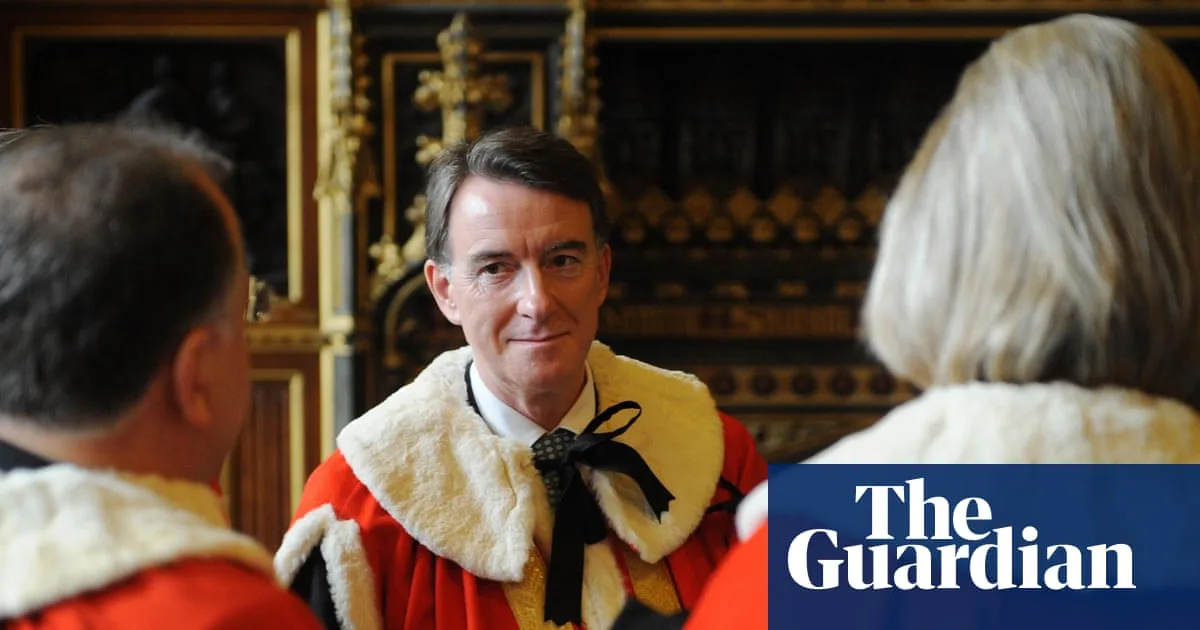
At precisely 2.50pm, the ceremonial axe fell in the most quintessentially British manner imaginable. Lord Forsyth, the newly appointed Speaker of the House of Lords, rose from the Woolsack, his dark robes and springy tufts of hair giving him the distinguished appearance of a freshly preened raven. 'Milords,' he intoned softly, 'given the considerable public interest and for the convenience of the House, I have decided to inform the House that the Clerk of the Parliaments has today received notification from the noble Lord, Lord Mandelson, of his intention to retire from the House.' For the convenience of the House, indeed! The irony was palpable.
A Sudden Departure Sends Shockwaves
Peers were to be formally notified that very day, 'in the normal way'. That normal way typically involves warm tributes and thanks for a departing lord's service. Yet the question hanging heavily in the ornate chamber was whether such courtesies would be extended to the man now widely regarded as Westminster's Public Enemy Number One. The political establishment could scarcely discuss anything else, with this tremendous scandal simultaneously galvanising and numbing the political class.
Radio Waves and Long-Held Grudges
For those with an appetite for political drama, Radio 4's Today programme set the morning's tone with an interview featuring Harriet Harman, a long-standing critic of Mandelson. He had once considered her intellectually lacking and advised Tony Blair against promoting her. When a pollster insisted focus groups liked Harman, Blair reportedly retorted: 'Refocus your focus groups.' Speaking with evident satisfaction to a slightly aloof Radio 4 presenter, Lady Harman declared she had found Lord Mandelson 'untrustworthy from the 1990s' and that he had 'cast a stain over politics'.
Cabinet Fury and Unparliamentary Language
The Cabinet convened mid-morning, and the Prime Minister faced a challenge if he wished to match Lady Harman's three-decade-long animosity towards Peter Mandelson. His press team consequently briefed journalists that he had spent much of the meeting fulminating against the former minister. He was described as 'appalled' by the 'disgrace' of it all, labelling the affair 'gobsmacking'. This is not a term one expects to find recorded in the formal minutes of Cabinet proceedings.
Commons Disquiet and Labour Unrest
In the House of Commons, the Scottish National Party's Kirsty Blackman revealed that Downing Street had sent the police 'unredacted correspondence' between Mandelson and the late financier Jeffrey Epstein. She demanded to know why Sir Keir Starmer was not making an official statement to the House. An air of greater disobedience seemed to permeate the Labour benches. During justice questions, Karl Turner, a longstanding opponent of jury-trial cuts, was more unbridled than usual. 'We used to be friends, David,' he cried at Justice Secretary David Lammy, gesticulating wildly and rolling his eyes towards the public galleries. Moments later, he shouted at Lammy's junior minister, Sarah Sackman, 'that's just not true'. Notably, no Labour backbencher rose to object to his conduct.
Farage's Pub Summit and Political Speculation
Meanwhile, Nigel Farage had organised an event at a Westminster pub to promote Reform UK's policies on the hospitality industry. However, interest in pubs was minimal; all anyone wanted to discuss was Mandelson. Mr Farage speculated that Sir Keir Starmer's leadership could soon be 'finito'. He pondered whether Lord Hermer, the Attorney General, would authorise a prosecution of Lord Mandelson and questioned if Labour backbenchers would demand the resignation of Sir Keir's chief strategist, Morgan McSweeney. 'If Mr McSweeney swung,' Farage suggested, 'you'll know Sir Keir won't last long afterwards.' Events, he implied, were moving with remarkable speed.
Under the glare of television lights, Mr Farage's polished black shoes gleamed. He bulged his eyes in mock astonishment at the unfolding drama, a touch of his old mischievous spirit returning. He spoke without warmth about the Royal Family, grumbled that he, not Mandelson, should have been appointed ambassador to the United States, and declared loudly: 'I can't be bribed. I can't be bullied.' He clearly scents a significant political opportunity in the chaos.
A Contrasting Arrival in the Lords
Back in the House of Lords, a starkly different scene unfolded as they welcomed another former MP: Sarah Teather, the diminutive former Liberal Democrat minister from the Coalition era. One wonders how the robe-makers managed to fashion ermine robes to fit her 4ft 10in frame. During the elaborate introduction ceremony, a bewigged clerk read the royal writ with the faintest hint of disbelief, proclaiming her as 'Baroness Teather of Boughton in our county of Leicestershire'. She was granted the right to 'enjoy and use the rights, privileges, pre-eminences, immunities and advantages to the degree of a baron duly and of right belonging' for life.
That is, of course, unless she, like the departing Lord Mandelson, should ever step on a political landmine.