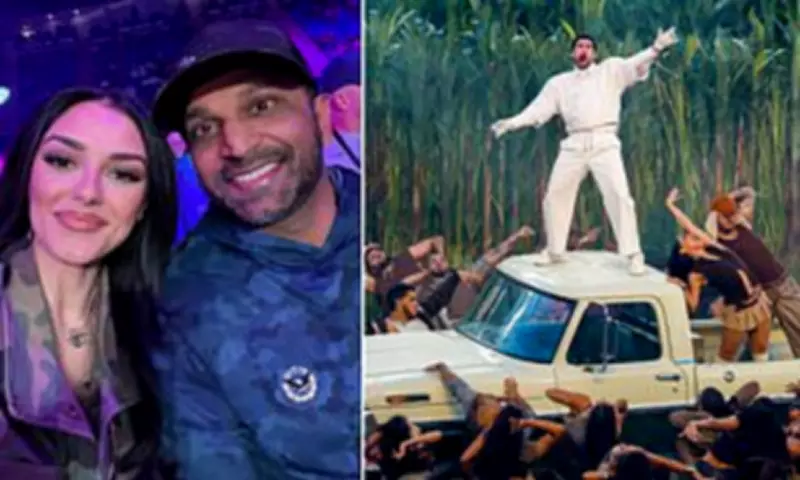
Alexis Wilkins, the 27-year-old girlfriend of former Trump administration official Kash Patel, has ignited a significant backlash within the MAGA movement after publicly praising aspects of Bad Bunny's controversial Super Bowl halftime performance. The incident highlights deepening internal divisions over cultural messaging and political branding among conservatives.
Social Media Praise Sparks Immediate Conservative Fury
Wilkins, who has been dating the 45-year-old Patel since 2023, responded on Sunday night to a Democratic Party post on X featuring the Puerto Rican rapper Bad Bunny with stars and stripes branding labelled 'All-American Halftime'. In her now-deleted post, Wilkins wrote: 'Unpopular: Republicans need to unite and get on better messaging because this branding is fantastic and allows all dems to get behind it.' She added the brief comment: 'Also - super aesthetic.'
This endorsement directly contradicted the prevailing conservative narrative surrounding the halftime show, which saw millions of Republican viewers instead tuning into Turning Point USA's alternative 'All American Halftime Show' featuring Kid Rock and a tribute to the organization's late founder Charlie Kirk.

Trump's Scathing Critique Contrasts Sharply
Former President Donald Trump had already established the MAGA position on the performance, branding it the 'worst show ever' in social media posts. On his Truth Social platform, Trump elaborated with characteristic bluntness, calling the show 'absolutely terrible' and 'one of the worst, EVER!'
'It makes no sense, is an affront to the Greatness of America, and doesn't represent our standards of Success, Creativity, or Excellence,' Trump wrote. He further criticized the performance as inappropriate for young viewers, stating: 'Nobody understands a word this guy is saying, and the dancing is disgusting, especially for young children that are watching from throughout the U.S.A., and all over the World.' Trump concluded by declaring the performance a deliberate 'slap in the face' to his administration and its values.
Wilkins Attempts Damage Control After Criticism
Facing immediate online fury from Trump supporters, Wilkins attempted to walk back her initial comments with a lengthy clarification. 'I didn't watch Bad Bunny's performance at all. My point wasn't the show,' she wrote in a follow-up post. 'My point was that we can't give the left an inch of the ground we gained in the last election.'
She elaborated on her strategic concerns, warning that Democrats were 'clearly going to cosplay as people who 'love America' and our constitution to pick up moderates and youth votes.' Wilkins, a U.S. citizen of Armenian descent, emphasized the need for conservative unity, stating: 'We have to be mindful to unite as the right (clearly this is not our strong suit) and recognize that Dems in office is worse than anything the right could ever produce in office.'
Analyzing the Political Optics of Performance
In her attempted clarification, Wilkins framed her original comments as purely analytical regarding political messaging rather than artistic appreciation. 'I'm looking at optics and I see the left performing as a wolf in sheep's clothing,' she explained. 'We all thought Bad Bunny was going to come out in a dress that said ICE OUT - but he didn't. This would've all been easier to message if he did. They're pulling the unity trope and we can't let them have it.'
This incident underscores the intense scrutiny conservative figures face regarding cultural commentary and the challenges of maintaining messaging discipline within the MAGA movement. The controversy also reveals how seemingly apolitical entertainment events like the Super Bowl halftime show have become significant political battlegrounds in America's ongoing culture wars.
Bad Bunny, whose real name is Benito Antonio Martinez Ocasio, headlined the official halftime show in Santa Clara, California, performing to a global audience of millions. The divergent reactions to his performance between Wilkins and mainstream conservative voices illustrate the complex intersection of entertainment, politics, and identity in contemporary American discourse.