White House Press Secretary's Composure Frays During Contentious Iran Briefing
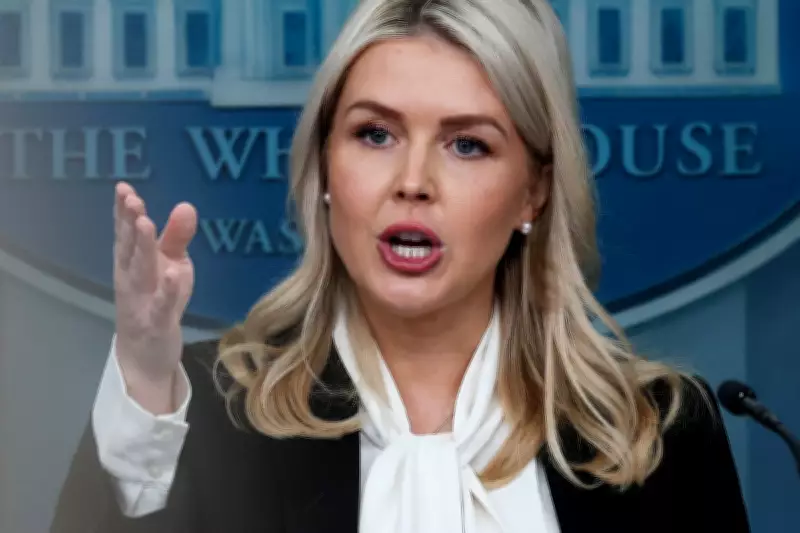
In a striking departure from her usual polished demeanour, White House Press Secretary Karoline Leavitt appeared visibly flustered during a press conference addressing the escalating conflict with Iran. The briefing, held on Wednesday 4th March 2026, revealed cracks in the administration's typically seamless messaging apparatus.
A Departure from the Usual Script
Leavitt, renowned as one of the Trump administration's smoothest and most dependable operators, opened with characteristic stridency. She delivered a rapid-fire historical indictment of Iran, asserting the regime was "paying for their crimes against America and they are paying in blood." The initial presentation followed a familiar pattern, praising President Trump as a "man of action" while criticising predecessors Barack Obama and Joe Biden as "weak and ineffective."
However, the press secretary's trademark precision began to waver as questioning commenced. Leavitt made uncharacteristic awkward pauses, stopped to reword sentences, and eventually let her frustration show. This marked a significant shift for an official known for her buttoned-up delivery and ruthless adherence to scripted talking points.

The Mask Slips Under Press Scrutiny
The briefing's most revealing moment occurred when CNN's Kaitlan Collins asked about the six American service members killed in the Middle East. Leavitt's response turned confrontational. "Listen to me — especially you!" she snapped, accusing the press of taking "every single thing this administration says and tries to use it to make the president look bad. That is an objective fact!"
This outburst contrasted sharply with her usual controlled persona. Observers noted that yelling instructions to "listen to me" projected defensiveness rather than the strength the administration typically aims to convey. The episode suggested significant pressures operating behind the scenes.
Challenging Questions and Evasive Answers
Leavitt faced particularly difficult questions regarding the conflict's justification and consequences. When asked about potential Israeli intelligence sharing regarding Ayatollah Khamenei's location, she acknowledged it might have affected strike "timing" but insisted President Trump acted on a "good feeling" that Iran might strike first—a claim presented without supporting evidence.
Two critical questions received notably indirect responses. Regarding spiking oil prices, Leavitt suggested costs "should probably become cheaper now Iran isn't controlling the Strait of Hormuz." On the issue of regime change in Iran, she stated there was "no plan" but that Trump was "actively considering" and "discussing" the matter with advisers.
The Growing Burden of Selling an Expanding Conflict
The briefing highlighted the immense challenge facing Leavitt and the administration: convincing the American public that an unmistakably expanding war remains "limited, controlled, and, above all, necessary." This task grows increasingly difficult amid voter concerns about affordability, with foreign policy ratings declining even among the administration's own supporters.
Leavitt must navigate questions about economic impacts, casualties, and strategic objectives while maintaining the administration's preferred narrative. The evacuation of Americans from the Middle East, with the administration "rapidly chartering flights free of charge," was presented as evidence of competence rather than acknowledgement of a rapidly deteriorating situation.
When questioned about the Iranian people's fate, Leavitt responded with a smile that their future "rests in their hands," effectively distancing the administration from responsibility for the conflict's humanitarian consequences. The overall performance left observers questioning whether the administration's messaging can withstand the mounting pressures of an increasingly complex and unpopular military engagement.