

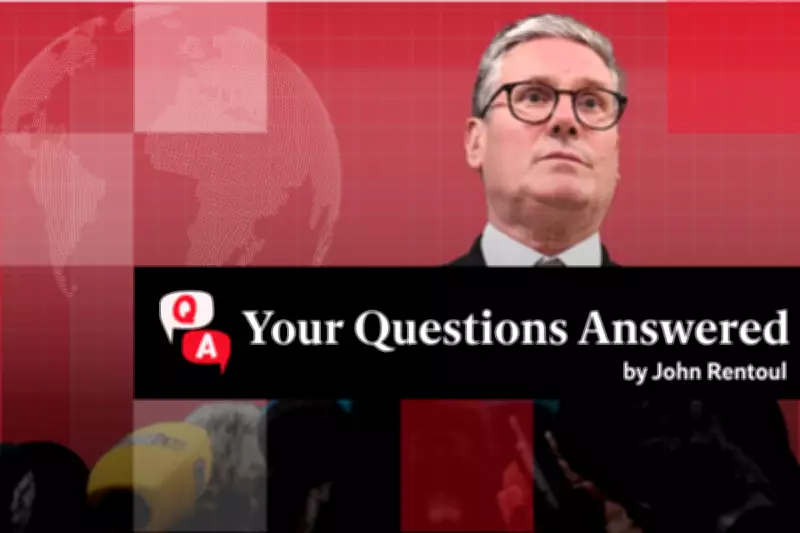
In a revealing question and answer session with Independent readers, chief political commentator John Rentoul has provided a stark analysis of the Labour Party's deepening internal crisis. He argues that the turmoil under Sir Keir Starmer's leadership reflects a fundamental crisis of discipline and strategic direction that risks ceding political momentum to Nigel Farage's Reform party.
The Scale of Labour's Disarray
Despite commanding a Commons majority nearly as substantial as Tony Blair's historic win, and with a government still in its early stages, Labour finds itself embroiled in near-constant internal conflict. This level of discord has not been witnessed on such a scale since the fractious 1970s. Too many Labour MPs appear more preoccupied with internal battles than with governing effectively or confronting the political challenge posed by Nigel Farage.
The immediate flashpoint is the contentious row surrounding Andy Burnham. A letter signed by fifty Labour MPs demanding that Starmer reverse his decision to block Burnham's return to the Commons has highlighted a profound malaise within the party. While the protest was never likely to succeed, it has exposed deeper structural weaknesses.

Roots of the Paralysis
Rentoul traces this malaise back to Starmer's leadership campaign following the disastrous 2019 general election. To secure victory, Starmer felt compelled to align himself with Corbynism, a strategic move that later made it exceptionally difficult to argue against its principles. The consequence was a period of paralysis in opposition, inadequate preparation for government, and a relentless cycle of rebellions and policy U-turns once in power.
Policy confusion on critical issues from welfare reform to migration and the post-Brexit landscape has only intensified the perception of a government adrift. However, Rentoul contends that Starmer himself is not the core problem. The fundamental issue lies in delivery. Unless the Labour government can demonstrate tangible progress on fixing the NHS, raising living standards, and controlling immigration, Nigel Farage will continue to gain political ground, regardless of who leads the party.
Key Questions from Readers
Is Labour Now an Unruly Party?
Responding to a reader's analogy of a school in special measures, Rentoul acknowledged the comparison. He emphasised that effective leadership requires clarity of purpose, constant communication, visibility, and accountability. Managing the tension between leading from the front and listening to colleagues is the true test of a leader—a test Rentoul fears Starmer has not passed well, citing a tendency for unfocused media appearances and being unduly influenced by backbench pressure.
The Farage Threat and Leadership
On whether replacing Starmer is necessary to counter Farage, Rentoul was clear: "I do not think Keir Starmer is the problem." The solution, he argues, is not a change at the top but demonstrable action on the public's priorities: stopping small boat crossings, improving the NHS, and boosting living standards. While figures like Wes Streeting or Shabana Mahmood might be superior communicators, without solving these foundational issues, Farage's appeal will remain potent.
Andy Burnham's Balancing Act
Addressing Andy Burnham's predicament, Rentoul suggested the Mayor of Greater Manchester has complicated his position by publicly criticising the party's treatment of him. Burnham should have anticipated Starmer's veto and accepted the decision gracefully. His challenge now is to vigorously support the party and its leader while subtly positioning himself as a potential future leader—a difficult act that his supporters may be misreading based on superficial polling data.
Policy Reversals and Rhetoric
Readers questioned the damaging gap between Labour's rhetoric and reality, particularly on Brexit. Rentoul agreed that Starmer has a tendency towards "over-emphasis and absolutism." On Brexit, he noted that while many Leave voters acknowledge shortcomings, there is little appetite to re-open negotiations—a sentiment shared by the EU.

The fine line between a U-turn and 'listening' was also explored, using the example of winter fuel payments. The problem, Rentoul suggested, was not the policy adjustment itself, but the contradictory justifications offered by Chancellor Rachel Reeves, which undermined government credibility.
Other Personalities and Prospects
On the prospect of a female leader like Angela Rayner, Rentoul praised her as a "great politician" but noted her limited ministerial achievements and lack of broad public popularity, which he attributes more to class prejudice than sexism. He was sceptical that she, Andy Burnham, or Louise Haigh present an obvious solution to Labour's deeper issues.
Regarding Ed Miliband, Rentoul distanced himself from the 'right-wing press' but was critical of Miliband's energy policy and fiscal approach, stating he would not make a good Chancellor due to a perceived inclination towards increased borrowing and spending.
These insights were drawn from an 'Ask Me Anything' session hosted by John Rentoul. The questions and answers have been edited for clarity and conciseness, offering a compelling snapshot of the profound challenges facing the Labour Party as it seeks to govern amidst internal strife and external threats.





