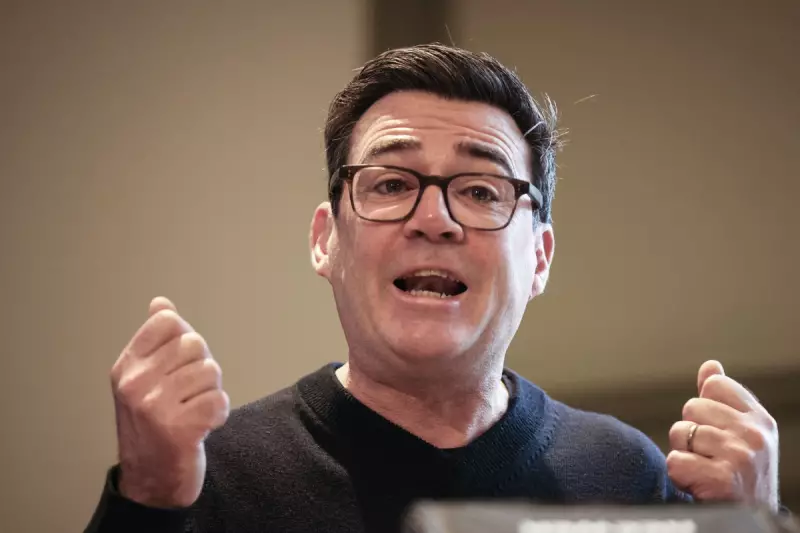
Labour's promise of change appears to be crumbling as the party tears itself apart in a dramatic internal confrontation. Fifty Labour MPs have demanded that Prime Minister Keir Starmer reverse his decision to block Andy Burnham from standing in the Gorton and Denton by-election, raising serious questions about party discipline and leadership authority.
The Burnham Blockade: A Calculated Political Move
This represents one U-turn that Starmer will categorically not be making. Despite the round-robin letter drafted by Clive Lewis and signed by fifty parliamentarians, the prime minister's position remains firm. The decision to keep his most dangerous leadership rival out of Westminster was not merely an act of ruthless self-preservation but, according to government insiders, squarely in the Labour Party's broader interests.
When Andrew Gwynne stood down as MP, Labour faced a stark strategic dilemma: potentially lose the parliamentary by-election or risk sacrificing the Greater Manchester mayoralty. Neither outcome was guaranteed, but both possibilities were sufficiently likely to make the rational choice clear. By blocking Burnham's candidacy, Labour could maintain control of the vital northern mayoral position while accepting the probable loss of a Commons seat.

A Pointless Protest with Serious Implications
The protest letter, while unlikely to change Starmer's mind, reveals significant fractures within the parliamentary party. In previous eras, the vast majority of Labour MPs would have automatically refrained from adding their names to such obviously futile challenges against the leadership. That fifty have now done so signals a dangerous erosion of traditional party discipline.
Burnham's popularity in the region and his reputation as an anti-Starmer figure might well have secured the by-election seat, but at what cost? The likely price would have been losing Greater Manchester to Reform, a devastating blow to Labour's northern strongholds. The blocking of Burnham may appear as cynical machine politics, but it represents a calculated strategic decision that will not be reversed by backbench complaints or by Burnham's own accusations about broken commitments.
The Unruliest Parliamentary Party in Labour History
This government has been fundamentally different from previous Labour administrations. Despite commanding a majority almost as dominant as Tony Blair's, Starmer has repeatedly bowed to the threat of Labour MPs voting against him. While he has mostly avoided the humiliation of losing Commons votes, this has come at the price of U-turning on policy after policy before votes are even held.
Today's reversal concerns business rates for pubs, following last year's damaging abandonment of cuts to disability benefits. Taken together, these retreats point toward higher public spending and increased taxation, undermining the government's economic credibility. The parliamentary party has become arguably the most unruly in Labour's history, with rebellions now commonplace rather than rare exceptions.
Leadership Calculations and Future Challenges
Starmer may have bought himself temporary breathing space by keeping Burnham at bay, potentially enough to leave the country without fearing an immediate leadership coup. MPs on the party's right insist that fifty signatories represents a manageable number, noting that roughly half belong to the Socialist Campaign Group, which opposes the leadership consistently except during Jeremy Corbyn's tenure.
However, fifty is not far from eighty-one - the number needed to nominate a rival candidate publicly and force a leadership election. Angela Rayner, the most likely recipient of such nominations, recently told a fundraiser: "We need to be unapologetically Labour." Her subtext was unmistakable, reminding Burnham's supporters that someone shares their politics while actually being eligible to run for leadership.
This kind of internal conflict represents more than mere political theatre. While not the root cause of the Labour government's problems, such self-indulgent infighting makes solutions far harder to achieve. With a country to govern and Nigel Farage's Reform party to worry about, Labour appears more interested in fighting itself than confronting external challenges.

A party unable to restrain its own self-destructive tendencies - and increasingly resembling the later years of the last Conservative government with its incessant leadership plotting - finds itself poorly positioned to see off external threats. The Burnham blockade may have provided temporary relief, but the underlying unruliness of Labour MPs continues to destabilise Starmer's authority and the government's effectiveness.