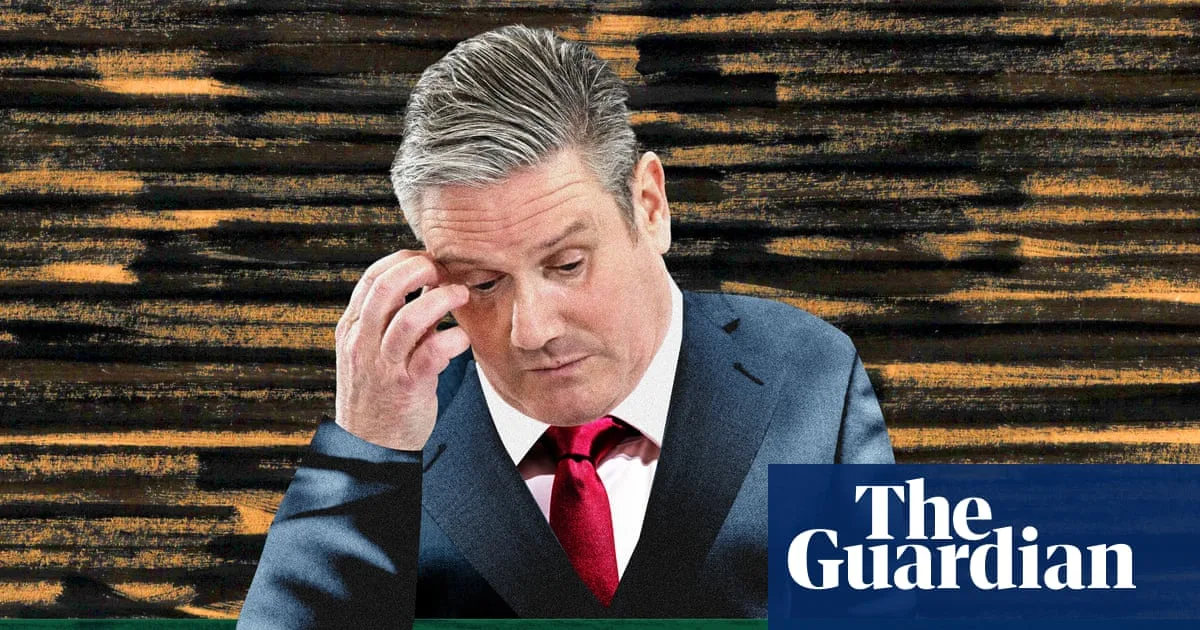
Labour Minimalism's Failure: Starmer's Crisis and the End of Small Politics
Labour Minimalism's Failure: Starmer's Crisis Explained

The Slow Implosion of Keir Starmer's Government Repudiates Labour Minimalism

The gradual unraveling of Keir Starmer's administration stands as the ultimate rejection of what has been termed 'Labour minimalism'. This dominant tradition within the party, long focused on appeasing powerful interests, is proving ill-suited to the demands of contemporary political landscapes.

A Century of Internal Conflict

Labour has always been a complex political entity, striving for over a hundred years to reconcile warring traditions, philosophies, and factions. Internal disputes have not merely stemmed from personal rivalries but from profound disagreements about how—and to what extent—to challenge Britain's deeply entrenched structures of power and wealth.

The current crisis, while directly linked to Keir Starmer's political missteps and the selective morality of figures like Peter Mandelson, fundamentally results from this minimalist tradition failing to address today's societal needs.

The Rise of Labour Minimalism

Labour minimalists operate on the belief that England is inherently conservative and right-leaning. They argue that electoral success and effective governance require the party to appear moderate and non-threatening to powerful interests. In 1985, Mandelson commissioned a report by political analyst Philip Gould, which concluded that negative perceptions of Labour, particularly regarding 'beyond the pale' figures, outweighed positive ones.

This led to a strategy of paring back provocative leftwing MPs, bold policies, and fierce rhetoric to reposition Labour on the centre ground. Under leaders from Neil Kinnock to Tony Blair, Gordon Brown, and Keir Starmer, minimalism became the party's guiding principle, emphasising discipline, self-denial, and risk aversion.

Radical leaders like Jeremy Corbyn and Ed Miliband were dismissed as naive and targeted in media briefings, while the party hierarchy filled with micromanagers focused on avoiding negative coverage.

Hypocrisy and Recklessness

Despite this caution, Labour minimalists did not always apply their rules to themselves, as seen in Mandelson's dealings with Jeffrey Epstein and the party's often careless interactions with the wealthy. This hypocrisy revealed a paradox: excessive caution bred recklessness.

A key trait of minimalism has been acceptance of the social status quo, including extreme wealth. Mandelson's 1998 statement about being 'intensely relaxed' about people getting 'filthy rich' as long as they pay taxes epitomised this approach. Labour governments have kept taxes on the rich low by European standards while praising them as wealth creators.

The party has also deferred to right-leaning voters, from homeowners in the home counties to socially conservative white men in the 'red wall', rarely challenging their views or interests. In return, minimalist politicians like Mandelson gained access to elite circles, with mixed outcomes.

Electoral Success and Its Limits

This conciliatory strategy helped Labour secure huge Commons majorities in 1997, 2001, and 2024, outperforming the Tories. The 2024 victory seemed like minimalism's peak, with a purged candidate list, a prime minister shedding radical commitments, and a modest total vote concentrated for maximum effect.

However, since taking office, Labour has faced a political landscape that has moved on. Populism, with its huge promises and extravagant rhetoric, contrasts sharply with minimalism. Reform UK's growing support and widespread public fears driven by economic, technological, and environmental upheavals highlight this shift.

The era of gradual, understated reforms that worked under Blair feels distant. Many Britons express anger and engagement through protests and online activity, indicating that politics has regained importance in an inflamed atmosphere where Labour's shrunken approach fails to resonate.

A Shift Towards Boldness

Interestingly, Starmer's more popular policies, such as improving workers' rights and rolling out clean energy, are expansive rather than minimalist. These appeal not only to green activists and trade unions but also to a broader audience seeking larger-scale solutions in times of crisis.

Across Labour, there is growing agreement that the government should be bolder, more inclusive, and truer to egalitarian values. Minimalist politics, practised effectively and then disastrously by figures like Mandelson, appears to be out—at least for now.

Starmer has sounded less constrained publicly since his political near-death experience. Potential successors like Angela Rayner and Andy Burnham offer sweeping critiques, while even Wes Streeting, favoured by control freaks, has spoken out on issues beyond his brief, such as the far right and Gaza.

The Future of Labour Politics

Labour has belatedly recognised that the era of small politics is over. To avert a potential disaster—Britain's first government of the populist hard right—the party will likely need to form alliances and compromises with others. In politics, as in life, seeking excessive control can ultimately lead to losing it.




