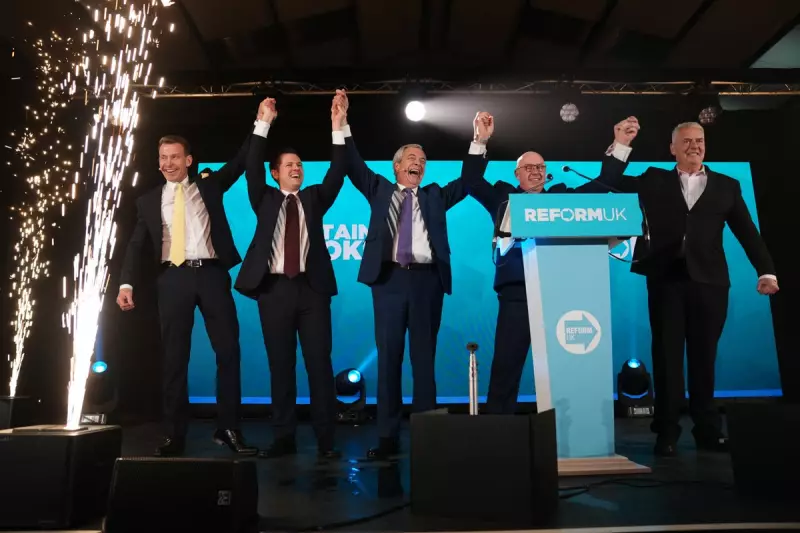
Robert Jenrick, the former Conservative minister who recently defected to Reform UK, experienced a moment of political theatre during his first major constituency address under his new party banner. The event, upgraded to a full-scale rally in Newark, was briefly interrupted by a lone protester whose shouted remarks were largely incomprehensible to both the MP and the assembled crowd.
A Rally Interrupted by Unclear Protest
As Jenrick took to the stage before hundreds of supporters in a large hall equipped with big screens and teleprompters, a man began shouting. The MP, unable to discern the specific content of the outburst, responded with a polite "Good to see you, my friend" as security personnel escorted the protester away. Subsequent reports from the Daily Mirror revealed the man was yelling: "David Davis supports Lucy Letby." This cryptic statement referenced the Conservative MP's campaign to re-examine the conviction of nurse Lucy Letby for murdering infants, though the precise point the protester intended to make remained obscure.
The Audience Reaction and Social Media Confusion
The disruption prompted boos from many in the audience, directed at the protester rather than Jenrick himself. This led to some initial confusion on social media platforms, where brief reports suggested the MP was being booed—a scenario that would have carried greater political significance. In the hierarchy of public dissent, being booed by a general assembly represents a notable step up from isolated heckling, indicating a broader level of discontent. Such moments have recently occurred for figures like London Mayor Sadiq Khan, who faced boos when his image appeared on screen at an NBA game at Wembley Arena.

The Art of the Heckle: From Wembley to Westminster
Interestingly, the same Wembley event featured a more effective example of public commentary. During the performance of the American national anthem, an anonymous voice shouted "Leave Greenland alone!"—a clear reference to Donald Trump's past interest in purchasing the territory. This intervention was timely, sharp, and immediately understandable, drawing cheers and applause from sections of the crowd. It stood in stark contrast to the muddled protest at Jenrick's rally, highlighting what constitutes a quality heckle.
Historically, British politics has witnessed more artful exchanges. Former Prime Minister Harold Wilson was renowned for his witty ripostes to hecklers. To those throwing eggs, he remarked they could only afford such waste under a Labour government. To a shout of "Rubbish!", he deftly responded: "I'll come to your special interest in a minute, sir." These engagements demonstrated a level of verbal dexterity and connection with the public that seems diminished in contemporary political discourse.
Booing Versus Heckling: A Political Barometer
Booing, as seen at events like BBC Question Time, is often a reflexive, thoughtless expression of disapproval. A well-crafted heckle, however, requires intelligence, timing, and clarity of message. It serves as a specific critique rather than a generalised groan of dissatisfaction. Recent incidents involving figures like Boris Johnson, who was booed at St Paul's Cathedral during the Queen's Jubilee service, and Tony Blair, who faced slow-handclapping at the Women's Institute, show that public dissent is not always a predictor of immediate political demise. Blair, after all, remained Prime Minister for seven more years after his 2000 encounter.
Modern Political Engagement and Citizen Dissent
Today's political figures often experience different forms of disruption. Labour leader Keir Starmer, for instance, had glitter sprinkled on him by a protester demanding proportional representation at a post-election conference. This reflects a current trend where direct action sometimes replaces verbal debate. The episode at Jenrick's rally, combined with the more pointed Wembley intervention, suggests a need for both citizens and politicians to refine their approach to public dissent and response.

Effective heckling can sharpen political debate, holding leaders to account in real-time. The hope for observers of the political scene is that future protests might learn from the clarity of the "Leave Greenland alone" cry, and that politicians like Starmer and Jenrick might rediscover the art of the witty, engaged retort exemplified by figures like Harold Wilson. In an era of soundbites and social media storms, the quality of our public disagreements matters more than ever.