Good Friday: Solemn Christian Observance with Ancient Rituals and Global Processions
Good Friday: Solemn Christian Observance with Ancient Rituals

Good Friday: A Solemn Day of Ancient Christian Observance

Good Friday stands as a uniquely solemn day within the Christian calendar, commemorating the crucifixion and death of Jesus Christ. This pivotal event precedes the central tenet of Christian faith—the resurrection celebrated on Easter Sunday, as recounted in the Gospels. In 2026, Good Friday falls on April 3 for Catholics and Protestants, while Orthodox Christians observe it on April 10.

Distinctive Liturgical Practices Across Denominations

Across Christian denominations, Good Friday services diverge markedly from typical worship. They incorporate centuries-old, annual traditions both within liturgy and in public spaces, where elaborate processions and rituals of fervent popular piety unfold. For Catholics, it is the sole day without a Mass, as the sacrament of the Eucharist—the transformation of bread and wine into Jesus' body and blood—is omitted. Similarly, Orthodox Christians refrain from celebrating the Eucharist on Great and Holy Friday.

Most mainline Protestant denominations and Evangelicals conduct unique services, such as Lutheran devotions focusing on Jesus' last words from the cross, though they generally impose less strict fasting rules compared to Catholics and Orthodox adherents. Services often extend beyond an hour, typically commencing at 3 p.m., the traditional hour of Jesus' death. Despite not being a day of obligation and occurring on a workday in the United States, churches frequently experience high attendance.

Wide Pickt banner — collaborative shopping lists app for Telegram, phone mockup with grocery list

Personal Reflections and Youth Engagement

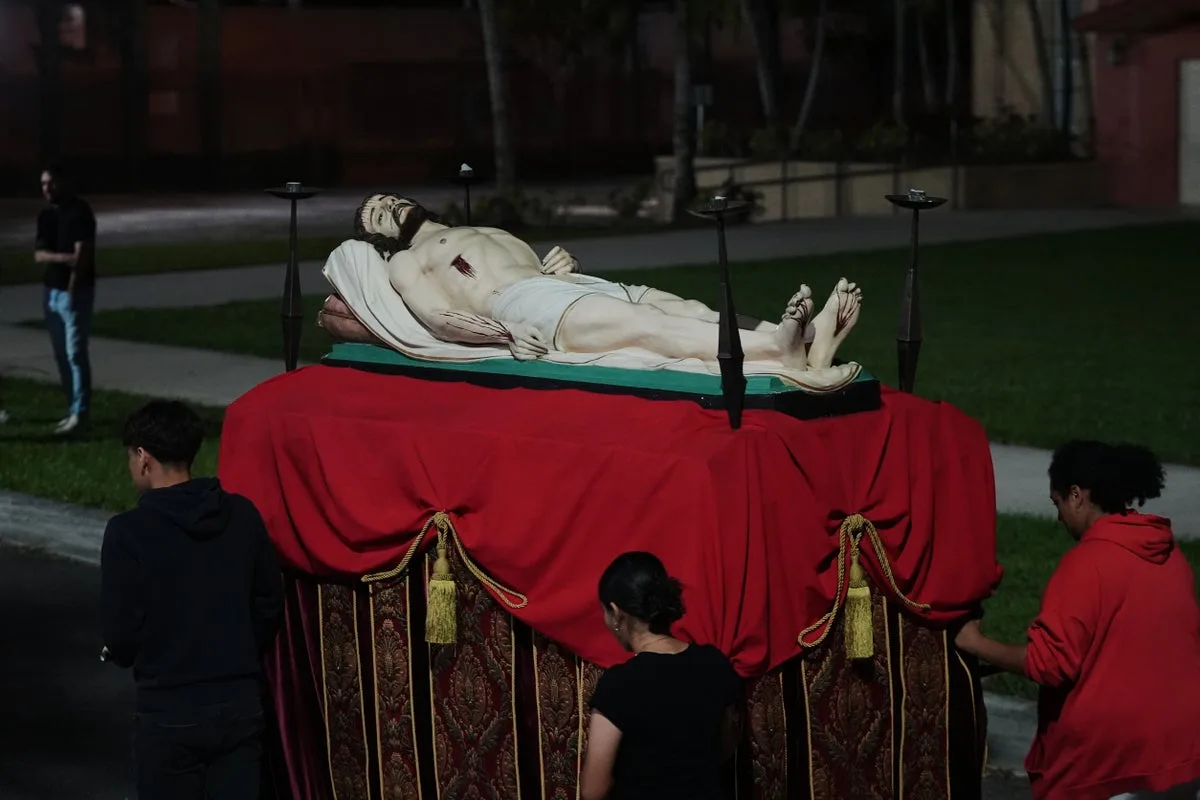
"The time leading up to Good Friday is a big reflection on sacrifice—what he did for me and what I am doing in return," remarked Manuel León, a 22-year-old member of Miami's Corpus Christi Catholic Church youth group. He participates in a Good Friday procession through a central neighborhood, carrying a realistic statue of Jesus crucified. "Pushing that statue from the back and seeing how torn up he is, what he did for us really becomes real," León added, highlighting the emotional impact of these rituals.

Ancient Liturgical Traditions and Reforms

Reverend John Baldovin, a professor of historical and liturgical theology at Boston College, notes that some of the most ancient liturgical practices define Catholic Good Friday services. "The most solemn days tend to retain the oldest ceremonies," he explained, citing examples such as priests and ministers prostrating themselves before the altar at the service's outset.

Another ancient tradition involves extensive prayers of the faithful, interspersed with genuflections, which today include intentions ranging from prayers for the pope and Jewish people to those who do not believe in God. Prior to Holy Week reforms introduced by the Vatican in the 1950s, Communion was not distributed on Good Friday; now, it is administered using hosts consecrated on Holy Thursday. A highlight of the ceremony is the adoration of the cross, where faithful line up to kiss or touch it in reverence—a practice documented as early as the 4th century by a pilgrim from modern-day Spain to Jerusalem's Church of the Holy Sepulchre.

Global Processions and Cultural Expressions

Life-sized statues depicting Jesus crucified, the weeping Virgin Mary, and scenes from the Gospels' accounts of Jesus' torture and death are carried in large processions worldwide. In Seville, southern Spain, tens of thousands witness awe-inspiring, hours-long processions featuring venerated images during Holy Week. "Not all of us have the ability to look at the sky and feel fulfilled. Others like me need the images," said Manolo Gobea, who moved from Seville to Miami three decades ago and now leads the brotherhood organizing a Good Friday procession from Corpus Christi church through Wynwood's graffiti-splashed neighborhood.

As statues exit the palm-fringed church, they are carried over intricate carpets made of colored sawdust and flowers—a tradition exuberantly followed in Antigua, Guatemala, where miles of these carpets are created twice on Good Friday. "On Good Friday, we feel the pain of Mary, Jesus' pain, his surrender for love," shared Silvia Armira, who prepares carpet drawings for Miami's procession after arriving from Guatemala in the 1990s. "It's the great love of God, who gave up his only son for us."

Pickt after-article banner — collaborative shopping lists app with family illustration

From Solemnity to Easter Joy

Solemn and popular rituals on Good Friday vary widely, from the pope's traditional "way of the cross" in Rome to pilgrimages in New Mexico and even self-flagellation in the Philippines. For many clergy, these practices offer opportunities to evangelize beyond church walls, emphasizing that Jesus' gruesome death is not the story's end. "Our procession is a cry to the world—'get out, look at what is the way, the truth, the life,'" stated Reverend José Luis Menéndez, a Cuban-born, Spanish-raised pastor at Corpus Christi in Miami.

Addressing over 100 faithful at a procession rehearsal, he urged, "May your entire attitude be a living prayer." Gobea, overseeing a float adorned with silver-plated ornaments and flowers, noted that Good Friday celebrations ultimately lead from death to Easter joy. "To the weeping Mary, we put flowers, we sing hymns, and that's because we know how it ends—which is the resurrection," he concluded, encapsulating the day's profound transition from sorrow to hope.