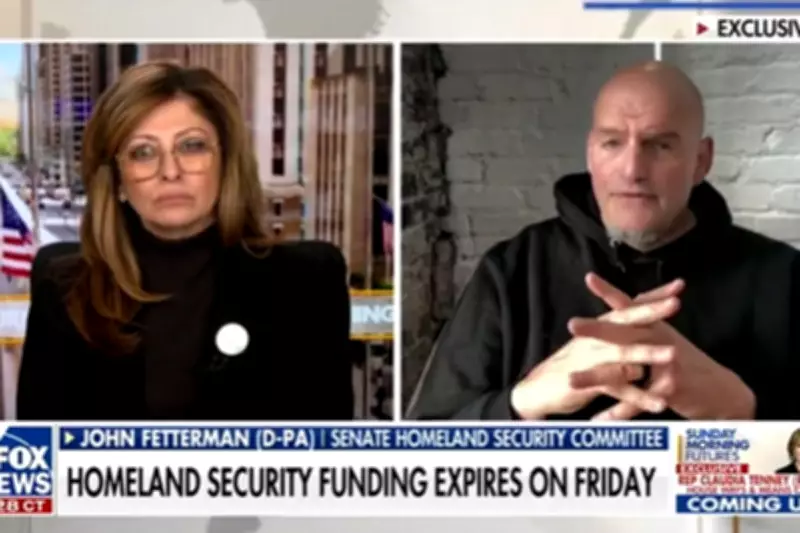
Senator Fetterman Forecasts Partial Government Shutdown Amid DHS Funding Deadlock
Senator John Fetterman has issued a stark warning that Washington remains perilously close to another partial government shutdown, with critical funding for the Department of Homeland Security hanging in the balance. The Pennsylvania Democrat expressed his pessimistic outlook during a Sunday appearance on Fox News's Sunday Morning Futures, where he indicated that the Senate chamber shows little progress toward resolving the impasse before the February 13 deadline.
Immigration Reforms Become Sticking Point in Negotiations
The core of the dispute centers on Democratic demands for substantial reforms to U.S. Immigration and Customs Enforcement operations in exchange for supporting the DHS funding legislation. Fetterman revealed that Democrats have compiled a list of ten specific demands they want codified into law, which include significant restrictions on the scope of ICE raids, prohibitions on enforcement actions near schools and other sensitive locations, and the establishment of official standards against racial profiling practices.
"If I had to say now, they probably expect that there will be a shutdown because things are [...] committed to do that," Fetterman told host Maria Bartiromo, highlighting the entrenched positions on both sides of the aisle. He acknowledged that Democrats are "certainly not going to get all 10" items on their reform agenda, but emphasized that substantial concessions would be necessary to secure Democratic votes.

Political Dynamics Complicate Resolution Efforts
The political landscape presents significant challenges to reaching a timely agreement. Republicans have dismissed many Democratic demands as unrealistic "wish list" items, though they have shown some openness to considering certain reforms. Meanwhile, Fetterman himself represents an interesting political figure within the debate – historically more willing than many colleagues to support government funding measures and a proponent of tougher immigration enforcement who previously supported the Laken Riley Act in early 2025.
Despite his generally more conservative stance on immigration matters, Fetterman expressed uncertainty about his own party's "red lines" regarding DHS funding, adding another layer of complexity to the negotiations. His vote could prove crucial, as Senate Republicans will need support from at least four Democrats to overcome a potential filibuster and pass any funding package.
Minneapolis Crisis Intensifies Pressure for Reform
The urgency of the immigration reform debate has been amplified by recent events in Minneapolis, where a massive immigration enforcement surge has sparked public outcry following the deaths of two Americans shot by ICE and Border Patrol agents. The Trump administration has already responded to the crisis by replacing the top ICE commander in the region and announcing plans to withdraw hundreds of agents from the city.
These developments have strengthened Democratic resolve to secure meaningful reforms, with some senators calling for DHS Secretary Kristi Noem's resignation. Senator Mark Kelly of Arizona offered particularly harsh criticism, stating that "The agency is being run by people who have no idea what they're doing and don't seem to give a s**t about the constitutional rights of the American people."
Continuing Resolutions Offer Temporary Solution
With the February 13 deadline rapidly approaching, Senate Republican leader John Thune has raised the possibility of relying on continuing resolutions to fund DHS temporarily while negotiations continue. "A two-week CR probably means there's going to be another two-week CR and then maybe another two-week CR after that," Thune told reporters in late January, adding that "I just think it's going to be really, really hard to get anything done."
This approach would mirror the two-week continuing resolution passed at the beginning of last week, which initiated the current countdown clock for resolving the DHS funding dispute. If Congress fails to reach agreement by the deadline, only DHS and its related agencies would be affected by the partial shutdown, as their funding was separated from the larger long-term spending package.

Fetterman's prediction of an impending shutdown reflects the broader political reality in Washington, where deep divisions over immigration policy continue to threaten basic government functions. As negotiations enter their final days, the prospects for averting disruption appear increasingly dim, setting the stage for another chapter in Washington's recurring budget battles.