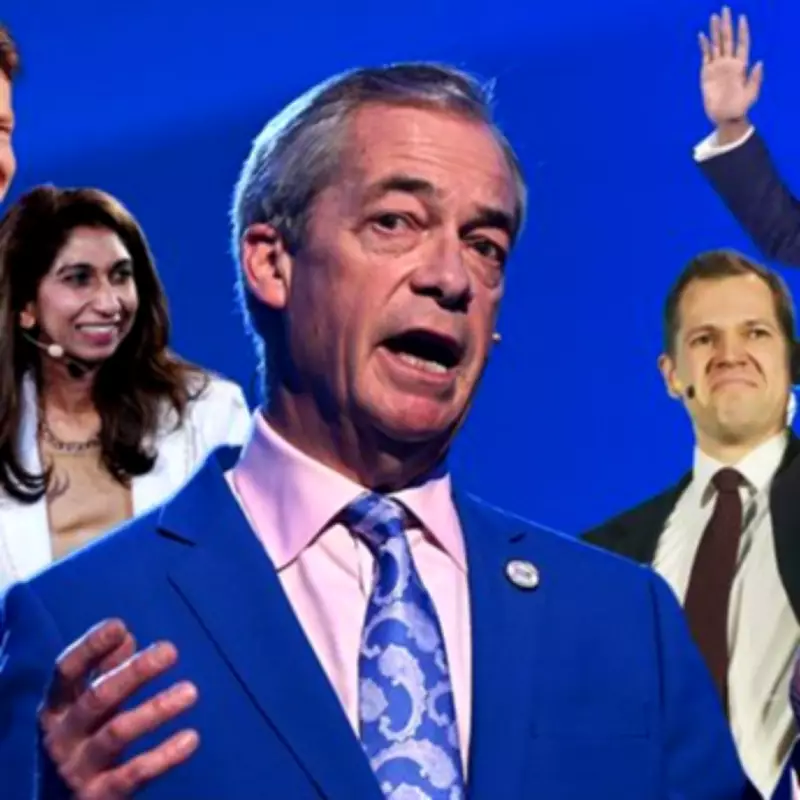
Nigel Farage Announces Reform UK's Top Frontbench Team in London
Reform UK leader Nigel Farage has unveiled key appointments to his party's frontbench, a move designed to counter persistent criticism that his hard-right political outfit operates as a 'one-man band'. The announcement, made at a press conference in London, sees the party's top team significantly bolstered by the inclusion of several high-profile defectors from the Conservative Party.
Mr Farage directly addressed the long-standing critique of his party's structure. "Too often the criticism over the last 20 months has been that we're a one-man band, to which I generally respond by saying well, it's better than a no-man band," he stated. "But the time has come to broaden the party, to put in place people in shadow positions, and that process begins today."
Conservative Party Dismisses Line-Up as 'Tribute Act'
The Conservative Party was quick to dismiss the new appointments. Party Chairman Kevin Hollinrake remarked, "After months of infighting and leaks, Nigel Farage has unveiled a front bench dominated by ex-Conservatives - a line-up that looks more like a tribute act to the old Conservative Party than a credible alternative." It is important to note that the official title of Shadow Cabinet constitutionally belongs to the main opposition party, which is currently the Conservative Party.

Key Appointments and Controversial Figures
The announced roles place several controversial figures in prominent positions:
- Robert Jenrick as Shadow Chancellor: The former Conservative Cabinet Minister was handed the crucial economic portfolio. In his speech, he criticised 'decades of mismanagement' of the economy, omitting his own tenure as a Treasury Minister under Theresa May and his service under Boris Johnson, Liz Truss, and Rishi Sunak. His political journey has seen him transform from a David Cameron-backing Remainer into a hardline right-winger. His record includes admitting to unlawfully approving a housing development that saved a Tory donor over £40 million in tax, and ordering murals in an asylum centre to be painted over. Notably, he served as Immigration Minister during a period of significant expansion in the use of asylum hotels.
- Suella Braverman as Shadow Minister for Education, Skills and Equalities: The twice-ousted former Home Secretary, a recent Tory recruit to Reform, used the platform to rant against diversity and inclusion initiatives, pledging to scrap the Equalities Department if Reform gained power. A deeply divisive figure, her controversies include describing immigration as an 'invasion' and expressing her 'dream' to see deportation flights to Rwanda take off. She was removed from the Home Secretary role once by Liz Truss for leaking sensitive documents and again by Rishi Sunak after clashing with the police.
- Richard Tice as Shadow Deputy Prime Minister and Business Lead: A long-time ally of Nigel Farage and former co-leader of Reform, Tice is set to lead a proposed Department for Business, Trade and Energy. A noted net zero sceptic, he stated the party would prioritise using oil and gas to boost the economy and would abandon existing climate targets. A fervent Brexiteer, he was previously a Tory donor and member before quitting in 2019 to join Farage's Brexit Party.
- Zia Yusuf as Shadow Home Secretary: The wealthy banker takes on the critical home affairs brief, immediately launching into an explosive rant about deportations. He controversially claimed, "more people have turned up on our beaches uninvited in the last seven years than stormed the beaches of Normandy on D-Day."
This strategic reshuffle aims to project an image of a broadened, more substantial political force for Reform UK, moving beyond its perception as a vehicle solely for Nigel Farage's personal brand. The appointments, however, have ignited immediate controversy and drawn sharp criticism from established political rivals, framing the new frontbench as a collection of recycled and rejected Conservative politicians rather than a fresh alternative.