The chant of 'Get Starmer Out' echoes from outside the Sunniside social club on the outskirts of Newcastle as Nigel Farage rallies his troops. Inside, around 120 Reform candidates have gathered for a pep talk from their leader ahead of next month's local elections, when the party is dreaming of a historic result.
Mr Farage tells them they are on the brink of triggering a political 'earthquake' in the May 7 poll, which will leave Labour in the rubble. 'Get Starmer Out' was adopted as Reform's campaign slogan weeks ago in a bid to turn the elections into a referendum on an unpopular Prime Minister.
Mr Farage acknowledges that Sir Keir has been 'a gift' to campaigners trying to persuade people to take the leap to Reform. With a throaty laugh, he adds: 'I just don't want him to go before May 7!'

The slogan, 'Let's Get Starmer Out', which we chose before this (Mandelson story) broke, is now looking better by the minute. And I think we can justifiably say, with another massive defeat for this guy, he will be gone by the end of May.'
'It depends on the results up here in the North East and in central and southern Yorkshire, bits of the North West, South Wales... if I'm right, that we're going to wipe out Labour in their traditional areas, and the Greens are going to hit them in the more metropolitan areas, then I just don't see how he survives.'
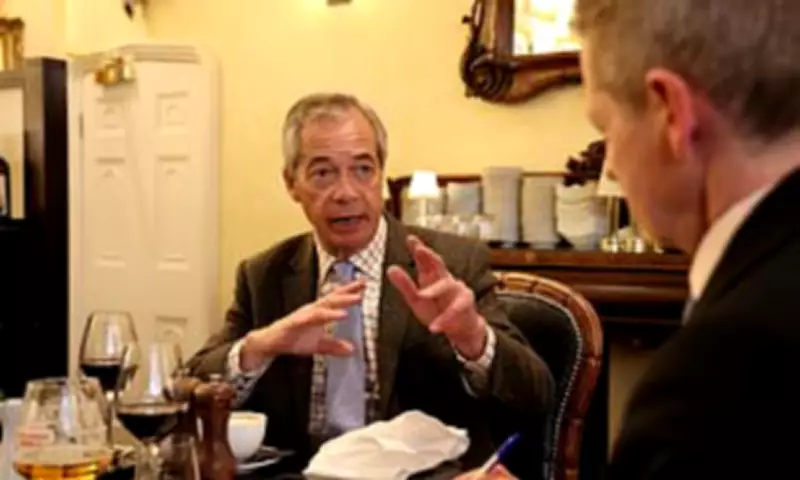
Yesterday, the party leader was blitzing the North East again, with walkabout tours in South Shields and Gateshead as well as candidate briefings. Over a lunch of ribeye steak and beaujolais at an upmarket country hotel in County Durham, he argues that Reform can reach even deeper into Labour's traditional Red Wall heartlands than Boris Johnson did in 2019.
Mr Farage points out that voters in Red Wall areas fired a series of electoral 'warning shots' at Labour, including in the Brexit referendum – but says the 'complacent' party 'took them for granted'.
'Boris never got a sniff of winning Gateshead,' he says. 'Or Barnsley, or Tameside or St Helens. This is going way beyond anything that remarkable Brexit election produced in 2019, and my view is that this switch is not a one-off... this is a fundamental shift away from the Labour Party.'
'What Reform has emerged as, genuinely, is the party of working people. That, by the way, is a very broad canvas, everything from entrepreneurs to people who work for the council, but working people. Everyone can see the Labour Party is now the party of welfare, not work, and the Tories up here can't connect.'
The Reform leader is into his seventh week of campaigning for what will be the biggest electoral contest before the next general election. Around 5,000 council seats in England are up for grabs, along with the devolved governments in Scotland and Wales. Polls suggest Reform will win big in England and party strategists believe they will come first in Wales, where Labour has ruled since devolution.
Mr Farage also hopes to end the Conservatives' status as a national party – and is focusing substantial time and resources on Essex in the hope of dealing a psychological blow to the Tories in a county where Kemi Badenoch and half the Shadow Cabinet have their constituencies. The Reform leader is dismissive of any kind of electoral deal with the Tories. He acknowledges that a post-election pact cannot be ruled out, but is clear it would be 'highly undesirable', adding: 'They don't deserve it.'
Former Tory treasurer Lord Ashcroft attempted a bit of peace-making by mischievously seating the two leaders on the same table at his recent 80th birthday. It was not a success, with Mr Farage spending more time chatting to Mrs Badenoch's 'charming' husband Hamish. He acknowledges that Mrs Badenoch is landing blows against Labour but suggests it will make no difference. 'She's obviously trying very hard, and that's fine, but she's leading a broken brand, and that's really the point,' he says.
Mr Farage says Reform is gaining the mantle of the 'party of working people'. 'We're going to have to have a much tougher society,' he said. 'Attitudes are going to have to harden. I'm sorry, but as I go around the country... I now believe there's one big divide in British society, and it's not based on class or money or race or religion. The biggest divide in society is those that work and those that don't.'

On the streets of South Shields and Gateshead, the public reception for Mr Farage is generally warm but it would be an exaggeration to say he is mobbed. Passers-by come over to shake hands and ask for selfies but there are, bluntly, not enough people around to form a mob. 'Everyone is saying it's the parking charges,' he says in an eerily quiet South Shields. 'The council handed out thousands of fixed penalty notices last year – once you've had one of those, you don't come back. It's crazy – this war on the motorist is killing our towns.'
In some tight-knit working-class communities, activists also believe they are discovering a new phenomenon – the 'shy Reformer' – which Mr Farage believes could add 'a few per cent' to the party's final tally. 'Some of these communities are very tight and very traditional, and so saying you're voting Reform is rather like coming out (as gay), you know – it's a big decision.'
Mr Farage brands Green Party leader Zack Polanski 'incredibly dangerous' and questions whether he 'actually believes half the things he says'. But he acknowledges that the party's success in 'shattering the Left-wing vote' will also help Reform in seats across the country.
The Iran war has come at an awkward time for Mr Farage, whose longstanding friendship with Donald Trump, which was once an asset, now risks becoming a liability. He believes Sir Keir got it 'wrong' by initially refusing to let the US use British bases to launch attacks – a position that was rapidly dropped but which incensed the US President.
He says stopping Iran acquiring a nuclear weapon is a 'worthy cause', as is regime change. But he suggests Mr Trump 'feels slightly hoodwinked by Israeli intelligence, by his own internal intelligence – the neocon Right might have had a slight upper hand'.
Is Trump losing the plot? The question causes Mr Farage to pause and choose his words carefully for the only time in the interview. 'He'll be 80 in June,' he says finally. 'He's an incredibly resilient individual. He has closed the border. The American economy is still going gangbusters. He's not everyone's cup of tea.
'I do, as a friend, worry slightly about his judgment on this, yes. I do. It will be a terribly sad end to an amazing political career if the man that was always anti-war in the end gets (brought) down by this – I struggle to understand it.'
One area where the two men still agree is energy, where he supports a 'revolution' that would see not just the end of Ed Miliband's Net Zero targets and renewed drilling in the North Sea, but also the State potentially taking a stake in the rollout of mini nuclear reactors, and even a green light for fracking. Cheap energy, he says, has to be at the heart of any industrial revival – coupled with a dramatic welfare clampdown designed to save money and prod people into work.
'What I'm talking about is a completely new vision for industry, for jobs and an energy revolution,' Mr Farage says. Will this include fracking, which was paused by the Conservatives and halted by Labour? 'Yeah, I won't quite make it compulsory,' he says, 'but the North Lincolnshire field – up under the Humber towards Doncaster, in an area with a history of extractive industries – we can have that operational within nine months. Jackdaw (gas field) in the North Sea, within 12 weeks.'
'These morons like Reeves think the gas costs the same wherever it comes from. Really? So are you telling me, Rachel Reeves, that if you drill gas in Montana, liquefy it, drive it to Baltimore, bring it across the Atlantic, re-gasify from liquid and deliver it to where it's needed, it's the same price as producing it next door? I mean, they're just off their trolleys.'
On Brexit, too, he pledges to unpick Sir Keir's reset deal. The US economy, he says, is now twice the size of the EU's, having been roughly the same size in 2008. Burning bridges with America to cosy up to Europe would be a 'bloody stupid thing to do'. 'The starkness of the approach towards money, risk appetite, capital in America and Europe is incredible,' he says. 'And here's Starmer taking us ever closer back to the European Union.'
He acknowledges there is 'disappointment' among Brexiteers about the failure of the political elite to deliver on the potential. South Shields, he says by way of an example, would have an 'absolutely booming fishing industry' if successive governments had not traded away access to the EU. But he argues that the PM is an 'idiot' to gamble on the hope that Brexit supporters no longer care about the issue.
'There is disappointment among Brexiteers,' he says. 'I would say our 5.7million small businesses are disappointed that Brexit has not delivered for them. But have they given up hope on it? No, and is going back into the increasing regulatory maw of Brussels, what anyone demands? No. You've even got Remainers writing in The Times that going back in now to a single market with no say is completely mad.'
So will he put Brussels on notice now that he will tear up any deal agreed with Sir Keir? 'Oh yes,' he smiles. 'In the words of the song, I want to break free.'