
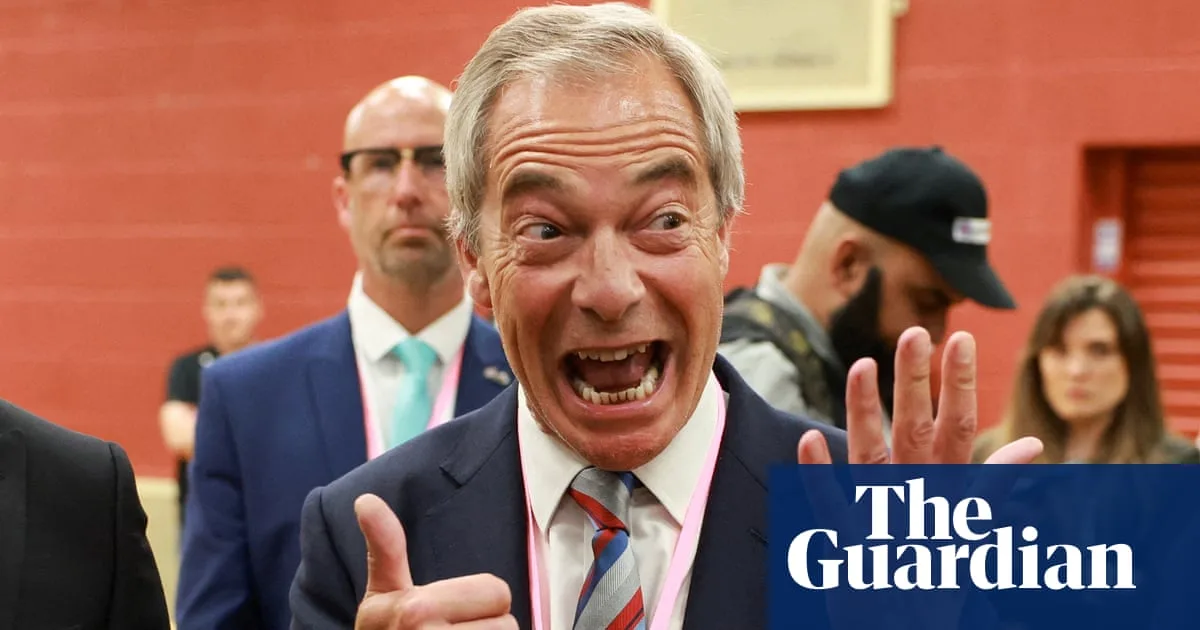
Nigel Farage has claimed that Reform UK has overtaken the Conservatives as the main opposition party after his party secured a narrow byelection victory, a mayoralty and about two dozen council seats in early results on Friday. The Reform leader said the results from Runcorn and Helsby, Greater Lincolnshire and a handful of local elections across England demonstrated that his party should now be taken seriously as a prospective party of government.
Reform won the Runcorn and Helsby byelection, held after the Labour MP Mike Amesbury was convicted of punching a constituent, with a majority of just six votes. The party achieved a 17-point swing away from Labour, overturning a majority of more than 14,000. The Conservatives slumped from 16% of the vote at last year’s general election to 7%, narrowly finishing ahead of the Green party in third place. Meanwhile, former Conservative MP Andrea Jenkyns won the newly created Greater Lincolnshire mayoralty with a majority of 44,000 votes. By 1pm on Friday, Reform had won 23 council seats, while Labour had lost 10 and the Conservatives seven, and the party took control of Staffordshire council, formerly held by the Tories.
Labour did manage to hold on in three closely watched mayoral contests, winning in Doncaster, North Tyneside and the West of England. Prime Minister Sir Keir Starmer, speaking to reporters during a visit to a defence factory in Luton, acknowledged voters’ disillusionment but said the answer was to “go further and faster” on the change the government had already delivered. However, some Labour MPs and the re-elected Doncaster mayor Ros Jones warned that cuts to the winter fuel payment and other benefits had angered voters. Jones said Starmer had not realised how hard life was for people in Doncaster.
Polling expert Professor Sir John Curtice of the University of Strathclyde noted that it was unprecedented for a party other than Labour or Conservatives to have more votes and more council seats at an interim stage. Farage, speaking in Runcorn, said his party had “dug deep into the Labour vote” and “deep into the Conservative vote”, adding: “There’s no question, in most of the country we are now the main opposition party to this government.” The results mirrored national polls showing Reform ahead of both Labour and the Conservatives, with support increasingly fragmented among the five main UK-wide parties.




