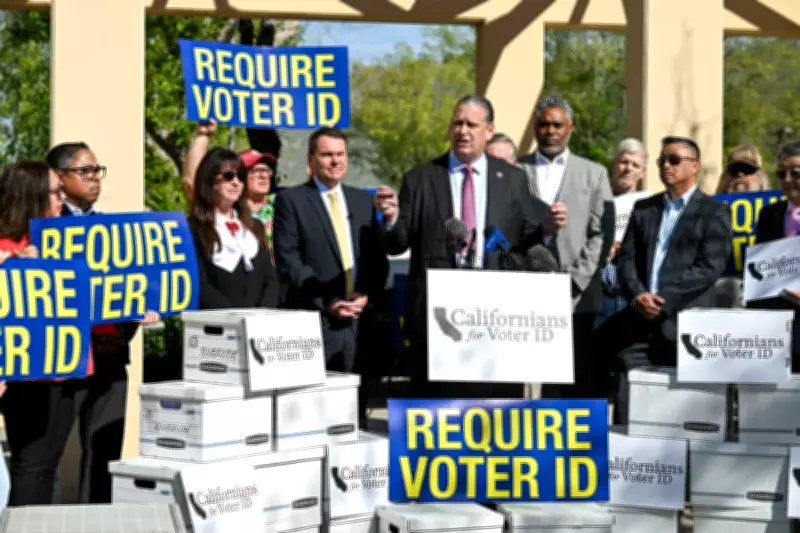
Republican organizers in California have announced a significant milestone in their campaign to tighten voting laws, confirming they have gathered enough signatures to place a measure requiring voter identification on the ballot this November. Proponents of the initiative revealed that they have collected 1.3 million signatures on a petition, far exceeding the 874,641 signatures required under California state law. Officials must now verify these signatures before the measure can proceed to the midterm elections.
Current Voting Laws and Proposed Changes
Under existing California law, voters are not mandated to show or provide identification when casting a ballot, whether in person or by mail. However, identification is required during the voter registration process, and individuals must swear under penalty of perjury—a felony—that they are eligible U.S. citizens. The proposed ballot measure would introduce stricter requirements, necessitating identification every time a vote is cast and mandating that election officials verify the citizenship of registered voters.
Key Figures and Funding Behind the Campaign
The push for voter identification laws in California has been led by Carl DeMaio, a Republican state assemblymember. DeMaio received substantial fundraising support from Julie Luckey, mother of tech entrepreneur and Donald Trump supporter Palmer Luckey. The campaign committee, Californians for Voter ID, founded by Julie Luckey, raised nearly $10 million to advance the ballot measure, according to DeMaio. This financial backing has fueled a robust signature-gathering effort across the state.

National Context and Political Reactions
This California initiative aligns with a broader national movement among Republicans to tighten voting eligibility. In February, the House passed the Save America Act, which would require proof of citizenship at registration and impose restrictions on mail-in voting. The legislation passed narrowly with a vote of 218 to 213 but has since stalled in the Senate. Former President Donald Trump has amplified these efforts, baselessly accusing Democrats of voter fraud in his State of the Union address, claiming, "They want to cheat. They have cheated. And their policy is so bad that their only way to get elected is to cheat. And we’re going to stop it."
Opposition and Criticisms
Opponents of the California measure include prominent organizations such as the ACLU of Northern and Southern California, California Common Cause, Disability Rights California, League of Women Voters of California, Asian Law Caucus, and California Donor Table. Julia Gomez, senior staff attorney at the ACLU of Southern California, criticized the initiative, stating, "This initiative is about advancing Trump’s agenda to sow chaos in our elections and keep eligible Californians from voting. The state already verifies voters and protects ballots at every stage of the process, and there is no evidence to justify new barriers. We’re confident that Californians will see it for what it is and reject this blatant power grab to block our votes from being counted."
Financial Implications and Estimates
California’s legislative analysts office, a nonpartisan entity providing fiscal and policy advice, estimates that implementing the new requirements could cost state and local governments "tens of millions of dollars to the low hundreds of millions of dollars" annually. These potential expenses add another layer to the ongoing debate over the measure's necessity and impact on public resources.
As the signature verification process unfolds, the voter ID measure is poised to become a focal point in the upcoming midterm elections, reflecting deeper national divisions over election security and voter access.