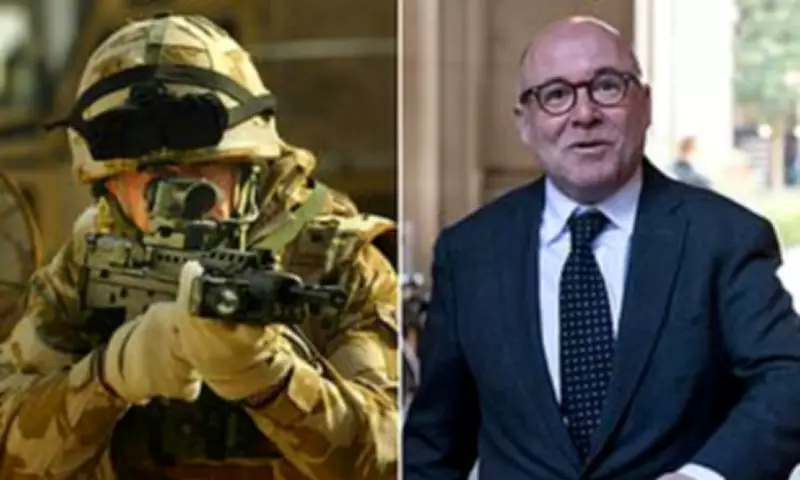
The revelation that Attorney General Lord Hermer was part of a group of lawyers said to have hounded British soldiers on behalf of Iraqi hoodlums and thugs will surprise no one who served in Iraq or in any recent British military campaign. Speaking for many thousands of veterans, both full-time and reservist, I say that what we truly think of Hermer and his coterie of human-rights lawyers is unprintable. But contempt, anger and derision would be good starting places.
The Reality of Combat
The comfortable world of the solicitors' consulting room was a far cry from the blinding heat, dust and sweat in Iraq or Afghanistan. Imagine patrolling for hours, weary with heavy kit on your back, wrapped in Osprey body armour weighing 10 kilos, sweat dripping into your eyes, head boiling beneath a chunky helmet. Then imagine having to make life-and-death, split-second decisions under attack from the Iran-backed Mahdi Army militia in Iraq or Taleban fighters in Afghanistan.
Yet it was these brave British soldiers, who endured such perilous conditions day after day, who became the target for a despicable witch-hunt mounted by lawyers from their own country. Now Hermer's personal role in giving legal advice to fellow lawyers, at least one subsequently struck off, in a large-scale attempt to sue the Ministry of Defence has come to light.

The al-Sweady Inquiry
The resulting five-year public inquiry, a £31 million bonanza for lawyers, attempted to present the British Army as no more than a gang of marauding thugs bent on Vietnam War-style massacres. But the claims had been a tissue of lies from beginning to end, and the al-Sweady investigation cleared the British troops. It is disgraceful that, even today, the hounding of our soldiers continues with ageing Northern Ireland veterans chased through the courts for actions and events of decades ago.
Is it any wonder the British army is gripped by a recruitment crisis? Special Forces soldiers are reportedly quitting early for fear of being sued in years to come for obeying lawful orders.
Starmer's Role
The whole debacle was a repugnant play in two acts, both of which also involved Prime Minister Sir Keir Starmer. Act One: lawyers campaigned to use European human-rights laws to investigate, and presumably prosecute, British troops. Back in 1997, Starmer himself called for such laws to be used to investigate our troops in Iraq. Act Two: Starmer was instrumental in a 2007 case which extended European and British human rights laws to cover military operations in Iraq, opening an Aladdin's cave for greedy lawyers to attack British forces.
It is now alleged that Lord Hermer was one of the lawyers who advised how to pursue claims against the Ministry of Defence, and that he continued to press for large payouts on behalf of vile, lying clients even as evidence mounted of their shameless dishonesty.
Political Blame
Our politicians must also bear some blame. Allowing human rights legislation to be used against our military in the first place was an act of cowardice and stupidity. The policy originated under the government of Tony Blair, another example of his corrosive influence on public life. The truth is that Britain has always had high standards in soldiering. Our troops, mostly during their long years in Northern Ireland, developed a culture of intelligent soldiering and a deep humanity for the societies in which they operated.
At the close of the Second World War, German civilians were desperate to fall under British control rather than into the hands of Soviet troops, now reviled in posterity for the mass rape and murder of women and men. To depict British soldiers as an out-of-control rabble, such as the Russian army in Ukraine today, is a despicable libel. Should individual British soldiers behave badly, there has always been a robust military chain to deal with them, including courts martial.

Lance Corporal Brian Wood
One of the soldiers caught up in the Iraqi scandal, Lance Corporal Brian Wood, said Hermer and others had pursued a witch-hunt for years. Hermer, he said, 'was representing the people trying to kill us.' 'Look at where we are in the world at the moment,' he continued, 'and you wonder if we can trust the Government.' I agree. Wood was awarded the Military Cross for his courage in Iraq during the Battle of Danny Boy, the name of a British checkpoint ambushed by Iraqi militia in May 2004.
I served in Iraq and Afghanistan. I remember the exhaustion at the end of patrols, the gunshots over and near your patrol, the rocks thrown at you, missiles aimed at your base. Decisions are taken by young men and women fighting exhaustion, heat, the enemy and armed with only limited situational awareness. My admiration for people like Wood is boundless. Yet I am ashamed of the legal, political and military classes that failed to protect good soldiers like him.
Impact on Military Operations
One of the baleful consequences of ambulance-chasing human rights lawyers has been the effect on the Ministry of Defence. I remember painful conversations, including an absurd one in Basra in Iraq in late 2007, when a Ministry of Defence Policy Advisor tuttingly lectured me, the condescension dripping from her voice like a leaky tap, on the importance of not preparing for contact with a militant on the off-chance they had an innocent explanation for carrying a rocket-propelled grenade. So fearful were we of the human-rights class that protecting the lives of British soldiers and innocent Iraqi civilians came second to militants' rights to carry weapons.
We were being defeated by British lawyers, not a foreign enemy. By 2014 and the rise of ISIS, our legal processes had become so convoluted that we were fearful of making arrests on the ground. Permission sets, jargon for the rules under which we operated, became a mess. Allies, notably the United States, grew weary of working with us because of this legal paralysis.
Class Dimension
There is also an additional and very ugly dimension to this. The lawyers who intimidated our soldiers were often well-heeled and highly educated. Their targets were young soldiers from white, working-class communities in neglected towns across the Midlands and North, some following in the footsteps of their forebears into famous regiments such as the Fusiliers, the Lancashires and others. These young soldiers' education might sometimes have been limited. Some were from troubled backgrounds. But their courage, decency and patriotism were first class. They were sacrificial lambs for the enlightened of North London.
Hermer's Defence
Hermer says his role in this was minor. On Wednesday, a spokesman said the suggestion the Attorney acted for individuals with the knowledge that their claims were false is categorically untrue. Starmer, too, has played down his involvement. But I see these two senior figures and those like them for what they are: members of a class of lawyers who used British statute to attack British soldiers and the state. Their actions, deliberately or not, helped undermine our national resolve.
They were aided and abetted in this shameful enterprise by parts of the media, notably the BBC and The Guardian. I regret to say that the response of legal advisers in the Foreign Office and Ministry of Defence was hand-wringingly feeble and has remained so to this day.
Call for Action
In my opinion, Hermer's reputation is now damaged beyond repair. I hope MPs, including Conservative leader Kemi Badenoch, demand answers. Did Hermer really press for lucrative payouts when it was likely that his Iraqi clients were lying? Is a man who willingly takes on cases such as these someone who should be our senior legal officer? General Sir Peter Wall, one of the commanders in Iraq, has said that the orchestrated claims against British troops following the Battle of Danny Boy 'were tantamount to treason'. What does Hermer, the country's chief legal officer, have to say to these devastating accusations?
I try not to hate, but there is a deep and abiding anger from so many soldiers directed at the legal vultures who libelled the British Army and hounded individual soldiers. Prime Minister Starmer will go soon. But if he cared what servicemen and women thought, there is one last thing he could do before he slinks off the political stage: sack his Attorney General, Richard Hermer.
Dr Bob Seely MBE is the author of The New Total War. He served as a British soldier on the Iraq, Afghan, Libya and ISIS campaigns.