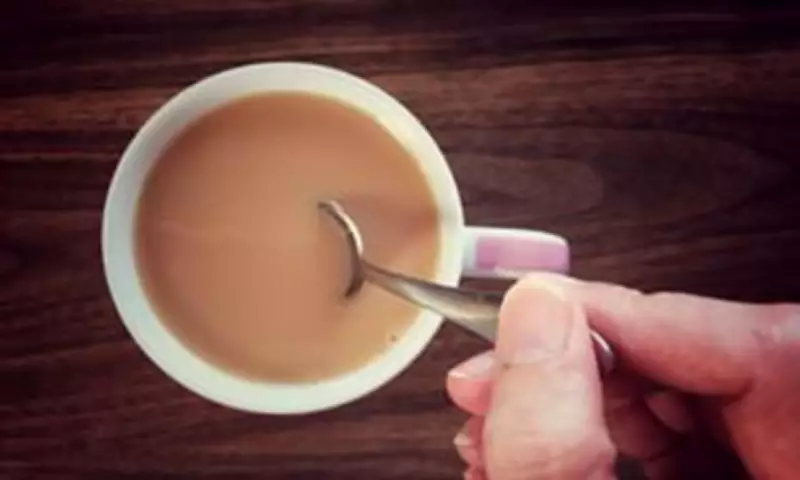
It is a riddle that has baffled millions in offices and institutions across the world for decades: where have all the blooming teaspoons gone? Now British scientists have concluded there really is no definitive answer.
The Edinburgh Experiment
Academics at Edinburgh University, seemingly driven to distraction by the ever-shrinking resources available to lift their own teabags, set up an experiment to explore the phenomenon. They bought 48 new teaspoons, half of them gold-coloured and the rest a cheaper-looking silver, and left them in the staff common room – then kept a discreet count for ten months.
The team – led by neuroscientist Professor Tara Spires-Jones – were appalled to discover that two-thirds of them vanished during the course of the study. There was also a bias towards the gold items, which had a half-life of 182 days compared with 280 days for the silver.

Findings Published in Brain Communications
Their report, published in the journal Brain Communications, said: 'Teaspoons are an essential component of any research institute. Some people use a spoon daily to eat their mousse while many others use them for dispensing instant coffee, fishing tea bags out of cups, or adding sugar or milk and stirring their beverage of choice.'
'From this study, we conclude that in our building, people indeed steal teaspoons from the common room. Where [they] have gone remains a mystery. We did observe a few appearing in places outside of the common room in the building but most remain untraceable.'
Inspiration from an Australian Study
The Edinburgh study was inspired by a similar experiment carried out in 2005 at the Macfarlane Burnet Institute for Medical Research and Public Health in Melbourne. In the Australian version, scientists lost 80 per cent of their 70 stirrers in only five months. They calculated that 250 new pieces of cutlery would need to be bought each year to keep their institute common rooms stocked up with a steady 70.
Conclusion and Future Research
The Edinburgh study concluded: 'Over 20 years later, the issue of teaspoon loss from common rooms has not abated... Pilfering of teaspoons from academic common rooms remains a problem that warrants further research as it impacts the well-being of scientists.' Future work that was suggested in their lab included examining migration of other types of cutlery, particularly forks.