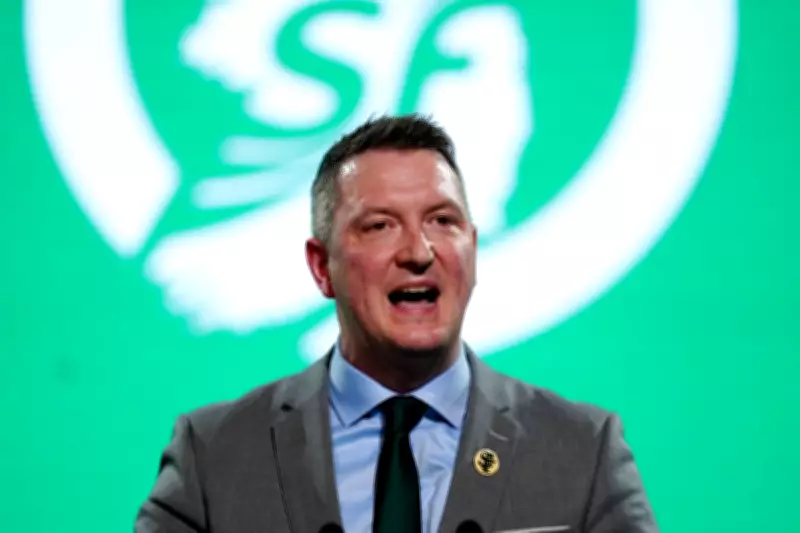
The UK Government is taking a “dangerous path” with amendments to the Legacy Bill, Sinn Fein MP John Finucane has warned. The North Belfast MP said he has received “no assurances” on changes to the framework, which risks becoming “veterans’ legislation”.
Background to the Legacy Bill
Upon entering government in 2024, Labour pledged to repeal and replace the previous Conservative government’s Legacy Act. That Act ended police investigations into Troubles-related killings and established a new Independent Commission for Reconciliation and Information Recovery (ICRIR). Labour’s Bill, agreed as part of a joint framework with the Irish Government, will put in place a reformed Legacy Commission with enhanced powers.
Last week, Northern Ireland Secretary Hilary Benn postponed the Government’s Troubles Bill, stating it would return to Parliament with “substantial amendments” including “additional protections and reassurances” for veterans.

Finucane's Concerns
Mr Finucane expressed deep concern over the updates to the long-awaited legislation. Speaking at the Sinn Fein Ard Fheis in Belfast, he remarked: “You would be forgiven for forgetting that this is actually a victims’ legislation, you’d be forgiven for thinking that this is actually veterans’ legislation.”
He described the government’s statement as “very partial, partisan” and aimed at emboldening and protecting “a body of people that were actually victim-makers in our conflict here.” He warned: “I think to elevate one section of people above another is very dangerous and, precedent has shown us, not the wisest way to go about dealing with legacy.”
Mr Finucane stressed that any process must deliver for everyone. “There has to be a process put in place that can deliver for everybody and to elevate one section of people above another is a very dangerous path,” he added.
He highlighted the plight of victims of state violence, noting that “state violence can take the form of people in a uniform or people not necessarily in a uniform.” These victims, he said, are being asked to trust a process where the British government is “going out of their way, bending over backwards, to very cynically protect veterans as a result of their own self interest.”
Lack of Assurances
Mr Finucane confirmed he had personally spoken with the Northern Ireland Secretary to seek clarity on the new measures. “We’ll wait and see what exactly is in the detail, but certainly as a direction of travel this is something that has caused concern, not just to us politically, but certainly to a lot of people who we represent,” he said.
He added: “There’s nothing that the Secretary of State has said that would provide me with any assurance having listened to what he has said publicly this week.”
Public Inquiry Calls
A public inquiry is due to begin into the murder of Mr Finucane’s father, Pat Finucane. He also reiterated his party’s call for a full public inquiry into the murder of Sean Brown. Mr Brown, chairman of Wolfe Tones GAA Club in Bellaghy, County Londonderry, was abducted, kidnapped, and murdered in May 1997. His widow, Bridie Brown, who has campaigned for decades for answers, attended the Ard Fheis.
Mr Finucane noted: “I can’t think of another family who have had the endorsement of five High Court judges and a PSNI Chief Constable in calling for a public inquiry.” He criticised the government for forcing a nearly 90-year-old woman to the Supreme Court “over what is essentially an academic legal point.” He concluded: “I think the British government have the power to grant a public inquiry, they have the ability to do that efficiently and effectively, and they are refusing to do so. And that feeds into the wider confidence in the legacy context for lots of families who maybe are not the Brown family, but look to the Brown family as inspiration.”