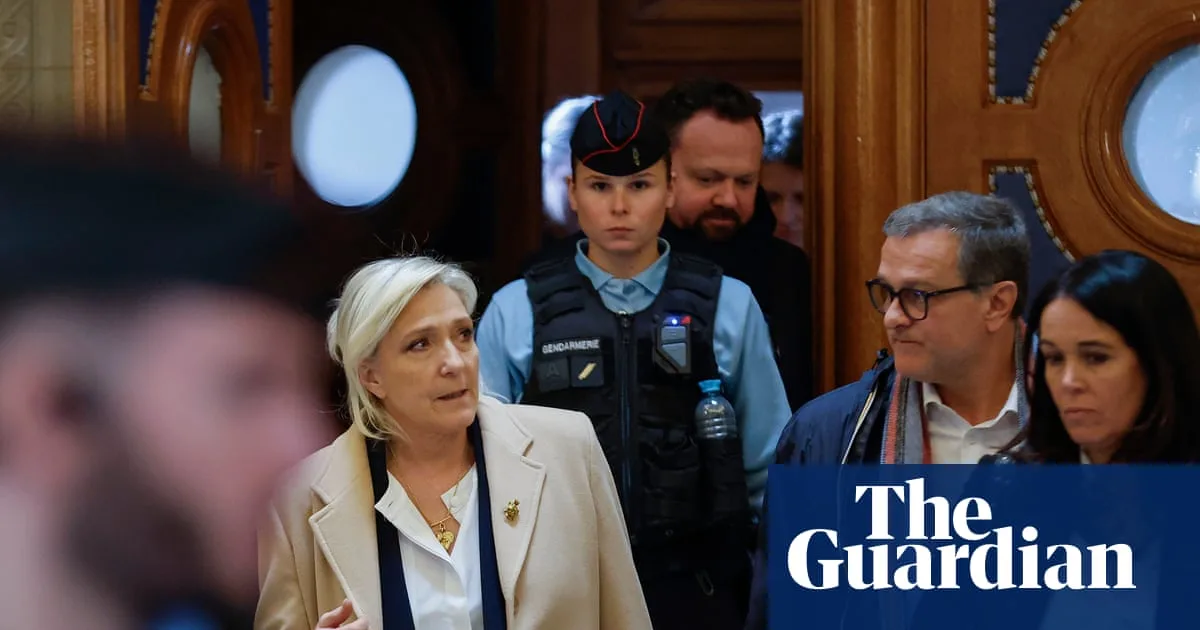
Defence lawyers for Marine Le Pen have told a Paris appeals court that she did not orchestrate a system to misuse European parliament funds, at the close of an embezzlement trial that will determine whether the far-right leader can run in the 2027 French presidential election.
Le Pen's lawyer, Sandra Chirac Kollarik, told the court on Wednesday: 'At no moment did Marine Le Pen imagine that she broke the rules.' She added: 'Never in her life would she have deliberately accepted making a false contract.' Le Pen, 57, has denied organising a fake jobs scheme to embezzle European parliament funds, telling the court any job contracts were transparent and 'we don't have the feeling of having committed the slightest crime'.
The leader of the anti-immigration National Rally (RN) had been a top contender for next year's presidential election until last March, when her conviction in the fake jobs trial led to a five-year ban from running for public office. Judges ruled Le Pen had been 'at the heart' of a carefully organised system of embezzlement from 2004 to 2016, handing her a four-year prison sentence (two suspended, two to be served outside jail with an electronic bracelet) and a €100,000 fine.

During the appeal trial, Le Pen has sought to overturn the verdict and sentence, denying wrongdoing and insisting she wanted to run again for president. The verdict, to be delivered on 7 July, will determine her political future and whether she can make a fourth presidential attempt next year. If not, she would be replaced by her protege and party president, 30-year-old Jordan Bardella.
Last week, state prosecutors asked appeal court judges to maintain the five-year election ban on Le Pen, arguing she had been at the heart of a 'thought-out', 'centralised' and almost 'industrial' system to embezzle European parliament funds. They said taxpayer money allocated to MEPs to pay their assistants had been siphoned off by the party from 2004 to 2016 to pay its own workers in France, with the loss to European funds estimated at €4.8m (£4.2m).
Prosecutor Thierry Ramonatxo criticised Le Pen for making public attacks on judges after last year's verdict, when she said a 'tyranny of judges' wanted to stop her running. He said judges simply applied the law voted for by parliament. The judges will retire to consider their verdict over several months.